

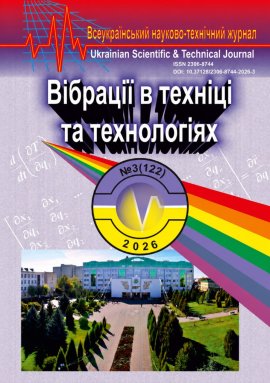
Issue №: 3(122)
The journal deals with the problems of vibration technologies and machines, mathematical methods of vibration process studies, information on design and technological development, presents teaching and methodological aspects of teaching in the Higher School of Applied Sciences, where vibration machines and technologies are studied.
SYSTEMATIZATION OF MATHEMATICAL MODELS OF FEED MATERIAL MIXING
Kupchuk Ihor – Candidate of Technical Sciences, Associate professor, Associate Professor of the Department of Engineering Mechanics and Technological Processes in the Agricultural Industry, Faculty of Engineering and Technology, Vinnytsia National Agrarian University (3, Sonychna St., Vinnytsia, 21008, Ukraine, e-mail: kupchuk.igor@i.ua; http://orcid.org/0000-0002-2973-6914).
Mathematical description of feed material mixing requires a clear distinction between models, since the heterogeneity of the components and the complexity of their movement determine the specific nature of transport, segregation, and interparticle interactions. This limits the direct transfer of models and their parameters between different material systems.
The study aims to systematize mathematical models of mixing, determine their functional interrelationships, establish the conditions for transition between different levels of description, and define their applicability limits with regard to material properties and the structural and technological parameters of mixers. The methodological basis comprised systemic, structural-functional, and comparative approaches. Statistical, kinetic, RTD, zonal, Markov, continuum, and particle-based models were analysed.
The models were compared according to the mathematical object, spatial and temporal scale, state variables, evolution law, observation procedure, parameters, and output indicators. An operator architecture was proposed to distinguish the physical state of the mixture, its model representation, evolution, formation of observable quantities, and quantitative evaluation. It was shown that the coefficient of variation, mixing indices, and RTD moments are primarily results of observation and data reduction rather than universal state variables.
The transition from DEM to a continuum description was found to be achieved through spatial averaging, whereas the transition to a zonal model is based on the integration of balances over defined volumes. Markov and RTD representations are formed through the description of interzonal exchange and observation of the output signal. The information preserved and lost during model reduction was identified. It was substantiated that the choice of mathematical representation should be determined by the purpose of the calculation, the required level of detail, material properties, mixer design, and available experimental data. The formulated provisions provide a basis for developing zonal-balance models of feed material mixing.
1. Danckwerts, P. V. (1952). The definition and measurement of some characteristics of mixtures. Applied Scientific Research, Section A, 3, 279–296. https://doi.org/10.1007/BF03184936
2. Lacey, P. M. C. (1997). The mixing of solid particles. Chemical Engineering Research and Design, 75(Suppl. S), S49–S55. https://doi.org/10.1016/S0263-8762(97)80004-4
3. Lacey, P. M. C. (1954). Developments in the theory of particle mixing. Journal of Applied Chemistry, 4(5), 257–268. https://doi.org/10.1002/jctb.5010040504
4. Rose, H. E. (1959). A suggested equation relating to the mixing of powders and its application to the study of the performance of certain types of machine. Transactions of the Institution of Chemical Engineers, 37, 47–64.
5. Kristensen, H. G. (1973). Statistical properties of random and non-random mixtures of dry solids. Part I. A general expression for the variance of the composition of samples. Powder Technology, 7, 249–257. https://doi.org/10.1016/0032-5910(73)80031-2
6. Cooke, M. H., & Bridgwater, J. (1977). The relationship between variance and sample size for mixtures. Chemical Engineering Science, 32(11), 1353–1357. https://doi.org/10.1016/0009-2509(77)85031-8
7. Fan, L. T., Gelves-Arocha, H. H., Walawender, W. P., & Lai, F. S. (1975). A mechanistic kinetic model of the rate of mixing segregating solid particles. Powder Technology, 12(2), 139–156. https://doi.org/10.1016/0032-5910(75)80006-4
8. Strek, F., Rochowiecki, A., & Karcz, J. (1978). A mathematical model of mixing of particulate solids. Powder Technology, 20(2), 243–248. https://doi.org/10.1016/0032-5910(78)80055-2
9. Hwang, C. L., & Hogg, R. (1980). Diffusive mixing in flowing powders. Powder Technology, 26(1), 93–101. https://doi.org/10.1016/0032-5910(80)85011-X
10. Habermann, R. (2021). Herleitung und Validierung eines einfachen Modells zur Beschreibung des Misch- und Entmischungsprozesses beim Feststoffmischen. Chemie Ingenieur Technik, 93(10), 1649–1656. https://doi.org/10.1002/cite.202100071
11. Danckwerts, P. V. (1953). Continuous flow systems. Distribution of residence times. Chemical Engineering Science, 2(1), 1–13. https://doi.org/10.1016/0009-2509(53)80001-1
12. Williams, J. C., & Rahman, M. A. (1972). Prediction of the performance of continuous mixers for particulate solids using residence time distributions. Part I. Theoretical. Powder Technology, 5(2), 87–92. https://doi.org/10.1016/0032-5910(72)80005-6
13. Weinekötter, R., & Reh, L. (1995). Continuous mixing of fine particles. Particle & Particle Systems Characterization, 12(1), 46–53. https://doi.org/10.1002/ppsc.19950120108
14. Kehlenbeck, V. (2006). Continuous dynamic mixing of cohesive powders [Doctoral dissertation, Technische Universität München]. Technische Universität München.
15. Pernenkil, L., & Cooney, C. L. (2006). A review on the continuous blending of powders. Chemical Engineering Science, 61, 720–742. https://doi.org/10.1016/j.ces.2005.06.016
16. Portillo, P. M., Ierapetritou, M. G., & Muzzio, F. J. (2008). Characterization of continuous convective powder mixing processes. Powder Technology, 182(3), 368–378. https://doi.org/10.1016/j.powtec.2007.06.024
17. Gao, Y., Vanarase, A., Muzzio, F., & Ierapetritou, M. (2011). Characterizing continuous powder mixing using residence time distribution. Chemical Engineering Science, 66(3), 417–425. https://doi.org/10.1016/j.ces.2010.10.045
18. Vanarase, A. U., & Muzzio, F. J. (2011). Effect of operating conditions and design parameters in a continuous powder mixer. Powder Technology, 208(1), 26–36. https://doi.org/10.1016/j.powtec.2010.11.038
19. Doucet, J., Bertrand, F., & Chaouki, J. (2008). A measure of mixing from Lagrangian tracking and its application to granular and fluid flow systems. Chemical Engineering Research and Design, 86(12), 1313–1321. https://doi.org/10.1016/j.cherd.2008.09.003
20. Legoix, L., Milhé, M., Gatumel, C., & Berthiaux, H. (2017). Free flowing and cohesive powders agitation in a cylindrical convective blender: Kinetics experiments and Markov chain modelling. EPJ Web of Conferences, 140, Article 03050. https://doi.org/10.1051/epjconf/201714003050
21. Doucet, J., Hudon, N., Bertrand, F., & Chaouki, J. (2008). Modeling of the mixing of monodisperse particles using a stationary DEM-based Markov process. Computers & Chemical Engineering, 32(6), 1334–1341. https://doi.org/10.1016/j.compchemeng.2007.06.017
22. Rippie, E. G., & Chou, C. H. (1978). Kinetics of mass transport in sheared particulate beds: Markov chains. Powder Technology, 21(2), 205–216. https://doi.org/10.1016/0032-5910(78)80090-4
23. Dury, C. M., & Ristow, G. H. (1999). Competition of mixing and segregation in rotating cylinders. Physics of Fluids, 11(6), 1387–1394. https://doi.org/10.1063/1.870003
24. Choi, J., Kudrolli, A., Rosales, R. R., & Bazant, M. Z. (2004). Diffusion and mixing in gravity-driven dense granular flows. Physical Review Letters, 92, Article 174301. https://doi.org/10.1103/PhysRevLett.92.174301
25. Hajra, S. K., & Khakhar, D. V. (2005). Radial mixing of granular materials in a rotating cylinder: Experimental determination of particle self-diffusivity. Physics of Fluids, 17, Article 013101. https://doi.org/10.1063/1.1825331
26. Gray, J. M. N. T., & Thornton, A. R. (2005). A theory for particle size segregation in shallow granular free-surface flows. Proceedings of the Royal Society A, 461(2057), 1447–1473. https://doi.org/10.1098/rspa.2004.1420
27. Chassagne, R., Maurin, R., Chauchat, J., Gray, J. M. N. T., & Frey, P. (2020). Discrete and continuum modelling of grain size segregation during bedload transport. Journal of Fluid Mechanics, 895, Article A30, 365–398. https://doi.org/10.1017/jfm.2020.274
28. Liu, Y., Gonzalez, M., & Wassgren, C. (2018). Modeling granular material blending in a rotating drum using a finite element method and advection–diffusion equation multiscale model. AIChE Journal, 64(9), 3277–3292. https://doi.org/10.1002/aic.16179
29. Zheng, Q., Bai, L., Yang, L., & Yu, A. (2019). 110th Anniversary: Continuum modeling of granular mixing in a rotating drum. Industrial & Engineering Chemistry Research, 58(41), 19251–19262. https://doi.org/10.1021/acs.iecr.9b03642
30. Yang, L., Zheng, Q., & Yu, A. (2022). A continuum model for the segregation of bidisperse particles in a blade mixer. AIChE Journal, 68(8), Article e17734. https://doi.org/10.1002/aic.17734
31. Cundall, P. A., & Strack, O. D. L. (1979). A discrete numerical model for granular assemblies. Géotechnique, 29(1), 47–65. https://doi.org/10.1680/geot.1979.29.1.47
32. Kaneko, Y., Shiojima, T., & Horio, M. (2000). Numerical analysis of particle mixing characteristics in a single helical ribbon agitator using DEM simulation. Powder Technology, 108(1), 55–64. https://doi.org/10.1016/S0032-5910(99)00251-X
33. Stewart, R. L., Bridgwater, J., Zhou, Y. C., & Yu, A. B. (2001). Simulated and measured flow of granules in a bladed mixer: A detailed comparison. Chemical Engineering Science, 56(19), 5457–5471. https://doi.org/10.1016/S0009-2509(01)00190-7
34. Bertrand, F., Leclaire, L.-A., & Levecque, G. (2005). DEM-based models for the mixing of granular materials. Chemical Engineering Science, 60(8–9), 2517–2531. https://doi.org/10.1016/j.ces.2004.11.048
35. Hassanpour, A., Tan, H., Bayly, A., Gopalkrishnan, P., Ng, B., & Ghadiri, M. (2011). Analysis of particle motion in a paddle mixer using discrete element method (DEM). Powder Technology, 206(1–2), 189–194. https://doi.org/10.1016/j.powtec.2010.07.025
36. Yaraghi, A., Ebrahimi, M., Ein-Mozaffari, F., & Lohi, A. (2018). Mixing assessment of non-cohesive particles in a paddle mixer through experiments and discrete element method (DEM). Advanced Powder Technology, 29(11), 2693–2706. https://doi.org/10.1016/j.apt.2018.07.019
37. Toson, P., Doshi, P., Matic, M., et al. (2021). Continuous mixing technology: Validation of a DEM model. International Journal of Pharmaceutics, 608, Article 121065. https://doi.org/10.1016/j.ijpharm.2021.121065
38. Ghaderi, A. (2006). A mathematical theory for mixing of particulate materials [Doctoral dissertation, University of Surrey].
39. Rielly, C. D. (2015). Mixing theory. In P. J. Cullen, R. J. Romañach, N. Abatzoglou, & C. D. Rielly (Eds.), Pharmaceutical blending and mixing (pp. 3–24). Wiley. https://doi.org/10.1002/9781118682692.ch1
40. Villermaux, E. (2019). Mixing versus stirring. Annual Review of Fluid Mechanics, 51, 245–273. https://doi.org/10.1146/annurev-fluid-010518-040306
41. Costa, A., Agazzi, A., Perricone, V., Savoini, G., Lazzari, M., Nava, S., & Tangorra, F. M. (2019). Influence of different loading levels, cutting and mixing times on total mixed ration (TMR) homogeneity in a vertical mixing wagon during distribution: A case study. Italian Journal of Animal Science, 18(1), 1093–1098. https://doi.org/10.1080/1828051X.2019.1618742
42. Cao, K., Li, X. H., Gao, H. D., Zhang, L. X., & You, F. (2023). Design and analysis of a vertical screw stirring device for feeding dairy goats. International Journal of Simulation Modelling, 22(3), 462–473. https://doi.org/10.2507/IJSIMM22-3-655
43. Goldhirsch, I. (2010). Stress, stress asymmetry and couple stress: From discrete particles to continuous fields. Granular Matter, 12, 239–252. https://doi.org/10.1007/s10035-010-0181-z
About the journal
The journal "Vibrations in Engineering and Technologies" is included in the list of technical scientific publications of Ukraine
(Category "B", Order of the Ministry of Education and Science of Ukraine dated July 2, 2020 No. 886)
Old version of the site: http://vibrojournal.vsau.edu.ua/
The journal "Vibrations in Engineering and Technology" is indexed by the following databases and catalogs:





The certificateof massmedia State registration:kv no 16643-5115 from 30.04.2010 .
Founder of the journal: Vinnytsia National Agrarian University
The journal is devoted to highlighting current issues in engineering, mechanical engineering, and technological processes, including the study of dynamic and oscillatory phenomena in technical systems, the application of mathematical methods for process modeling and analysis, as well as the presentation of results of design-engineering and technological developments. Particular attention is given to the study of vibration processes and their application in modern technologies.
The purpose of the scientific journal “Vibrations in Engineering and Technologies” is to disseminate the results of fundamental and applied research in the field of engineering sciences aimed at developing theoretical foundations and practical approaches to the design, analysis, and improvement of machines, materials, and technological processes, including the use of vibration and oscillatory effects in various sectors of production.
The publication is focused on the formation of a modern scientific and informational environment for the effective exchange of research results, support of innovative development, and implementation of advanced technical solutions in industry, agro-industrial production, and related fields.
The journal promotes the development of interdisciplinary research, the integration of modern engineering approaches, and the enhancement of the efficiency of technological processes and technical systems, including through the rational use of vibration phenomena.
Objectives of the Scientific Journal
To achieve its stated purpose, the journal addresses the following key objectives:
dissemination of results of fundamental and applied scientific research in the fields of mechanics, mechanical engineering, technological processes, machine dynamics, and equipment, as well as in areas related to the application of vibration phenomena in engineering and technologies;
promotion of research aimed at the creation and improvement of machines, mechanisms, and technological equipment based on oscillatory and vibration processes;
support for the implementation of modern technological solutions focused on improving productivity, energy efficiency, and reliability of technical systems;
обеспечение scientific exchange of research results among research institutions, higher education establishments, and industrial enterprises;
development of interdisciplinary cooperation among researchers in the fields of mechanics, materials science, material processing technologies, and automation of technological processes;
dissemination of modern scientific achievements and advanced technologies related to the application of vibration processes in production and technical systems.
Publisher Vinnytsia National Agrarian University
In June 1994 the 2nd International Scientific and Technical Conference "Application of vibrations for technological purposes" was organized on the basis of Vinnytsia State Agricultural Institute. Leading experts in this field, noting the significant contribution to the school of Vibration Engineering under the leadership of P. S. Bernyk, proposed to create a professional all-Ukrainian scientific and technical journal "Vibration in engineering and technology..The journal was foundedat Vinnytsia State Agricultural Institute and P.S. Bernyk was elected to be the chief editor .
For all these years (since 1994) theJournal "vibration in engineering and technology" published 119 issues wherestudy of vibration effects, the creation of progressive energy saving technologies and equipment for their implementation were highlighted.
Currently Ihor Kupchuk, Candidate of Technical Sciences, Associate professor, Associate Professor of the Department of Engineering Mechanics and Technological Processes in the Agricultural Industry Faculty of Engineering and Technology Vinnytsia National Agrarian University is the chief editor of the "Vibrations in engineering and Technology"
The journal "Vibration in Engineering and technology", which has no analogues on the territory of Ukraine, is well known abroad.
