

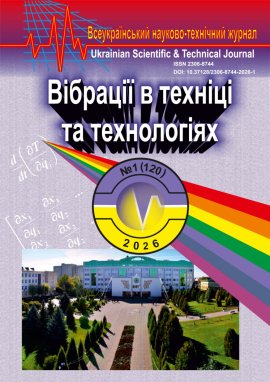
Issue №: 1(120)
The journal deals with the problems of vibration technologies and machines, mathematical methods of vibration process studies, information on design and technological development, presents teaching and methodological aspects of teaching in the Higher School of Applied Sciences, where vibration machines and technologies are studied.
STUDY OF THE STRESS-STRAIN STATE OF THIN-WALLED CYLINDRICAL VESSELS WITH SPHERICAL BOTTOMS UNDER THE ACTION OF INTERNAL PRESSURE
Nevdakha Yurii - Associate Professor, PhD in Engineering, Associate Professor of the Department of Machine Parts and Applied Mechanics, Central Ukrainian National Technical University, Kropyvnytskyi, Ukraine, e-mail: uanevdakha@ukr.net, (066) 5249790, https://orcid.org/0000-0003-4355-4065
Skrypnyk Oleksandr - Associate Professor, PhD in Engineering, Associate Professor of the Department of Materials Science and Foundry, Central Ukrainian National Technical University, Kropyvnytskyi, Ukraine, e-mail: skripnik1966@ukr.net, (095) 0278011, https://orcid.org/0000-0002-5735-0648,
Nevdakha Nataliia - head of the Educational Laboratory of the Department of Materials Science and Foundry, Central Ukrainian National Technical University, Kropyvnytskyi, Ukraine, e-mail: natalian65@ukr.net, (095) 9048267, https://orcid.org/0009-0004-9841-4216,
Riabovolyk Yaroslav - applicant for higher education at the first (bachelor's) level of higher education in the specialty G9 "Applied Mechanics", Central Ukrainian National Technical University, Kropyvnytskyi, Ukraine, e-mail: Ryabovolik@ ukr.net, (097) 8275939, https://orcid.org/0009-0003-6367-7182
The article investigates the stress-strain state of a thin-walled cylindrical pressure vessel with smoothly joined spherical heads operating under internal overpressure. The structural configuration of the sealed vessel, formed by sheet elements connected by longitudinal and circumferential leak-tight riveted joints, is considered, and a verification calculation of its main components is performed. The study generalizes contemporary approaches to the analysis of riveted joints with due regard to strength conditions, tightness, preload compressive forces, and the characteristic features of possible failure, which made it possible to substantiate the expediency of using such joints in critical pressure-loaded structures.
Based on the principles of strength of materials for thin-walled shells, the regularities of membrane stress distribution in the vessel walls were determined as a function of the shell geometry, wall thickness, and radii of curvature. It is shown that in the cylindrical part of the vessel, the stress in the longitudinal section is twice as high as that in the circumferential section; consequently, the longitudinal riveted joints are the most heavily loaded and should be regarded as the governing elements in calculations under internal pressure. A sequence for the verification calculation of riveted joints is presented, including the selection of the joint type, determination of the required wall thickness, evaluation of the joint efficiency coefficient, selection of the rivet diameter, and verification of the joint with respect to shear, bearing, and tightness.
Two possible design variants of this joint were considered, and it was established that the more rational solution is the one in which the cylindrical shell is arranged as an internal element relative to the head. Such a design promotes higher tightness of the circumferential joint, reduces the influence of local compressive forces in the transition zone, and improves the overall reliability of the structure. The obtained results can be used in the design, calculation, and improvement of sealed thin-walled pressure vessels operating under internal pressure.
1. Sizhe Wang, Qingtian Su, Liang Chen, Xu Jiang (2025). Strengthening of riveted steel truss joints: Experimental and numerical study on rivet behavior. Engineering Structures ISSN: 0141-0296. 2025. Vol. 342. Page: 120834. in English
2. Lundkvist Axel (2022) Static strength analysis of riveted joints. Student thesis. URL: https://www.diva portal.org/smash/record.jsf?pid=diva2%3A1711839&dswid=4756 in English
3. Kerong Ren , Haobing Han , Wentao Xu and Hua Qing. (2023) The Effect of Rivet Arrangement on the Strengths of Lap Joints and Lap Joint Design Methods. Appl. Sci. 2023. Vol. 13(9). Page: 5629. in English
4. Anna Rudawska1, Izabela Miturska, Dana Stančeková1, Jacek Mucha (2018) The strength of traditional and self-pierced riveted joints. MATEC Web of Conferences. 2018. https://doi.org/10.1051/matecconf/201824401007 in English
5. Lucjan Witek, Monika Lubas (2019). Experimental Strength Analysis of Riveted Joints Using Blind Rivets. Journal of KONES Powertrain and Transport. ISSN: 1231-4005. 2019. Vol. 26, No. 1. Р. 199-206. in English
6. Monika Lubas (2022). The visual research of changes in the geometry of a rivet joint for material model effect for simulation riveted joints made of EN AW 5251. Technologia i automatyzacja montażu. 2022. NR 4. Р. 54-63. in English
7. Mike R. Bambach (2025). Tension Strength of Multi-Fastener, Single-Lap Joints in Flax and Jute Composite Plates Using Bolts or Rivets. Materials. 2025. Vol.18(10). Page: 2180. in English
8. Pysarenko, G.S. et al. (2004) Strength of Materials: Textbook for Universities. Kyiv: Vyshcha Shkola [in Ukrainian].
9. Pavlishche V.T. (1993) Fundamentals of Design and Calculation of Machine Parts: Textbook. Kyiv: Vyshcha Shkola [in Ukrainian].
About the journal
The journal "Vibrations in Engineering and Technologies" is included in the list of technical scientific publications of Ukraine
(Category "B", Order of the Ministry of Education and Science of Ukraine dated July 2, 2020 No. 886)
Old version of the site: http://vibrojournal.vsau.edu.ua/
The journal "Vibrations in Engineering and Technology" is indexed by the following databases and catalogs:





The certificateof massmedia State registration:kv no 16643-5115 from 30.04.2010 .
Founder of the journal: Vinnytsia National Agrarian University
The journal is devoted to highlighting current issues in engineering, mechanical engineering, and technological processes, including the study of dynamic and oscillatory phenomena in technical systems, the application of mathematical methods for process modeling and analysis, as well as the presentation of results of design-engineering and technological developments. Particular attention is given to the study of vibration processes and their application in modern technologies.
The purpose of the scientific journal “Vibrations in Engineering and Technologies” is to disseminate the results of fundamental and applied research in the field of engineering sciences aimed at developing theoretical foundations and practical approaches to the design, analysis, and improvement of machines, materials, and technological processes, including the use of vibration and oscillatory effects in various sectors of production.
The publication is focused on the formation of a modern scientific and informational environment for the effective exchange of research results, support of innovative development, and implementation of advanced technical solutions in industry, agro-industrial production, and related fields.
The journal promotes the development of interdisciplinary research, the integration of modern engineering approaches, and the enhancement of the efficiency of technological processes and technical systems, including through the rational use of vibration phenomena.
Objectives of the Scientific Journal
To achieve its stated purpose, the journal addresses the following key objectives:
dissemination of results of fundamental and applied scientific research in the fields of mechanics, mechanical engineering, technological processes, machine dynamics, and equipment, as well as in areas related to the application of vibration phenomena in engineering and technologies;
promotion of research aimed at the creation and improvement of machines, mechanisms, and technological equipment based on oscillatory and vibration processes;
support for the implementation of modern technological solutions focused on improving productivity, energy efficiency, and reliability of technical systems;
обеспечение scientific exchange of research results among research institutions, higher education establishments, and industrial enterprises;
development of interdisciplinary cooperation among researchers in the fields of mechanics, materials science, material processing technologies, and automation of technological processes;
dissemination of modern scientific achievements and advanced technologies related to the application of vibration processes in production and technical systems.
Publisher Vinnytsia National Agrarian University
In June 1994 the 2nd International Scientific and Technical Conference "Application of vibrations for technological purposes" was organized on the basis of Vinnytsia State Agricultural Institute. Leading experts in this field, noting the significant contribution to the school of Vibration Engineering under the leadership of P. S. Bernyk, proposed to create a professional all-Ukrainian scientific and technical journal "Vibration in engineering and technology..The journal was foundedat Vinnytsia State Agricultural Institute and P.S. Bernyk was elected to be the chief editor .
For all these years (since 1994) theJournal "vibration in engineering and technology" published 119 issues wherestudy of vibration effects, the creation of progressive energy saving technologies and equipment for their implementation were highlighted.
Currently Ihor Kupchuk, Candidate of Technical Sciences, Associate professor, Associate Professor of the Department of Engineering Mechanics and Technological Processes in the Agricultural Industry Faculty of Engineering and Technology Vinnytsia National Agrarian University is the chief editor of the "Vibrations in engineering and Technology"
The journal "Vibration in Engineering and technology", which has no analogues on the territory of Ukraine, is well known abroad.
