

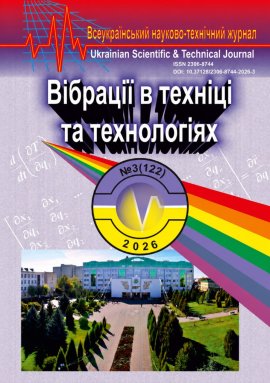
Issue №: 3(122)
The journal deals with the problems of vibration technologies and machines, mathematical methods of vibration process studies, information on design and technological development, presents teaching and methodological aspects of teaching in the Higher School of Applied Sciences, where vibration machines and technologies are studied.
SELECTION OF THE STRAIN RATE CHANGE MODE DURING HIGH-TEMPERATURE FLAT-DIE UPSETTING OF CYLINDRICAL BILLETS
Mykhalevych Volodymyr – Doctor of Technical Sciences, Professor of the Department of Higher Mathematics, Vinnytsia National Technical University (95 Khmelnytske Shose, Vinnytsia, 21021, Ukraine, email: mykhalevych@vntu.edu.ua, https://orcid.org/0000-0003-1557-7331).
Kolisnyk Mykola – Doctor of Philosophy in Materials Science, Senior Lecturer of the Department of Electric Power Engineering, Electrical Engineering and Electromechanics, Vinnytsia National Agrarian University (3 Soniachna str., Vinnytsia, 21008, Ukraine, email: kolisnik30@gmail.com, https://orcid.org/0000-0001-5502-6556).
Dymnich Igor – Security Advisor, DIDWW (Israel, email: security@didww.com, https://orcid.org/0000-0001-5401-9143)
The paper considers the problem of selecting a rational mode of strain rate change during high-temperature isothermal flat-die upsetting of cylindrical billets. The object of the study is the hot upsetting process; the subject is the law of strain rate change at the critical point of the billet and the corresponding law of motion of the deforming tool. The relevance of the work stems from the fact that upsetting is one of the most energy-intensive forging operations, while the tool speed is in practice assigned as a constant value based on equipment capabilities rather than on conditions for the fullest use of the plastic capacity of the material.
Known results on the optimization of the rate mode of multistage hot deformation have been obtained for processes with a homogeneous stress-strain state, for which the stress triaxiality ratio remains unchanged. During flat-die upsetting this ratio at the critical point on the equator of the lateral surface changes during the process due to barrelling, which formally makes the direct transfer of known results impossible.
To overcome this obstacle, a hypothesis is formulated on the weak dependence of the limiting strain on the stress triaxiality ratio during high-temperature deformation for a certain class of materials. It is shown that a weakened form of the hypothesis is sufficient for a correct transfer of the results, requiring independence from the triaxiality ratio only for the strain rate sensitivity exponent. It is established that the resource dependence parameter enters exclusively into the scale factor of the solution and does not affect the shape of the optimal trajectory, while the relative error of the limiting strain is smaller than the relative error of this parameter.
The problem of matching the optimal law of strain rate change with the tool kinematics is solved. A closed-form analytical expression for the tool speed is obtained, which does not require numerical inversion of the dependence of strain intensity on the upsetting ratio. For exponential and polynomial trajectories the law of tool motion is presented in explicit form. An estimate of the strain rate deviation within a stage is proposed, which gives the number of stages a specific technological meaning.
A numerical calculation for 14Kh17N2 steel at 1150 °C established that the plastic resource of the material is not exhausted during flat-die upsetting, i.e. the process is limited geometrically rather than by deformation. For such materials the problem of minimizing the process time is meaningful. A relation is obtained linking the reduction of deformation time with the increase of the limiting strain; it is shown that an increase of the limiting strain by 5.9 % corresponds to a reduction of the upsetting time by 47 %. The conditions for applicability of the obtained results to processes of local deformation by roller burnishing are determined.
1. Mykhalevych, V. M. (1998). Tenzorni modeli nakopychennia poshkodzhen [Tensor models of damage accumulation]. Vinnytsia: UNIVERSUM-Vinnytsia. [in Ukraine].
2. Sampaio, R. F. V., Pragana, J. P. M., Joaquim, G. P., Bragança, I. M. F., Silva, C. M. A., Martins, P. A. F. (2026). Reevaluating fracture forming limits in bulk forming under non-monotonic strain loading paths. Journal of Manufacturing and Materials Processing, 10(2), 66. https://doi.org/10.3390/jmmp10020066. [in Switzerland].
3. Kukhar, V., Artiukh, V., Butyrin, A., Prysiazhnyi, A. (2018). Stress-strain state and plasticity reserve depletion on the lateral surface of workpiece at various contact conditions during upsetting. Advances in Intelligent Systems and Computing, 692, 201–211. [in Switzerland].
4. Kukhar, V. V., Klimov, E. S., Chernenko, S. M., Balalayeva, E. Yu. (2020). Correlation of barreling effect with boundary friction coefficient during upsetting of various materials workpieces under processing conditions. Materials Science Forum, 992, 751–756. [in Switzerland].
5. Zhbankov, I. G., Markov, O. E., Perig, A. V. (2014). Rational parameters of profiled workpieces for an upsetting process. The International Journal of Advanced Manufacturing Technology, 72, 865–872. https://doi.org/10.1007/s00170-014-5727-5. [in Germany].
6. Titov, V. A., Zlochevska, N. K., Lavrinenkov, A. D., Haranenko, T. R. (2011). Doslidzhennia parametriv protsesu izotermichnoho presuvannia zahotovok z tytanovykh splaviv. Visnyk NTU «KhPI», 46, 67–72. [in Ukraine].
7. Syvak, R. I., Kotsiubivska, K. I., Sukhorukov, S. I. (2016). Vplyv protytysku, shcho stvoriuietsia tverdym seredovyshchem, na deformivnist zahotovok pry radialnomu vydavliuvanni. Visnyk mashynobuduvannia ta transportu, 4(2), 101–108. [in Ukraine].
8. Mykhalevych, V. M., Kraievskyi, V. O. (2009). Formuliuvannia variatsiinoi zadachi dlia modeli nakopychennia poshkodzhen pry hariachomu deformuvanni. Obrobka materialiv tyskom, 2(21), 12–16. [in Ukraine].
9. Kraievskyi, V. O. (2011). Vzaiemozviazok rozviazkiv variatsiinykh zadach, shcho pobudovani na osnovi modeli nakopychennia poshkodzhen spadkovoho typu. Teoretychni i prykladni zadachi obrobky metaliv tyskom ta avtotekhnichnykh ekspertyz: zbirnyk tez dopovidei. Vinnytsia: VNTU, 196–198. [in Ukraine].
10. Kraievskyi, V. O., Mykhalevych, V. M. (2015). Optymizatsiia shvydkisnoho rezhymu bahatostupenevoho hariachoho deformuvannia pry odnakovii tryvalosti stupeniv. Visnyk Donetskoho natsionalnoho universytetu. Ser. A: Pryrodnychi nauky, 1–2, 46–52. [in Ukraine].
11. Kraievskyi, V. O., Mykhalevych, V. M., Dobranyuk, Yu. V., Sawicki, D., Mussabekov, K. (2018). Selection of optimal path of strain rate change in the process of multistage hot deformation under the condition of the equal duration of stages. Proceedings of SPIE, 10808, 108084T. https://doi.org/10.1117/12.2501490. [in USA].
12. Mykhalevych, V. M., Kraievskyi, V. O. (2011). Optymizatsiia hariachoho tsyklichnoho deformuvannia iz pauzamy. Visnyk NTU «KhPI». Novi rishennia v suchasnykh tekhnolohiiakh, 46, 103–106. [in Ukraine].
13. Mykhalevych, V. M., Kraievskyi, V. O., Dobranyuk, Yu. V. (2009). Visesymetrychna osadka tsylindrychnykh zahotovok. Naukovi notatky, 25(1), 241–249. [in Ukraine].
14. Mikhalevich, V. M., Abramchuk, I. V. (2021). Maximum accumulated strain for linear two-link triangle-like deformation trajectories. International Applied Mechanics, 57(6), 720–736. https://doi.org/10.1007/s10778-022-01121-w. [in USA].
15. Myhalevich, V., Kolisnyk, M., Shtuts, A., Hryhorenko, N. (2025). Study of technological processes of stamping of flange-type parts based on the application of combined expression methods. Herald of Khmelnytskyi National University. Technical Sciences, 351(3.1), 590–599. https://doi.org/10.31891/2307-5732-2025-351-77. [in Ukraine].
16. Myhalevych, V. M., Shtuts, A. A., Kolisnyk, M. A., Zozulyak, I. A., Jelenich, A. P. (2025). Research into the processes of rolling stamping of ring and flange billets with a complex profile. Metallofizika i Noveishie Tekhnologii, 47(6), 647–666. https://doi.org/10.15407/mfint.47.06.0647. [in Ukraine].
17. Mykhalevych, V. M., Kolisnyk, M. A., Shtuts, A. A. (2025). Doslidzhennia napruzheno-deformovanoho stanu materialu zahotovok pid chas plastychnoho shtampuvannia prokatuvanniam. Metallofizika i Noveishie Tekhnologii, 47(1), 57–81. https://doi.org/10.15407/mfint.47.01.0057. [in Ukraine].
18. Matviichuk, V. A., Mykhalevych, V. M., Shtuts, A. A. (2023). Analiz napruzheno-deformovanoho stanu materialu zahotovok pry vysadzhuvanni resursooshchadnym metodom shtampuvannia obkochuvanniam. Tekhnika, enerhetyka, transport APK, 1(120), 76–85. https://doi.org/10.37128/2520-6168-2023-1-9. [in Ukraine].
19. Matviychuk, V., Mikhalevich, V., Shtuts, A. (2023). Analysis of stress-strain state (SSS) of billet material in the course of setting by resource-saving method of roll stamping. Vibratsii v tekhnitsi ta tekhnolohiiakh, 1(108), 63–72. https://doi.org/10.37128/2306-8744-2023-1-7. [in Ukraine].
About the journal
The journal "Vibrations in Engineering and Technologies" is included in the list of technical scientific publications of Ukraine
(Category "B", Order of the Ministry of Education and Science of Ukraine dated July 2, 2020 No. 886)
Old version of the site: http://vibrojournal.vsau.edu.ua/
The journal "Vibrations in Engineering and Technology" is indexed by the following databases and catalogs:





The certificateof massmedia State registration:kv no 16643-5115 from 30.04.2010 .
Founder of the journal: Vinnytsia National Agrarian University
The journal is devoted to highlighting current issues in engineering, mechanical engineering, and technological processes, including the study of dynamic and oscillatory phenomena in technical systems, the application of mathematical methods for process modeling and analysis, as well as the presentation of results of design-engineering and technological developments. Particular attention is given to the study of vibration processes and their application in modern technologies.
The purpose of the scientific journal “Vibrations in Engineering and Technologies” is to disseminate the results of fundamental and applied research in the field of engineering sciences aimed at developing theoretical foundations and practical approaches to the design, analysis, and improvement of machines, materials, and technological processes, including the use of vibration and oscillatory effects in various sectors of production.
The publication is focused on the formation of a modern scientific and informational environment for the effective exchange of research results, support of innovative development, and implementation of advanced technical solutions in industry, agro-industrial production, and related fields.
The journal promotes the development of interdisciplinary research, the integration of modern engineering approaches, and the enhancement of the efficiency of technological processes and technical systems, including through the rational use of vibration phenomena.
Objectives of the Scientific Journal
To achieve its stated purpose, the journal addresses the following key objectives:
dissemination of results of fundamental and applied scientific research in the fields of mechanics, mechanical engineering, technological processes, machine dynamics, and equipment, as well as in areas related to the application of vibration phenomena in engineering and technologies;
promotion of research aimed at the creation and improvement of machines, mechanisms, and technological equipment based on oscillatory and vibration processes;
support for the implementation of modern technological solutions focused on improving productivity, energy efficiency, and reliability of technical systems;
обеспечение scientific exchange of research results among research institutions, higher education establishments, and industrial enterprises;
development of interdisciplinary cooperation among researchers in the fields of mechanics, materials science, material processing technologies, and automation of technological processes;
dissemination of modern scientific achievements and advanced technologies related to the application of vibration processes in production and technical systems.
Publisher Vinnytsia National Agrarian University
In June 1994 the 2nd International Scientific and Technical Conference "Application of vibrations for technological purposes" was organized on the basis of Vinnytsia State Agricultural Institute. Leading experts in this field, noting the significant contribution to the school of Vibration Engineering under the leadership of P. S. Bernyk, proposed to create a professional all-Ukrainian scientific and technical journal "Vibration in engineering and technology..The journal was foundedat Vinnytsia State Agricultural Institute and P.S. Bernyk was elected to be the chief editor .
For all these years (since 1994) theJournal "vibration in engineering and technology" published 119 issues wherestudy of vibration effects, the creation of progressive energy saving technologies and equipment for their implementation were highlighted.
Currently Ihor Kupchuk, Candidate of Technical Sciences, Associate professor, Associate Professor of the Department of Engineering Mechanics and Technological Processes in the Agricultural Industry Faculty of Engineering and Technology Vinnytsia National Agrarian University is the chief editor of the "Vibrations in engineering and Technology"
The journal "Vibration in Engineering and technology", which has no analogues on the territory of Ukraine, is well known abroad.
