

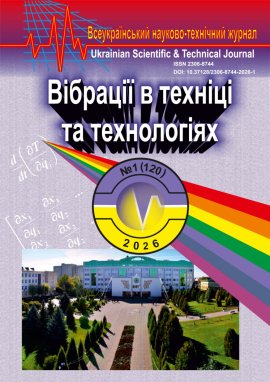
Issue №: 1(120)
The journal deals with the problems of vibration technologies and machines, mathematical methods of vibration process studies, information on design and technological development, presents teaching and methodological aspects of teaching in the Higher School of Applied Sciences, where vibration machines and technologies are studied.
INVESTIGATION OF THE PHYSICO-MECHANICAL AND THERMOPHYSICAL PROPERTIES OF ALFALFA SEED MATERIAL
Zamrii Mykhailo – Doctor of Philosophy in Industrial Mechanical Engineering, Senior Lecturer at the Department of Labor Protection and Biotechnical Systems in Animal Husbandry of Vinnytsia National Agrarian University. Office address: Vinnytsia, Sonyachna St. 3, VNAU 21008, https://orcid.org/0000-0002-9433-6714).
The paper presents the results of theoretical and experimental studies aimed at improving the efficiency of the drying process of alfalfa seed mass at the stationary stage of post-harvest processing. It has been established that, to ensure high-quality threshing and separation operations, the seed mixture must be dried to a moisture content of 19-21%, whereas it arrives from the field with a moisture content of 35-55%, which determines the necessity and high energy intensity of the drying operation. Alfalfa pods containing seeds were identified as the main object of research, as the key component of the seed mass that has the greatest influence on the preservation of sowing qualities.
As a result of experimental investigations, relationships between the density of alfalfa pods and their moisture content were obtained, which made it possible to refine the initial data for heat and mass transfer calculations. The maximum permissible heating temperatures of alfalfa pods were determined depending on their initial moisture content and drying exposure time. It was established that an increase in material moisture content significantly reduces the allowable heating temperature, while the effect of moisture content is much more pronounced than that of thermal exposure duration. An analytical dependence was obtained that can be used for the practical selection of drying regimes in order to prevent a decrease in seed germination.
The thermophysical characteristics of alfalfa pods-specific heat capacity, thermal conductivity, and thermal diffusivity-were experimentally determined, and their variation as a function of material moisture content was established. It was shown that with increasing moisture content, the specific heat capacity and thermal conductivity of the pods increase, whereas thermal diffusivity exhibits a characteristic inflection in the moisture range of 30–35%, which is associated with a change in the form of moisture binding within the material. The obtained results confirm the expediency of considering moisture content as a determining parameter in the mathematical modeling of drying processes.
The practical significance of the study lies in the fact that the established experimental relationships and limiting temperature regimes can be used to substantiate dryer design parameters and to optimize technological drying regimes for alfalfa seed mass, ensuring reduced energy consumption and preservation of high sowing qualities of seeds.
1. Zamrii, M. A. (2026). Obgruntuvannia parametriv ta rezhymiv roboty obladnannia dlia sushinnia nasinnievoi masy liutserny [Doctoral dissertation, Vinnytsia National Agrarian University]. Vinnytsia, Ukraine.
2. Tufekchi, V. I., & Veresotskyi, Yu. I. (2021). Doslidzhennia verkhnoho zhaliuziinoho rozpodilennia teplonosiia ta vyznachennia efektyvnykh parametriv sushinnia v kompleksakh rozpylniuvalnoho typu. Kharchova Promyslovist, 30, 96–109. https://doi.org/10.24263/2225-2916-2021-30-12
3. Solona, O. V., & Zamrii, M. A. (2022). Doslidzhennia protsesu sushinnia nasinnykiv trav. Vibratsii v tekhnitsi ta tekhnolohiiakh, 3(106), 78–87. https://doi.org/10.37128/2306-8744-2022-3-11
4. Kotov, B., Kalinichenko, R., Spirin, A., Gudzenko, N., Didyk, A., & Zamrii, M. (2024). Development and research of energy-efficient helio-air collectors for drying agricultural products. Technology Audit and Production Reserves, 6/1(80), 54–60. https://doi.org/10.15587/2706-5448.2024.318480
5. Moss, W. M., Guzzomi, A. L., Foster, K. J., Ryan, M. H., & Nichols, P. G. H. (2021). Harvesting subterranean clover seed: Current practices, technology and issues. Crop & Pasture Science, 72, 223–235. https://doi.org/10.1071/CP20269
6. Kaletnik, H., Solona, O., Kotov, B., Stepanenko, S., Shvydia, V., Kalinichenko, R., Tverdokhlib, I., & Polievoda, Y. (2024). The usage of the elemental base of the vibratory mill with the spatial circulation movement of material to create drying rig. Przegląd Elektrotechniczny, 100(3), 232–237. https://doi.org/10.15199/48.2024.03.41
7. Spirin, A., Borysiuk, D., Tsurkan, O., Tverdokhlib, I., Veselovska, N., & Edl, M. (2023). Ways of intensification of grass seed production. Journal of Engineering Sciences, 10(1), F11–F19. https://doi.org/10.21272/jes.2023.10(1).f3
8. Tokarchuk, O., Mytko, M., Burlaka, S., Zozulyak, I., & Stadnik, M. (2025). Comparison of technological operations in processing alfalfa hay in terms of their impact on forage quality and quantity. Technology Audit and Production Reserves, 2/3(82), 43–51. https://doi.org/10.15587/2706-5448.2025.326047
9. Kaletnik, H., Yaropud, V., Polievoda, Y., Solona, O., Babyn, I., & Tverdokhlib, I. (2024). Study of the process of active-ventilation drying of legume grasses' fractional processing products. Przegląd Elektrotechniczny, 100(2), 156–163. https://doi.org/10.15199/48.2024.02.32
10. Kalinichenko, R. A., & Voitiuk, V. D. (2017). Matematychne modeliuvannia teplomasoobminnykh protsesiv vysokotemperaturnoi termoobrobky zernovykh materialiv. Tekhnika ta enerhetyka, 275, 59–65.
11. Spirin, A., Kupchuk, I., Tverdokhlib, I., Polievoda, Y., Kovalova, K., & Dmytrenko, V. (2022). Substantiation of modes of drying alfalfa pulp by active ventilation in a laboratory electric dryer. Przegląd Elektrotechniczny, 98(5), 11–15. https://doi.org/10.15199/48.2022.05.02
12. Kaletnik, H. M., Yaropud, V. M., & Polievoda, Y. A. (2023). Chyselne modeliuvannia protsesu sushinnia aktyvnym ventyliuvanniam produktiv fraktsiinoi pererobky bobovykh trav v konvektyvnii strichkovii sushartsi. Tekhnika, enerhetyka, transport APK, 2(121), 5–15. https://doi.org/10.37128/2520-6168-2023-2-1
13. Bandura, V., Kalinichenko, R., Kotov, B., & Spirin, A. (2018). Theoretical rationale and identification of heat and mass transfer processes in vibration dryers with IR-energy supply. Eastern-European Journal of Enterprise Technologies, 94(4), 50–58.
14. Kotov, B. I., Stepanenko, S. P., & Kalinichenko, R. A. (2017). Kontseptualni osnovy stvorennia tekhnichnykh zasobiv pervynnoi obrobky zerna v umovakh hospodarstv APK. Konstruiuvannia, vyrobnytstvo ta ekspluatatsiia silskohospodarskykh mashyn, 47(1), 104–114.
15. Baranovskyi, V., Spirin, A., Tverdokhlib, I., & Volynets, Ye. (2025). Modeling of drying processes of alfalfa processed products taking into account equilibrium moisture content. Visnyk Kremenchutskoho Natsionalnoho Universytetu imeni Mykhaila Ostrohradskoho, 4(153), 347–352. https://doi.org/10.32782/1995-0519.2025.4.40
16. Spirin, A. V., Derkach, V. V., & Korobko, M. M. (2019). Obgruntuvannia tekhnolohii ta rezhymnykh parametriv resursozberihaiuchoho protsesu pidbyrannia sina. Kyiv: Komprint.
17. Paziuk, V., Snezhkin, Y., Dmytrenko, N., Ivanov, S., Tokarchuk, O., & Kupchuk, I. (2022). Thermal and physical properties and heat-mass transfer processes of drying pumpkin seeds. Przegląd Elektrotechniczny, 98(7), 154–157. https://doi.org/10.15199/48.2022.07.25
18. Baranovskyi, V. M., Burlaka, S. A., Kupchuk, I. M., & Boretska, T. Y. (2025). Vplyv ultrafioletovykh lamp na mikrobiolohichnu chystotu kormiv pid chas sushinnia. Vibratsii v tekhnitsi ta tekhnolohiiakh, 2(117), 110–116. https://doi.org/10.37128/2306-8744-2025-2-13
19. Lomach, S. M. (2020). Teoriia planuvannia eksperymentiv. Vykonannia rozrakhunkovo-hrafichnoi roboty. Kyiv: KPI im. Ihoria Sikorskoho.
20. Matviienko, S. M. (2019). Vdoskonalennia metodu vyznachennia skladu rechovyny za yikh teploprovidnistiu [Abstract of PhD dissertation]. Kyiv.
21. Solona, O., Spirin, A., Zamrii, M., Tverdokhlib, I., Polievoda, Y., & Kovalova, K. (2025). Determination of the dependence of the physico-mechanical properties of alfalfa seed pods on moisture content. Technology Audit and Production Reserves, 3/3(83), 84–90. https://doi.org/10.15587/2706-5448.2025.331286
About the journal
The journal "Vibrations in Engineering and Technologies" is included in the list of technical scientific publications of Ukraine
(Category "B", Order of the Ministry of Education and Science of Ukraine dated July 2, 2020 No. 886)
Old version of the site: http://vibrojournal.vsau.edu.ua/
The journal "Vibrations in Engineering and Technology" is indexed by the following databases and catalogs:





The certificateof massmedia State registration:kv no 16643-5115 from 30.04.2010 .
Founder of the journal: Vinnytsia National Agrarian University
The journal is devoted to highlighting current issues in engineering, mechanical engineering, and technological processes, including the study of dynamic and oscillatory phenomena in technical systems, the application of mathematical methods for process modeling and analysis, as well as the presentation of results of design-engineering and technological developments. Particular attention is given to the study of vibration processes and their application in modern technologies.
The purpose of the scientific journal “Vibrations in Engineering and Technologies” is to disseminate the results of fundamental and applied research in the field of engineering sciences aimed at developing theoretical foundations and practical approaches to the design, analysis, and improvement of machines, materials, and technological processes, including the use of vibration and oscillatory effects in various sectors of production.
The publication is focused on the formation of a modern scientific and informational environment for the effective exchange of research results, support of innovative development, and implementation of advanced technical solutions in industry, agro-industrial production, and related fields.
The journal promotes the development of interdisciplinary research, the integration of modern engineering approaches, and the enhancement of the efficiency of technological processes and technical systems, including through the rational use of vibration phenomena.
Objectives of the Scientific Journal
To achieve its stated purpose, the journal addresses the following key objectives:
dissemination of results of fundamental and applied scientific research in the fields of mechanics, mechanical engineering, technological processes, machine dynamics, and equipment, as well as in areas related to the application of vibration phenomena in engineering and technologies;
promotion of research aimed at the creation and improvement of machines, mechanisms, and technological equipment based on oscillatory and vibration processes;
support for the implementation of modern technological solutions focused on improving productivity, energy efficiency, and reliability of technical systems;
обеспечение scientific exchange of research results among research institutions, higher education establishments, and industrial enterprises;
development of interdisciplinary cooperation among researchers in the fields of mechanics, materials science, material processing technologies, and automation of technological processes;
dissemination of modern scientific achievements and advanced technologies related to the application of vibration processes in production and technical systems.
Publisher Vinnytsia National Agrarian University
In June 1994 the 2nd International Scientific and Technical Conference "Application of vibrations for technological purposes" was organized on the basis of Vinnytsia State Agricultural Institute. Leading experts in this field, noting the significant contribution to the school of Vibration Engineering under the leadership of P. S. Bernyk, proposed to create a professional all-Ukrainian scientific and technical journal "Vibration in engineering and technology..The journal was foundedat Vinnytsia State Agricultural Institute and P.S. Bernyk was elected to be the chief editor .
For all these years (since 1994) theJournal "vibration in engineering and technology" published 119 issues wherestudy of vibration effects, the creation of progressive energy saving technologies and equipment for their implementation were highlighted.
Currently Ihor Kupchuk, Candidate of Technical Sciences, Associate professor, Associate Professor of the Department of Engineering Mechanics and Technological Processes in the Agricultural Industry Faculty of Engineering and Technology Vinnytsia National Agrarian University is the chief editor of the "Vibrations in engineering and Technology"
The journal "Vibration in Engineering and technology", which has no analogues on the territory of Ukraine, is well known abroad.
