

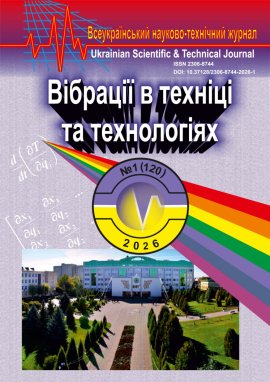
Issue №: 1(120)
The journal deals with the problems of vibration technologies and machines, mathematical methods of vibration process studies, information on design and technological development, presents teaching and methodological aspects of teaching in the Higher School of Applied Sciences, where vibration machines and technologies are studied.
EVALUATION OF THE ACCURACY OF DIMENSIONAL-STRENGTHENING HEAT-OXIDATION TREATMENT OF CARBIDE PRODUCTS
Paulikienė Simona - Department of Mechanical, Energy and Biotechnology Engineering, Faculty of Engineering, Agriculture Academy, Vytautas Magnus University, Studentų Str. 15A, Akademija, LT-53362 Akademija, Kaunas district, Kaunas, Lithuania; simona.paulikiene1@vdu.lt, https://orcid.org/0000-0002-8803-2941
Glowacki Szymon, Department of Fundamentals of Engineering and Power Engineering, Institute of Mechanical Engineering, Warsaw University of Life Sciences (SGGW), 02-787 Warsaw, Poland; szymon_glowacki@sggw.edu.pl https://orcid.org/0000-0002-0373-6633
The article investigates the accuracy of dimensional strengthening thermo-oxidative treatment of hard-alloy products. The study analyzes how temperature field nonuniformity in the furnace and temperature fluctuations during processing influence the dispersion of dimensions of tungsten–cobalt alloy parts. A theoretical model describing the relationship between dimensional deviations before and after thermo-oxidation is developed using statistical methods and the theory of random processes.
The influence of constant temperature gradients and random temperature fluctuations on the oxidation depth and dimensional accuracy is analytically evaluated. Correlation functions of temperature variations in furnaces with different control systems are determined, and their effect on the variance of the removed material layer during thermo-oxidation is established. Experimental studies on hard-alloy samples confirm the theoretical dependences and demonstrate that even small temperature differences in the furnace can lead to noticeable dimensional deviations.
The research also examines the effect of oxidation conditions (air and oxygen atmosphere) on the dimensional accuracy of hard-alloy elements used in high-pressure chambers. Results show that thermo-oxidative treatment improves surface microrelief and can slightly reduce the dispersion of dimensions. It is established that increasing the oxidation time while decreasing the oxidation rate and furnace temperature can significantly reduce dimensional variance and improve processing accuracy.
The obtained results provide recommendations for optimizing thermo-oxidative processing parameters and improving dimensional accuracy in the manufacturing of hard-alloy components.
1. Kaletnik, G.M. (2019). Perspektyvy pidvyshchennya enerhetychnoyi avtonomiyi pidpryyemstv APK v ramkakh vykonannya enerhetychnoyi stratehiyi Ukrayiny [Prospects for increasing the energy autonomy of agricultural enterprises in the framework of the energy strategy of Ukraine]. Bulletin of Agrarian Science of the Black Sea Region, 4, 90–98. DOI: https://doi.org/10.31521/2313-092X/2019-4(104)-10. [in Ukrainian].
2. Kaletnik, G.M., Lutkovska, S.M. (2022). Ekolohichna modernizatsiya ta orhanichne vyrobnytstvo v systemi ekolohichnoyi bezpeky: monohrafiya [Ecological modernization and organic production in the system of environmental security: monograph]. Vinnytsia: VNAU. [in Ukrainian].
3. Kaletnik, H.M., Yaropud, V.M. (2021). Fizyko-matematychna modelʹ ventylyatsiynoyi systemy nahnitannya chystoho povitrya u tvarynnytsʹkykh prymishchennyakh [Physico-mathematical model of the ventilation system for injecting clean air in livestock premises]. Tekhnika, enerhetyka, transport APK, 3 (114), 4–15. DOI: https://doi.org/10.37128/2520-6168-2021-3-1. [in Ukrainian].
4. Kaletnik, G.M., Yaropud, V.M. (2021). Theoretical studies of pneumatic losses of the air heat exchanger of the indirect-evaporative type of livestock premises [Teoretychni doslidzhennya pnevmovtrat povitryanoho teploobminnyka pobichno-vyparnoho typu tvarynnytsʹkykh prymishchenʹ]. Machinery & Energetics, 12 (4), 35–41. DOI: http://dx.doi.org/10.31548/machenergy2021.04.035. [in Ukrainian].
5. Kaletnik, G.M., Yaropud, V.M. (2022). Simulation of the heat and mass transfer process of the indirect-evaporative type heat exchanger [Symulyatsiya protsesu teplomasoobminu teploobminnyka pobichno-vyparnoho typu]. Tekhnika, enerhetyka, transport APK, 1 (116), 4–15. [in Ukrainian].
6. Dolgikh, D.O. (2021). Analiz roboty ta klasyfikatsiya gruntovykh teploobminnykiv [Analysis of operation and classification of soil heat exchangers]. Collection of scientific works of the Institute of Mechanization of Animal Husbandry of the National Academy of Sciences «Mechanization, environmentalization and conversion of bio-raw materials in animal husbandry», 1 (9), 56–63. [in Ukrainian].
7. Blazquez, C.S., Borge-Diez, D., Nieto, I.M., Martín, A.F., González-Aguilera, D. (2023). Multiparametric evaluation of electrical, biogas and natural gas geothermal source heat pumps. Green Energy and Technology. Springer, Cham. 103–122. DOI: https://doi.org/10.1007/978-3-031-24524-4_4. [in English].
8. Shakil, Masum, Liangliang, Jiang. (2023). Technical performance comparison of horizontal and vertical ground-source heat pump systems. Journal of GeoEnergy. https://doi.org/10.1155/2023/6106360 [in English].
9. Hałaj, E, Pająk, L, Papiernik, B. (2020). Finite element modeling of geothermal source of heat pump in long-term operation. Energies, 13 (6), 1341. DOI: https://doi.org/10.3390/en1306134. [in English].
10. Neuberger, P, Adamovský, R, Šeďová, M. (2014). Temperatures and heat flows in a soil enclosing a slinky horizontal heat exchanger. Energies, 7 (2), 972–987. DOI: https://doi.org/10.3390/en7020972. [in English].
11. Kovyazin, O.S., Dolgikh, D.O. (2013). Obgruntuvannya konstruktsiyi gruntovoho teploobminnyka [Ground heat exchanger construction justification]. Bulletin of KhNUTSG named after P. Vasylenko, 132, 167. [in Ukrainian].
12. Kovyazin, O.S. (2018). Obgruntuvannya diametra obsadnoyi truby gruntovoho teploobminnyka ta podachi povitrya v nʹoho [Justification of the diameter of the casing pipe of the soil heat exchanger and air supply to it]. Bulletin of the National Technical University «KhPI». Series: Energy and heat engineering processes and equipment, 12 (1288). DOI: 10.20998/2078-774X.2018.12.13. [in Ukrainian].
13. Zhengxuan Liu, Mingjing Xie, Yuekuan Zhou, Yingdong He, Lei Zhang, Guoqiang Zhang, Dachuan Chen. (2023). A state-of-the-art review on shallow geothermal ventilation systems with thermal performance enhancement system classifications, advanced technologies and applications. Energy and Built Environment, 4 (2), 148–168. DOI: https://doi.org/10.1016/j.enbenv.2021.10.003. [in English].
14. Sydorchuk, B., Naumchuk, O., Mazurek, P. (2021). Modeling of Joint Operation of a Ground Soil Heat Exchanger and a Thermal Pump Evaporator. Journal of Ecological Engineering, 22 (2), 256–261. DOI: https://doi.org/10.12911/22998993/131177. [in English].
15. Jalaluddin Jalaluddin, Miyara Akio, Tsubaki Koutaro, Yoshida Kentaro (2010). Thermal performances of three types of ground heat exchangers in short-time period of operation. International Refrigeration and Air Conditioning Conference. P. 1123. http://docs.lib.purdue.edu/iracc/1123 [in English].
16. Aliyev, E.B., Yaropud, V.M. (2015). Porivnyalʹnyy analiz rezulʹtativ teoretychnykh y eksperymentalʹnykh doslidzhenʹ protsesu funktsionuvannya teploutylizatora dlya tvarynnytsʹkykh prymishchen [Comparative analysis of the results of theoretical and experimental studies of the process of functioning of the heat exchanger for livestock premises]. Design, production and operation of agricultural machines, 4 (II), 120–124. [in Ukrainian].
17. Kaletnik, H.M., Yaropud, V.M. (2022). Rezulʹtaty chyselʹnoho modelyuvannya heotermalʹnoho okholodzhennya u ventylyatsiyniy systemi tvarynnytsʹkykh prymishchen [Results of numerical modeling of geothermal cooling in the ventilation system of livestock premises]. Vibrations in engineering and technology, 3 (106), 5–12. DOI: https://doi.org/10.37128/2306-8744-2022-3-1. [in Ukrainian].
18. Kaletnik, G.M., Yaropud, V.M. (2023). Eksperymentalʹni doslidzhennya efektyvnosti funktsionuvannya system zabezpechennya mikroklimatu vidʺyemnoho tysku v tvarynnytsʹkykh prymishchennyakh [Experimental studies of the effectiveness of systems for providing negative pressure microclimate in livestock premises]. Design, production and operation of agricultural machines, 53, 66–84. DOI: https://doi.org/10.32515/2414-3820.2023.53.66-84. [in Ukrainian].
About the journal
The journal "Vibrations in Engineering and Technologies" is included in the list of technical scientific publications of Ukraine
(Category "B", Order of the Ministry of Education and Science of Ukraine dated July 2, 2020 No. 886)
Old version of the site: http://vibrojournal.vsau.edu.ua/
The journal "Vibrations in Engineering and Technology" is indexed by the following databases and catalogs:





The certificateof massmedia State registration:kv no 16643-5115 from 30.04.2010 .
Founder of the journal: Vinnytsia National Agrarian University
The journal is devoted to highlighting current issues in engineering, mechanical engineering, and technological processes, including the study of dynamic and oscillatory phenomena in technical systems, the application of mathematical methods for process modeling and analysis, as well as the presentation of results of design-engineering and technological developments. Particular attention is given to the study of vibration processes and their application in modern technologies.
The purpose of the scientific journal “Vibrations in Engineering and Technologies” is to disseminate the results of fundamental and applied research in the field of engineering sciences aimed at developing theoretical foundations and practical approaches to the design, analysis, and improvement of machines, materials, and technological processes, including the use of vibration and oscillatory effects in various sectors of production.
The publication is focused on the formation of a modern scientific and informational environment for the effective exchange of research results, support of innovative development, and implementation of advanced technical solutions in industry, agro-industrial production, and related fields.
The journal promotes the development of interdisciplinary research, the integration of modern engineering approaches, and the enhancement of the efficiency of technological processes and technical systems, including through the rational use of vibration phenomena.
Objectives of the Scientific Journal
To achieve its stated purpose, the journal addresses the following key objectives:
dissemination of results of fundamental and applied scientific research in the fields of mechanics, mechanical engineering, technological processes, machine dynamics, and equipment, as well as in areas related to the application of vibration phenomena in engineering and technologies;
promotion of research aimed at the creation and improvement of machines, mechanisms, and technological equipment based on oscillatory and vibration processes;
support for the implementation of modern technological solutions focused on improving productivity, energy efficiency, and reliability of technical systems;
обеспечение scientific exchange of research results among research institutions, higher education establishments, and industrial enterprises;
development of interdisciplinary cooperation among researchers in the fields of mechanics, materials science, material processing technologies, and automation of technological processes;
dissemination of modern scientific achievements and advanced technologies related to the application of vibration processes in production and technical systems.
Publisher Vinnytsia National Agrarian University
In June 1994 the 2nd International Scientific and Technical Conference "Application of vibrations for technological purposes" was organized on the basis of Vinnytsia State Agricultural Institute. Leading experts in this field, noting the significant contribution to the school of Vibration Engineering under the leadership of P. S. Bernyk, proposed to create a professional all-Ukrainian scientific and technical journal "Vibration in engineering and technology..The journal was foundedat Vinnytsia State Agricultural Institute and P.S. Bernyk was elected to be the chief editor .
For all these years (since 1994) theJournal "vibration in engineering and technology" published 119 issues wherestudy of vibration effects, the creation of progressive energy saving technologies and equipment for their implementation were highlighted.
Currently Ihor Kupchuk, Candidate of Technical Sciences, Associate professor, Associate Professor of the Department of Engineering Mechanics and Technological Processes in the Agricultural Industry Faculty of Engineering and Technology Vinnytsia National Agrarian University is the chief editor of the "Vibrations in engineering and Technology"
The journal "Vibration in Engineering and technology", which has no analogues on the territory of Ukraine, is well known abroad.
