

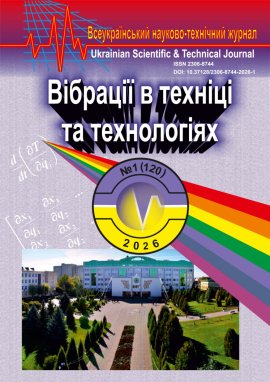
Issue №: 1(120)
The journal deals with the problems of vibration technologies and machines, mathematical methods of vibration process studies, information on design and technological development, presents teaching and methodological aspects of teaching in the Higher School of Applied Sciences, where vibration machines and technologies are studied.
ANALYSIS OF SIDE-EVAPORATIVE HEAT EXCHANGERS IN COGENERATION POWER SUPPLY SYSTEMS BASED ON RENEWABLE ENERGY SOURCES
Yaropud Vitalii, Doctor of Technical Sciences, Associate Professor, Dean of the Faculty of Engineering and Technology, Vinnytsia National Agrarian University (3 Soniachna St., Vinnytsia, 21008, Ukraine yaropud77@gmail.com https://orcid.org/0000-0003-0502-1356).
Shtuts Andrii - Ph.D., Senior Lecturer., Department of Electric Power Engineering, Electrical Engineering and Electromechanics, Vinnitsa National Agrarian University (3, Solnechna str., Vinnitsa, 21008, Ukraine, email: shtuts1989@gmail.com, https://orcid.org/0000-0002-4242-2100).
Kolisnyk Mykola - Doctor of Philosophy in Materials Science, Senior Lecturer Department of Electric Power Engineering, Electrical Engineering and Electromechanics, Vinnitsa National Agrarian University (3, Solnechna str., Vinnitsa, 21008, Ukraine, email: kolisnik30@gmail.com, https://orcid.org/0000-0001-5502-6556).
Lypnytskyi Roman - Assistant of the Department of Agroengineering and Technical Service, Vinnytsia National Agrarian University (3 Sonyachna St., Vinnytsia, 21008, Ukraine. lroma5105@gmail.com, https://orcid.org/0009-0001-3711-5632).
The article provides a comprehensive analytical review of indirect evaporative coolers (IEC) as a promising element for improving the energy efficiency of cogeneration systems based on renewable energy sources. The relevance of the study is обусловлена the need for the rational use of low-potential heat flows characteristic of biogas, biomass, and hybrid power plants, as well as the reduction of specific energy consumption for cooling under conditions of a growing share of renewable energy in the energy balance.
The prerequisites and main directions for the application of indirect evaporative coolers for cooling the air supplied to internal combustion engines operating on biogas, gas turbine and microturbine units, as well as for the utilization of low-potential waste heat, are considered. The physical principles of IEC operation are analyzed, which are based on indirect heat and mass transfer using the latent heat of water evaporation, ensuring intensified heat transfer under conditions of limited temperature differences.
The paper systematizes the main design solutions of indirect evaporative coolers, including plate-type, channel-type, and tubular configurations, as well as modern methods for intensifying heat and mass transfer through the use of capillary-porous materials, finned surfaces, and polymer and composite heat-exchange elements. A comparative assessment of industrial solutions offered by leading global manufacturers is presented according to the criteria of thermal efficiency, operational reliability, and economic feasibility of implementation.
It is shown that the greatest effect from the use of indirect evaporative coolers is achieved in biogas-based cogeneration systems through the cooling of intake air, which contributes to increasing electrical efficiency, stabilizing thermal operating conditions, and reducing internal energy consumption. Practical recommendations are formulated for selecting the IEC type for agro-industrial enterprises, taking into account climatic operating conditions, water quality, equipment service life requirements, and capital cost limitations.
1. Stadnik M., Shtuts A., Kolisnyk M., Hryhorenko N. (2025). Research on the implementation of intelligent systems to increase the reliability and efficiency of the operation of electric power complexes. Engineering, Energy, Transport AIC. No. 1 (128). P. 122-134. DOI: 10.37128/2520-6168-2025-1-14
2. Hbur Z. (2024). Development of renewable energy sources in Ukraine: opportunities, barriers and prospects. Public Administration: Concepts, Paradigm, Development, Improvement. No. 10. P. 36-44. DOI: 10.31470/2786-6246-2024-10-36-44
3. Selikhov Y. A., Horbunov K. O. (2023). Integration of thermal power plant operation. Integrated. Technologies and Energy Saving. No. 1. P. 62-68. DOI: 10.20998/2078-5364.2023.1.07
4. Riepin Y., Hryshchenko S., Klymchuk N., Serheiev M., Tkachov O. (2024). Efficiency of heat pumps using ground and ambient air heat in residential buildings. Refrigeration Engineering and Technology. Vol. 60(2). P. 122-130. https://doi.org/10.15673/ret.v60i2.2951
5. Prots L. A., Fordziun Y. I., Liutyi Y. M. (2025). Integration of thermal engineering processes in the design of energy-efficient mechanical engineering systems. Bulletin of Kherson National Technical University. Vol. 1. No. 1(92). P. 190-197. https://doi.org/10.35546/kntu2078-4481.2025.1.1.24
6. Zdyrko N. G., Tomashuk I. V. (2025). Assessment of the current state of accounting of bioenergy assets in agricultural enterprises of Ukraine. Business Navigator. No. 2 (79). P. 49-57. https://doi.org/10.32782/business-navigator.79-9
7. Skliar O. G., Skliar R. V., Komar A. S., Akulov V. D. (2025). Technological aspects of optimization of biogas plants. Scientific Bulletin of Tavria State Agrotechnological University. Technical Sciences. Vol. 15(1). P. 129-135. https://doi.org/10.32782/2220-8674-2025-15-1-15
8. Korobko V. V. (2020). Dependence of thermoacoustic engine characteristics on the temperature non-uniformity of heat exchanger surfaces. Aerospace Engineering and Technology. No. 5(165). P. 96-102. DOI: 10.32620/aktt.2020.5.12
9. Khalatov A., Fialko N. (2025). Gas turbine and gas piston power plants for the distributed energy sector of Ukraine. System Research in Energy. Vol. 1(81). P. 4-14. https://doi.org/10.15407/srenergy2025.01.004
10. Maliarenko V. A., Shubenko O. L., Andrieiev S. Y., Babak M. Y., Senetskyi O. V. (2018). Cogeneration technologies in small-scale energy. Kharkiv: O. M. Beketov National University of Urban Economy. 454 p.
11. Klymchuk O. A., Luzhanska H. V., Kandieieva V. V., Aksyonova I. V., Borokhov I. V. (2021). Ways to improve energy efficiency of heat and mass transfer equipment in low-temperature combined heating systems using alternative energy sources. Scientific Bulletin of TSATU. Vol. 11(2). P. 1-10. DOI: 10.31388/2220-8674-2021-2-33
12. Koviazyn O. S., Chyzhykov I. O., Dereza S. V., Pastushenko A. S. (2025). Analysis of alternative energy sources for air thermal regulation in livestock facilities. Scientific Bulletin of TSATU. Technical Sciences. Vol. 15(1). P. 61-67. https://doi.org/10.32782/2220-8674-2025-15-1-6
13. Bosyi M. V. (2022). Heat pumps for heat and hot water supply of agro-industrial enterprises. Bulletin of Sumy National Agrarian University. Vol. 2(48). P. 3-8. https://doi.org/10.32845/msnau.2022.2.1
14. Alekseik Y., Alekseik O. (2022). Designs of heat exchangers with two-phase heat transfer elements for heat recovery in ventilation systems: review. KPI Science News. Vol. 135(1-2). P. 11-25. https://doi.org/10.20535/kpisn.2022.1-2.264595
15. Hrytsuk I., Khudiakov I., Pohorletskyi D., Chernenko V., Kotov A., Zadorozhnyi V. (2025). Features of assessment and forecasting of the condition of marine heat exchangers based on digital twin technology. Bulletin of Pryazovskyi State Technical University. Technical Sciences. No. 51. P. 275-290. https://doi.org/10.31498/2225-6733.51.2025.344965
16. Bobrov Y. A. (2020). Current state of renewable energy development in EU countries. Scientific Notes of “KROK” University. No. 1(57). P. 32-38. https://doi.org/10.31732/2663-2209-2020-57-32-38
17. Yaropud V. M. (2024). Experimental studies of an indirect evaporative air heat exchanger. Vibrations in Engineering and Technology. No. 2(113). P. 55-65. https://doi.org/10.37128/2306-8744-2024-2-6
18. Babak V., Nikitin Y., Teslenko O. (2024). Holistic approach to the systemic transformation of the electric power industry, district heating and municipal infrastructure. System Research in Energy. Vol. 4(80). P. 6-25. https://doi.org/10.15407/srenergy2024.04.006
19. Pysarevskyi I. O., Mukminov I. I., Altman E. I. (2025). Use of annular channels with porous filling for low-potential heat recovery. Refrigeration Engineering and Technology. Vol. 61(2). https://doi.org/10.15673/ret.v61i2.3180
20. Khalatov A., Borysov I., Kobzar S., Kovalenko H., Donyk T., Shikhabutynova O. (2024). Heat transfer and hydrodynamics in fields of centrifugal mass forces. Monograph. 119 p. https://doi.org/10.23877/978-966-981-979-6
21. Kutnyi B. A., Pavlenko A. M. (2018). Mathematical modeling of phase transition processes in gas-liquid systems. Energy: Economics, Technology, Ecology. No. 4. P. 105-114. https://doi.org/10.20535/1813-5420.4.2018.175645
22. Podliesnyi A., Petrenko A. (2025). Heat recovery in ventilation systems: modern technologies, energy efficiency and anti-icing methods. Ventilation, Lighting and Heat Gas Supply. No. 54. P. 52-75. https://doi.org/10.32347/2409-2606.2025.54.52-75
23. Nazarova I. O. (2022). Heat recovery of flue gases from boiler units in a contact heat exchanger. Scientific Notes named after V.I. Vernadskyi. Technical Sciences. Vol. 33(72). No. 1. P. 212-216. https://doi.org/10.32838/2663-5941/2022.1/32
24. Hrytsuk I. V., Khudiakov I. V., Pohorletskyi D. S., Chernenko V. V., Kotov A. I., Zadorozhnyi V. K. (2025). Features of assessment and forecasting of the condition of marine heat exchangers. Bulletin of PSTU. Technical Sciences. No. 51. P. 275-290. https://doi.org/10.31498/2225-6733.51.2025.344965
25. Stadnik M., Shtuts A., Kolisnyk M., Hryhorenko N. (2025). Application of intelligent systems to improve reliability and efficiency of electric power networks. Bulletin of Khmelnytskyi National University. Technical Sciences. Vol. 347. No. 1. P. 291-299. DOI: 10.31891/2307-5732-2025-347-38
26. Stadnik M. I., Shtuts A. A., Yelenych A. P. (2025). Research on the method of autonomous power supply of a livestock farm based on combined energy sources. Vibrations in Engineering and Technology. No. 1(116). P. 63-74. DOI: 10.37128/2306-8744-2025-1-8
27. Stadnik M. I., Shtuts A. A., Pylypenko O. V. (2021). Level of energy supply of livestock farms using biogas. Engineering, Energy, Transport AIC. No. 1(112). P. 100-112. DOI: 10.37128/2520-6168-2021-1-12
About the journal
The journal "Vibrations in Engineering and Technologies" is included in the list of technical scientific publications of Ukraine
(Category "B", Order of the Ministry of Education and Science of Ukraine dated July 2, 2020 No. 886)
Old version of the site: http://vibrojournal.vsau.edu.ua/
The journal "Vibrations in Engineering and Technology" is indexed by the following databases and catalogs:





The certificateof massmedia State registration:kv no 16643-5115 from 30.04.2010 .
Founder of the journal: Vinnytsia National Agrarian University
The journal is devoted to highlighting current issues in engineering, mechanical engineering, and technological processes, including the study of dynamic and oscillatory phenomena in technical systems, the application of mathematical methods for process modeling and analysis, as well as the presentation of results of design-engineering and technological developments. Particular attention is given to the study of vibration processes and their application in modern technologies.
The purpose of the scientific journal “Vibrations in Engineering and Technologies” is to disseminate the results of fundamental and applied research in the field of engineering sciences aimed at developing theoretical foundations and practical approaches to the design, analysis, and improvement of machines, materials, and technological processes, including the use of vibration and oscillatory effects in various sectors of production.
The publication is focused on the formation of a modern scientific and informational environment for the effective exchange of research results, support of innovative development, and implementation of advanced technical solutions in industry, agro-industrial production, and related fields.
The journal promotes the development of interdisciplinary research, the integration of modern engineering approaches, and the enhancement of the efficiency of technological processes and technical systems, including through the rational use of vibration phenomena.
Objectives of the Scientific Journal
To achieve its stated purpose, the journal addresses the following key objectives:
dissemination of results of fundamental and applied scientific research in the fields of mechanics, mechanical engineering, technological processes, machine dynamics, and equipment, as well as in areas related to the application of vibration phenomena in engineering and technologies;
promotion of research aimed at the creation and improvement of machines, mechanisms, and technological equipment based on oscillatory and vibration processes;
support for the implementation of modern technological solutions focused on improving productivity, energy efficiency, and reliability of technical systems;
обеспечение scientific exchange of research results among research institutions, higher education establishments, and industrial enterprises;
development of interdisciplinary cooperation among researchers in the fields of mechanics, materials science, material processing technologies, and automation of technological processes;
dissemination of modern scientific achievements and advanced technologies related to the application of vibration processes in production and technical systems.
Publisher Vinnytsia National Agrarian University
In June 1994 the 2nd International Scientific and Technical Conference "Application of vibrations for technological purposes" was organized on the basis of Vinnytsia State Agricultural Institute. Leading experts in this field, noting the significant contribution to the school of Vibration Engineering under the leadership of P. S. Bernyk, proposed to create a professional all-Ukrainian scientific and technical journal "Vibration in engineering and technology..The journal was foundedat Vinnytsia State Agricultural Institute and P.S. Bernyk was elected to be the chief editor .
For all these years (since 1994) theJournal "vibration in engineering and technology" published 119 issues wherestudy of vibration effects, the creation of progressive energy saving technologies and equipment for their implementation were highlighted.
Currently Ihor Kupchuk, Candidate of Technical Sciences, Associate professor, Associate Professor of the Department of Engineering Mechanics and Technological Processes in the Agricultural Industry Faculty of Engineering and Technology Vinnytsia National Agrarian University is the chief editor of the "Vibrations in engineering and Technology"
The journal "Vibration in Engineering and technology", which has no analogues on the territory of Ukraine, is well known abroad.
