

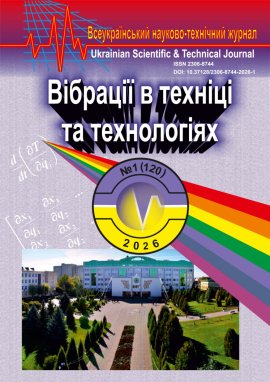
Issue №: 1(120)
The journal deals with the problems of vibration technologies and machines, mathematical methods of vibration process studies, information on design and technological development, presents teaching and methodological aspects of teaching in the Higher School of Applied Sciences, where vibration machines and technologies are studied.
MODELING THE INFLUENCE OF ULTRASONIC CAVITATION MODES ON THE QUALITY OF THE FAT PHASE IN HEMP-BASED BEVERAGE TECHNOLOGY
Bernyk Iryna – Doctor of Technical Sciences, Professor of the Department of Processes and Equipment for Processing of Agricultural Products, National University of Life and Environmental Sciences of Ukraine (12-B Heroiv Oborony St., Kyiv, 03040, Ukraine, e-mail: iryna_bernyk@ukr.net), https://orcid.org/0000-0002-1367-3058
Drachuk Ihor – PhD Student in Food Technology (Specialty 181), Department of Processes and Equipment for Processing of Agricultural Products, National University of Life and Environmental Sciences of Ukraine (12-B Heroiv Oborony St., Kyiv, 03040, Ukraine, e-mail: igor_drachyk000@ukr.net), https://orcid.org/0000-0003-0018-2871
The relevance of this study is determined by the need to control sonochemical processes in order to prevent excessive oxidative reactions in the lipid phase during ultrasonic stabilization of dispersed systems based on hemp seeds. It is well known that ultrasonic treatment can simultaneously enhance dispersion and intensify oxidation processes, which may negatively affect the quality of the final product. The chemical stability of the lipid phase is one of the key indicators of the quality of plant-based beverages, particularly in terms of total oxidation.
The aim of the study is to develop a mathematical model describing the influence of ultrasonic processing parameters on the total oxidation index of the lipid phase of an emulsion obtained from hemp seeds of the Glesia variety. To achieve this objective, a full-factorial experimental design of the 2³ type based on the Box–Wilson method was applied, which enabled the derivation of quadratic regression equations. The main factors considered in the study were ultrasonic power, specific energy input, and medium temperature. The adequacy of the developed model was verified using the Fisher criterion, confirming its statistical reliability and predictive capability.
The results indicate that temperature is the most significant factor affecting the oxidation intensity, while ultrasonic power has the least relative influence within the studied parameter range. It was established that the total oxidation index does not exceed 10 units, which meets the requirements for high-quality lipid phases and indicates the absence of critical degradation processes.
Rational ranges of ultrasonic processing parameters were determined, ensuring an optimal balance between the stability of the dispersed system and the preservation of lipid phase quality, namely a temperature range of 26–35 °C and a specific energy input of 200–350 kJ/kg. The obtained results can be used to substantiate technological regimes for the production of plant-based beverages from hemp seeds, predict their shelf life, and improve the efficiency of food processing technologies.
1. Daryani, D., Pegua, K., & Aryaa, S. S. (2024). Review of plant-based milk analogue: its preparation, nutritional, physicochemical, and organoleptic properties. Food Science and Biotechnology, 33(5), 1059–1073. https://doi.org/10.1007/s10068-023-01482-z in English
2. Asif, N., Anwar, O., Arif, S., et al. (2026). The rise of plant-based milk alternatives: exploring nutritional, health, and sustainability impacts. Food Chemistry: X, 34, Article 103528. https://doi.org/10.1016/j.fochx.2026.103528 in English
3. Kubatko, O., Merritt, R., Duane, S., & Piven, V. (2023). The impact of the COVID-19 pandemic on global food system resilience. Mechanisms of Economic Regulation, 1(99), 144–148. https://doi.org/10.32782/mer.2023.99.22 in English
4. Bernyk, I. M., & Drachuk, I. O. (2025). Otsinka ta analiz metodiv otrymannia roslynnoho analoha moloka [Assessment and analysis of methods for obtaining a plant-based milk analogue]. Zdorovia liudyny i natsii, 3(3), 137–148. https://doi.org/10.31548/humanhealth.3.2025.137 [in Ukrainian].
5. Esposito, M., & Piazza, L. (2022). Ultrasound-assisted extraction of oil from hempseed (Cannabis sativa L.): Part 1. Journal of the Science of Food and Agriculture, 102(2), 732–739. https://doi.org/10.1002/jsfa.11404 in English
6. Bernyk, I. M., & Drachuk, I. O. (2026). Fizychna model formuvannia stabilnoi kharchovoi matrytsi konoplianoi emulsii za ultrazvukovoho kavitatsiinoho vplyvu [Physical model of forming a stable food matrix of hemp emulsion under ultrasonic cavitation]. Zdorovia liudyny i natsii, 4(1), 139–153. https://doi.org/10.31548/humanhealth.1.2026.139 [in Ukrainian].
7. Li, N., Wang, T., Yang, X., Qu, J., Wang, N., Wang, L., Yu, D., & Han, C. (2022). Effect of high-intensity ultrasonic treatment on the emulsion of hemp seed oil stabilized with hemp seed protein. Ultrasonics Sonochemistry, 86, Article 106021. https://doi.org/10.1016/j.ultsonch.2022.106021 in English
8. Astráin-Redín, L., Skipnes, D., Cebrián, G., Álvarez-Lanzarote, I., & Rode, T. M. (2023). Effect of the application of ultrasound to homogenize milk and the subsequent pasteurization by pulsed electric field, high hydrostatic pressure, and microwaves. Foods, 12(7), Article 1457. https://doi.org/10.3390/foods12071457 in English
9. Stepišnik Perdih, T., Zupanc, M., & Dular, M. (2019). Revision of the mechanisms behind oil-water (O/W) emulsion preparation by ultrasound and cavitation. Ultrasonics Sonochemistry, 51, 298–304. https://doi.org/10.1016/j.ultsonch.2018.10.003 in English
10. Luhovskyi, O., Zheliaskova, T., Zilinskyi, A., & Zheliaskov, V. (2024). Doslidzhennia ultrazvukovoi kavitatsiinoi obrobky moloka. Eksperymentalnyi pidkhid [Research on ultrasonic cavitation treatment of milk. Experimental approach]. Mechanics and Advanced Technologies, 8(1), 108–114. https://doi.org/10.20535/2521-1943.2024.8.1(100).298105 [in Ukrainian].
11. Quintero-Quiroz, J., Zuluaga-Arroyave, N., Valencia-Naranajo, A., Molina-Castillo, M. C., Varela-Garcia, N., Medina-Rodriguez, M., Martínez-Saldarriaga, J., & Henao-Rojas, J. C. (2026). Non-thermal hydrodynamic cavitation for surplus fruits and vegetables: Improved vitamin C and bioactive preservation. Foods, 15(2), Article 268. https://doi.org/10.3390/foods15020268 in English
12. Liu, Y., Boeren, S., Zhang, L., Zhou, P., & Hettinga, K. (2021). Ultrasonication retains more milk fat globule membrane proteins compared to equivalent shear-homogenization. Innovative Food Science & Emerging Technologies, 70, Article 102703. https://doi.org/10.1016/j.ifset.2021.102703 in English
13. Prempeh, N. Y. A., Nunekpeku, X., Murugesan, A., & Li, H. (2025). Ultrasound in the food industry: Mechanisms and applications for non-invasive texture and quality analysis. Foods, 14(12), Article 2057. https://doi.org/10.3390/foods14122057 in English
14. Demesa, A. G., Saavala, S., Pöysä, M., & Koiranen, T. (2024). Overview and toxicity assessment of ultrasound-assisted extraction of natural ingredients from plants. Foods, 13(19), Article 3066. https://doi.org/10.3390/foods13193066 in English
15. Ashokkumar, M., Bhaskaracharya, R., Kentish, S., Lee, J., Palmer, M., & Zisu, B. (2010). The ultrasonic processing of dairy products: An overview. Dairy Science & Technology, 90, 147–168. https://doi.org/10.1051/dst/2009044 in English
16. Luhovskyi, O. F., Movchaniuk, A. V., Bernyk, I. M., Shulha, A. V., & Hryshko, I. A. (2021). Aparatne zabezpechennia ultrazvukovykh kavitatsiinykh tekhnolohii: monohrafiia [Hardware support for ultrasonic cavitation technologies: a monograph]. KPI im. Ihoria Sikorskoho. [in Ukrainian].
17. Wang, W., Tasset, A., Pyatnitskiy, I., Mohamed, H. G., Taniguchi, R., Zhou, R., Rana, M., Lin, P., Capocyan, S. L. C., Bellamkonda, A., Chase Sanders, W., & Wang, H. (2022). Ultrasound triggered organic mechanoluminescence materials. Advanced Drug Delivery Reviews, 186, Article 114343. https://doi.org/10.1016/j.addr.2022.114343 in English
18. Bernyk, I. M., Nazarenko, I. I., & Luhovskyi, O. F. (2021). Doslidzhennia khvylovoho oporu ridynno-dyspersnykh seredovyshch v umovakh ultrazvukovoi kavitatsiinoi obrobky [Investigation of the wave resistance of liquid-dispersed media under conditions of ultrasonic cavitation treatment]. Mechanics and Advanced Technologies, 5(3), 351–358. https://doi.org/10.20535/2521-1943.2021.5.3.250180 [in Ukrainian].
19. Ganguly, M., Debraj, D., Mazumder, N., et al. (2024). Impact of ultrasonication on the oxidative stability of oil-in-water nanoemulsions: Investigations into kinetics and strategies to control lipid oxidation. Industrial & Engineering Chemistry Research, 63(23), 10212–10225. https://doi.org/10.1021/acs.iecr.4c00506 in English
20. Mierez, J., AlTammar, M. J., Alruwaili, K. M., & Alfaraj, R. T. (2024). Recent advances of ultrasound applications in the oil and gas industry. Ultrasonics Sonochemistry, 103, Article 106767. https://doi.org/10.1016/j.ultsonch.2024.106767 in English
21. Jiang, L., Gao, L., Wang, W., et al. (2025). Kinetic study of triolein oxidation to generate α-dicarbonyl compounds promoted by high-intensity ultrasound using multi-response kinetic models. Food Chemistry, 496(2), Article 146786. https://doi.org/10.1016/j.foodchem.2025.146786 in English
22. Halim, H. H., & Thoo, Y. Y. (2018). Effect of ultrasound treatment on oxidative stability of sunflower oil and palm oil. International Food Research Journal, 25(5), 1959–1967. in English
23. Halvorsen, B. L., & Blomhoff, R. (2011). Determination of lipid oxidation products in vegetable oils and marine omega-3 supplements. Food & Nutrition Research, 55. https://doi.org/10.3402/fnr.v55i0.5792 in English
24. Bahramian, B., Ronizi, Z. K., Hashemi, M., et al. (2025). The effect of ultrasound process on the extraction yield and the quality of edible oils. Applied Food Research, 5(2), Article 101268. https://doi.org/10.1016/j.afres.2025.101268 in English
25. Tura, M., Ansorena, D., Astiasarán, I., Mandrioli, M., & Toschi, T. G. (2022). Evaluation of hemp seed oils stability under accelerated storage test. Antioxidants, 11(3), Article 490. https://doi.org/10.3390/antiox11030490 in English
26. Li, K., Li, Y., Liu, C.-L., Fu, L., Zhao, Y.-Y., Zhang, Y.-Y., Wang, Y.-T., & Bai, Y.-H. (2020). Improving interfacial properties, structure and oxidative stability by ultrasound application to sodium caseinate prepared pre-emulsified soybean oil. LWT, 131, Article 109755. https://doi.org/10.1016/j.lwt.2020.109755 in English
27. Ma, S., Yang, X., Zhao, C., & Guo, M. (2018). Ultrasound-induced changes in structural and physicochemical properties of β-lactoglobulin. Food Science & Nutrition, 6(4), 1053–1064. https://doi.org/10.1002/fsn3.646 in English
About the journal
The journal "Vibrations in Engineering and Technologies" is included in the list of technical scientific publications of Ukraine
(Category "B", Order of the Ministry of Education and Science of Ukraine dated July 2, 2020 No. 886)
Old version of the site: http://vibrojournal.vsau.edu.ua/
The journal "Vibrations in Engineering and Technology" is indexed by the following databases and catalogs:





The certificateof massmedia State registration:kv no 16643-5115 from 30.04.2010 .
Founder of the journal: Vinnytsia National Agrarian University
The journal is devoted to highlighting current issues in engineering, mechanical engineering, and technological processes, including the study of dynamic and oscillatory phenomena in technical systems, the application of mathematical methods for process modeling and analysis, as well as the presentation of results of design-engineering and technological developments. Particular attention is given to the study of vibration processes and their application in modern technologies.
The purpose of the scientific journal “Vibrations in Engineering and Technologies” is to disseminate the results of fundamental and applied research in the field of engineering sciences aimed at developing theoretical foundations and practical approaches to the design, analysis, and improvement of machines, materials, and technological processes, including the use of vibration and oscillatory effects in various sectors of production.
The publication is focused on the formation of a modern scientific and informational environment for the effective exchange of research results, support of innovative development, and implementation of advanced technical solutions in industry, agro-industrial production, and related fields.
The journal promotes the development of interdisciplinary research, the integration of modern engineering approaches, and the enhancement of the efficiency of technological processes and technical systems, including through the rational use of vibration phenomena.
Objectives of the Scientific Journal
To achieve its stated purpose, the journal addresses the following key objectives:
dissemination of results of fundamental and applied scientific research in the fields of mechanics, mechanical engineering, technological processes, machine dynamics, and equipment, as well as in areas related to the application of vibration phenomena in engineering and technologies;
promotion of research aimed at the creation and improvement of machines, mechanisms, and technological equipment based on oscillatory and vibration processes;
support for the implementation of modern technological solutions focused on improving productivity, energy efficiency, and reliability of technical systems;
обеспечение scientific exchange of research results among research institutions, higher education establishments, and industrial enterprises;
development of interdisciplinary cooperation among researchers in the fields of mechanics, materials science, material processing technologies, and automation of technological processes;
dissemination of modern scientific achievements and advanced technologies related to the application of vibration processes in production and technical systems.
Publisher Vinnytsia National Agrarian University
In June 1994 the 2nd International Scientific and Technical Conference "Application of vibrations for technological purposes" was organized on the basis of Vinnytsia State Agricultural Institute. Leading experts in this field, noting the significant contribution to the school of Vibration Engineering under the leadership of P. S. Bernyk, proposed to create a professional all-Ukrainian scientific and technical journal "Vibration in engineering and technology..The journal was foundedat Vinnytsia State Agricultural Institute and P.S. Bernyk was elected to be the chief editor .
For all these years (since 1994) theJournal "vibration in engineering and technology" published 119 issues wherestudy of vibration effects, the creation of progressive energy saving technologies and equipment for their implementation were highlighted.
Currently Ihor Kupchuk, Candidate of Technical Sciences, Associate professor, Associate Professor of the Department of Engineering Mechanics and Technological Processes in the Agricultural Industry Faculty of Engineering and Technology Vinnytsia National Agrarian University is the chief editor of the "Vibrations in engineering and Technology"
The journal "Vibration in Engineering and technology", which has no analogues on the territory of Ukraine, is well known abroad.
