

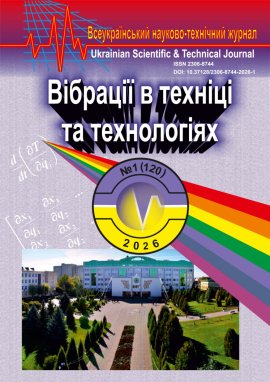
Issue №: 1(120)
The journal deals with the problems of vibration technologies and machines, mathematical methods of vibration process studies, information on design and technological development, presents teaching and methodological aspects of teaching in the Higher School of Applied Sciences, where vibration machines and technologies are studied.
DEVELOPMENT OF LITHIUM ENERGY STORAGE SYSTEMS FOR ENGINES AND POWER PLANTS
Chervinskyi Leonid Doctor of Technical Sciences, Professor Profesor of Department of Electrical Engineering, Electromechanics and Electrical Technology, National University of Life Resources and Environmental Sciences of Ukraine (35b John McCain St., apt. 28, Kyiv, 01042, Ukraine) email: lchervinsky@nubip.edu.ua), https://orcid.org/0000-0001-7215-2474
Lysikov Oleksandr PhD student of Department of Electrical Engineering, Electromechanics and Electrical Technology, National University of Life Resources and Environmental Sciences of Ukraine .email: alexlysikov2@gmail.com
The article examines the stages of formation, the current state, and the development trends of lithium-based electrical energy storage systems as components of engines, power plants, technological machines, and transport vehicles. The prerequisites for the widespread implementation of lithium battery systems in mechanical engineering are analyzed, driven by increasing requirements for energy efficiency, reliability, dynamic performance, and operational flexibility of electric drives and power systems. The main operational parameters of lithium batteries are substantiated, including specific energy, specific power, cycle life, permissible operating temperature ranges, charging rate, and fire and explosion safety indicators, which determine the effectiveness of their application in engines and power plants of various purposes. A comparative analysis of the main types of lithium batteries is presented according to key technical characteristics and fields of application in vehicles, technological equipment, and autonomous power plants. The influence of energy storage system parameters on electric motor operating modes, energy recuperation processes, load stabilization, and improvement of the overall efficiency of mechanical engineering systems is shown. It is established that the prospects for further development of lithium energy storage systems are associated with improving energy performance, safety level, durability, and environmental friendliness. Particular attention is paid to the analysis of promising technological solutions, including solid-state battery systems, cathode materials with reduced cobalt content, silicon anodes, and fast-charging technologies. It is confirmed that further improvement of lithium batteries is one of the key directions in the development of modern engines and power plants for mechanical engineering applications.
1. Schill, W.-P., & Zerrahn, A. (2018). Long-run power storage requirements for high shares of renewables: Results and sensitivities. Renewable and Sustainable Energy Reviews, 83, 156–171. https://doi.org/10.1016/j.rser.2017.05.205.
2. Augustine, Chad, and Nate Blair. Energy Storage Futures Study: Storage Technology Modeling Input Data Report. Golden, CO: National Renewable Energy Laboratory. NREL/TP-5700-78694. URL: https://www.nrel.gov/docs/fy21osti/78694.pdf.
3. Saraieva I.H. Analysis of operational characteristics of lithium-ion batteries in transport systems. Bulletin of KhNADU. 2019. Issue 86. pp. 112–118.
4. Buryk M.P., Lobodzynskyi V.V. (2021) Investigation of degradation of LiFePO₄ batteries in traction electric drives. Bulletin of Vinnytsia National Technical University. No. 4. pp. 45–52.
5. Olefir V.M. (2018) Energy storage systems for renewable and transport energy. Renewable Energy. No. 3. pp. 26–34.
6. Kryvenko M.O. (2020) Influence of charging modes on the lifetime of lithium-ion batteries. Electrical Engineering and Electromechanics. No. 6. pp. 38–44.
7. Poliakov O.I., Shevchenko D.M. (2017) Safety of operation of lithium-ion batteries in backup power supply systems. Scientific Bulletin of NMU. No. 5. pp. 97–103.
8. Romaniuk V.A. (2022) Prospects of solid-state lithium batteries for power plants. Bulletin of Lviv Polytechnic National University. No. 915. pp. 54–61.
9. Kuznietsov V.H. (2019) Battery management systems in electric transport. Bulletin of KPI. Electrical Engineering Series. No. 2. pp. 21–27.
10. Goodenough J.B., Park K.S. (2013) The Li-ion rechargeable battery: A perspective. Journal of the American Chemical Society.. DOI: 10.1021/ja3091438.
11. Yoshino A. (2018) Development of the lithium-ion battery and recent technological trends. Chemical Record. DOI: 10.1002/tcr.201700028.
12. Tarascon J.M., Armand M. (2001) Issues and challenges facing rechargeable lithium batteries. Nature. DOI: 10.1038/35104644.
13. Nitta N., Wu F., Lee J., Yushin G. (2015) Li-ion battery materials: present and future. Materials Today. DOI: 10.1016/j.mattod.2014.10.040.
14. Lee M., Lee S., Oh P., Kim Y., Cho J. (2014) High performance LiMn₂O₄ cathode materials grown with epitaxial layered nanostructure for Li-ion batteries. Nano Letters. DOI: 10.1021/nl404596p.
15. Horiba T. (2014) Lithium-ion battery systems. Proceedings of the IEEE. Vol. 102. No. 6. pp. 939–950. DOI: 10.1109/JPROC.2014.2319832.
16. Amin A., Ismail K., Hapid A. (2018) Implementation of a LiFePO₄ battery charger for cell balancing application. Journal of Mechatronics, Electrical Power, and Vehicular Technology. Vol. 9. No. 2. pp. 81–88. DOI: 10.14203/j.mev.2018.v9.81-88.
17. Shen W., Vo T.T., Kapoor A. (2012) Charging algorithms of lithium-ion batteries: An overview. Proceedings of the 7th IEEE Conference on Industrial Electronics and Applications.. pp. 1567–1572. DOI: 10.1109/ICIEA.2012.6360973.
18. Kai W., Xiao F., Jinbo P., Jun R., Chongxiong D., Liwei L. (2020) State of charge estimation of lithium-ion battery based on adaptive square root unscented Kalman filter. International Journal of Electrochemical Science. Vol. 15. No. 9. pp. 9499–9516. DOI: 10.20964/2020.09.84.
19. Wu Q., Zhang B., Lu Y. (2022) Progress and perspective of high-voltage lithium cobalt oxide in lithium-ion batteries. Journal of Energy Chemistry. Vol. 74. pp. 283–308. DOI: 10.1016/j.jechem.2022.06.015.
20. Camargos P.H., dos Santos P.H., dos Santos I.R., Ribeiro G.S., Caetano R.E. (2022) Perspectives on Li-ion battery categories for electric vehicle applications. International Journal of Energy Research. Vol. 46. pp. 19258–19268. DOI: 10.1002/er.8393.
21. Tahir M.U., Sangwongwanich A., Stroe D., Blaabjerg F. (2023) Optimized multi-stage constant current charging strategy for Li-ion batteries. Proceedings of the 25th European Conference on Power Electronics and Applications. pp. 1–9. DOI:10.23919/EPE23ECCEEurope.2023.10123456.
22. Smyrnov O.P., Borysenko A.O., Marchenko A.V. (2019) Diagnostics of high-voltage traction battery of the Nissan Leaf electric vehicle. Vehicle and Electronics. Innovative Technologies.. Vol. 16. pp. 19–25. DOI: 10.30977/VEIT.2019.16.0.19.
23. Plett G.L. (2004) Extended Kalman filtering for battery management systems of LiPB-based HEV battery packs. Part 1. Background. Journal of Power Sources.. Vol. 134. pp. 252–261. DOI: 10.1016/j.jpowsour.2004.02.031.
24. Zhang S.S. (2006) The effect of the charging protocol on the cycle life of a Li-ion battery. Journal of Power Sources. Vol. 161. pp. 1385–1391. DOI: 10.1016/j.jpowsour.2006.06.040.
25. Berecibar M., Gandiaga I., Villarreal I., Omar N., Van Mierlo J., Van den Bossche P. (2016) Critical review of state of health estimation methods of Li-ion batteries for real applications. Renewable and Sustainable Energy Reviews. Vol. 56. pp. 572–587. DOI: 10.1016/j.rser.2015.11.042.
About the journal
The journal "Vibrations in Engineering and Technologies" is included in the list of technical scientific publications of Ukraine
(Category "B", Order of the Ministry of Education and Science of Ukraine dated July 2, 2020 No. 886)
Old version of the site: http://vibrojournal.vsau.edu.ua/
The journal "Vibrations in Engineering and Technology" is indexed by the following databases and catalogs:





The certificateof massmedia State registration:kv no 16643-5115 from 30.04.2010 .
Founder of the journal: Vinnytsia National Agrarian University
The journal is devoted to highlighting current issues in engineering, mechanical engineering, and technological processes, including the study of dynamic and oscillatory phenomena in technical systems, the application of mathematical methods for process modeling and analysis, as well as the presentation of results of design-engineering and technological developments. Particular attention is given to the study of vibration processes and their application in modern technologies.
The purpose of the scientific journal “Vibrations in Engineering and Technologies” is to disseminate the results of fundamental and applied research in the field of engineering sciences aimed at developing theoretical foundations and practical approaches to the design, analysis, and improvement of machines, materials, and technological processes, including the use of vibration and oscillatory effects in various sectors of production.
The publication is focused on the formation of a modern scientific and informational environment for the effective exchange of research results, support of innovative development, and implementation of advanced technical solutions in industry, agro-industrial production, and related fields.
The journal promotes the development of interdisciplinary research, the integration of modern engineering approaches, and the enhancement of the efficiency of technological processes and technical systems, including through the rational use of vibration phenomena.
Objectives of the Scientific Journal
To achieve its stated purpose, the journal addresses the following key objectives:
dissemination of results of fundamental and applied scientific research in the fields of mechanics, mechanical engineering, technological processes, machine dynamics, and equipment, as well as in areas related to the application of vibration phenomena in engineering and technologies;
promotion of research aimed at the creation and improvement of machines, mechanisms, and technological equipment based on oscillatory and vibration processes;
support for the implementation of modern technological solutions focused on improving productivity, energy efficiency, and reliability of technical systems;
обеспечение scientific exchange of research results among research institutions, higher education establishments, and industrial enterprises;
development of interdisciplinary cooperation among researchers in the fields of mechanics, materials science, material processing technologies, and automation of technological processes;
dissemination of modern scientific achievements and advanced technologies related to the application of vibration processes in production and technical systems.
Publisher Vinnytsia National Agrarian University
In June 1994 the 2nd International Scientific and Technical Conference "Application of vibrations for technological purposes" was organized on the basis of Vinnytsia State Agricultural Institute. Leading experts in this field, noting the significant contribution to the school of Vibration Engineering under the leadership of P. S. Bernyk, proposed to create a professional all-Ukrainian scientific and technical journal "Vibration in engineering and technology..The journal was foundedat Vinnytsia State Agricultural Institute and P.S. Bernyk was elected to be the chief editor .
For all these years (since 1994) theJournal "vibration in engineering and technology" published 119 issues wherestudy of vibration effects, the creation of progressive energy saving technologies and equipment for their implementation were highlighted.
Currently Ihor Kupchuk, Candidate of Technical Sciences, Associate professor, Associate Professor of the Department of Engineering Mechanics and Technological Processes in the Agricultural Industry Faculty of Engineering and Technology Vinnytsia National Agrarian University is the chief editor of the "Vibrations in engineering and Technology"
The journal "Vibration in Engineering and technology", which has no analogues on the territory of Ukraine, is well known abroad.
