

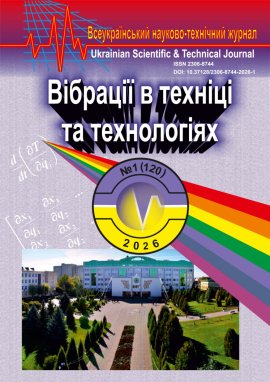
Issue №: 1(120)
The journal deals with the problems of vibration technologies and machines, mathematical methods of vibration process studies, information on design and technological development, presents teaching and methodological aspects of teaching in the Higher School of Applied Sciences, where vibration machines and technologies are studied.
DETERMINATION OF MODES, PARAMETERS AND RELIABILITY OF VIBRATING PLATE OPERATION IN ROAD CONSTRUCTION
Zaprivoda Andriy – candidate of technical sciences, associate professor, head of the department of automation of technological processes of the Kyiv National University of Construction and Architecture (Air Force Avenue,. Kyiv, 31, m. Kyiv, 03037 Ukraine, 03040, e-mail: andzap87@gmail.com, https://orcid.org/0000-0001-9171-9325
Nechiporuk Viktor – graduate student of the Department of Machines and Equipment of Technological Processes, Kyiv National University of Construction and Architecture, pr. Air Force, 31, m. Kyiv, Ukraine, 03037 E-mail: Nikky47@ukr.net, https://orcid.org/0009-0003-8091-2420
Modern road construction places extremely high demands on the quality and durability of concrete pavements, which directly depends on the technical condition and reliability of the working bodies of a number of construction equipment. An important place is occupied by pavers, which significantly determine the quality of the initial stage of roadbed formation. Among the functional units of pavers, an important role belongs to vibrating plates. Their modes, parameters and reliability are considered as an integral property that should ensure high-quality compaction and a given reliability of the established period of operation. At the same time, existing calculations are based on empirical or semi-empirical dependencies of the interaction of working bodies and processing environments. As a result, the real modes and parameters do not fully correspond to the calculated ones, which leads to a poor-quality result of the mixture compaction, an increase in the duration of the process and premature failure of the parts of the vibrating plates. This is due to the complexity of the processes occurring in the “machine - environment” system and the lack of a generally accepted calculation model that adequately reflects the real process. In the work, the solution to the problem is determined by the following hypotheses. The use of a comprehensive and systematic approach to considering the calculation model “machine - environment” as discrete - continuous, taking into account the mutual influence of these subsystems among themselves. And the determination of the reliability of the working life cycle of the vibrating plate is carried out on the basis of the energy hypothesis, which allows taking into account not only the operating time, but also the intensity of the load. Based on these hypotheses, the goal of the work is formulated, which is to determine the rational technological and energy parameters of the compaction processes and predict the service maintenance of parts and the vibrating plate as a whole. The results obtained open up possibilities for use in the design and creation of effective vibrating plates and similar vibrating machines
1. Maslov O. G., Salenko Yu. S., Maslova N. A. Research on the interaction of a vibrating plate with a cement-concrete mixture. Bulletin of the Mykhailo Ostrogradsky Kyiv National University. Issue 2/2011 (67). Part 1, p. 93-98
2. Nesterenko M.P.and others. Vibration platform for forming large-sized reinforcedconcrete products // Naukovyi Visnyk Natsionalnoho Hirnychoho Universytetu, 2019, No. 5. – P. 284 – 288.
3. Oryshchenko S.V. Theoretical studies and determination of the main stages of the movement of a vibrating screen. Construction technology. – 2010. – No. 24. – P. 44–47.
4. Ruchinsky M.M., Svyrydyuk D.Ya. Research of vibrations of a vibrating concrete mixer taking into account the influence of the transported material. Construction Engineering. Scientific and Technical Journal. Kyiv: KNUBA, 2013. No. 31. pp. 35–42
5. Nazarenko I.I. Applied problems of the theory of vibration systems: Textbook (2nd edition): – K.: Publishing House “Slovo”, 2010. – 440 p.
6. Nazarenko I., Zapryvoda A., Bondarenko A., Slyusar V. Determination of energy parameters of vibrating machines for compaction and formation of concrete products according to different power form of load. Strength of Materials and Theory of Structures. 2024. No. 113. pp. 18–28.
7. Viktor Nechyporuk, Serhiy Oryshchenko. Modern methods of machine diagnostics. Collection of scientific works “Construction Engineering”. 2025. No. 43. P.26–39.
8. Andriy Zaprivoda. Research on energy dissipation using a discrete-continuous model of a two-place vibration system. "Construction Technology". 2024. No. 40. P.41–52.
9. Investigation on asphalt-screed interaction during pre-compaction: Improving paving effect via numerical simulation / C. Wang and others. Construction and Building Materials. 2021. Т. 289. С. 123164. URL: https://doi.org/10.1016/j.conbuildmat.2021.123164.
10. Shi Y., Liu H., Wang G. Modeling of asphalt mixture-screed interaction: A nonlinear dynamic vibration model for improving paving density. Construction and Building Materials. 2021. Т. 311. С. 125296. URL: https://doi.org/10.1016/j.conbuildmat.2021.125296.
11. Liem N. V., Wang P., Zhang J. Experimental research and optimal control of vibration screed system (VSS) based on fuzzy control. Journal of Vibroengineering. 2020. Т. 22, № 6. С. 1415–1426.URL: https://doi.org/10.21595/jve.2020.21560
12.Vibration Analysis and Modeling of an Off-Road Vibratory Roller Equipped with Three Different Cab’s Isolation Mounts / V. Nguyen and others. Shock and Vibration. 2018. Т. 2018. С. 1–17.URL: https://doi.org/10.1155/2018/8527574
13.Study on paving compactness detection based on frequency domain characteristics of screed device vibration signal / Q. Luo and others. Construction and Building Materials. 2024. Т. 432. С. 136652. URL: https://doi.org/10.1016/j.conbuildmat.2024.136652
14 Harries L., Böhm S. Influence of the Shear Process on the Compaction Success and Friction Behavior During Asphalt Paving. International Journal of Pavement Research and Technology. 2023. URL: https://doi.org/10.1007/s42947-022-00265-9
15. Kamei K., Khan M. A. Current challenges in modelling vibrational fatigue and fracture of structures: a review. Journal of the Brazilian Society of Mechanical Sciences and Engineering. 2021. Vol. 43, no. 2. URL: https://doi.org/10.1007/s40430-020-02777-6
16. A discrete element simulation study of paver screed and hot mix asphalt interaction https://pmc.ncbi.nlm.nih.gov/articles/PMC12059008/ (дата звернення 10 лютого 2026 року).
About the journal
The journal "Vibrations in Engineering and Technologies" is included in the list of technical scientific publications of Ukraine
(Category "B", Order of the Ministry of Education and Science of Ukraine dated July 2, 2020 No. 886)
Old version of the site: http://vibrojournal.vsau.edu.ua/
The journal "Vibrations in Engineering and Technology" is indexed by the following databases and catalogs:





The certificateof massmedia State registration:kv no 16643-5115 from 30.04.2010 .
Founder of the journal: Vinnytsia National Agrarian University
The journal is devoted to highlighting current issues in engineering, mechanical engineering, and technological processes, including the study of dynamic and oscillatory phenomena in technical systems, the application of mathematical methods for process modeling and analysis, as well as the presentation of results of design-engineering and technological developments. Particular attention is given to the study of vibration processes and their application in modern technologies.
The purpose of the scientific journal “Vibrations in Engineering and Technologies” is to disseminate the results of fundamental and applied research in the field of engineering sciences aimed at developing theoretical foundations and practical approaches to the design, analysis, and improvement of machines, materials, and technological processes, including the use of vibration and oscillatory effects in various sectors of production.
The publication is focused on the formation of a modern scientific and informational environment for the effective exchange of research results, support of innovative development, and implementation of advanced technical solutions in industry, agro-industrial production, and related fields.
The journal promotes the development of interdisciplinary research, the integration of modern engineering approaches, and the enhancement of the efficiency of technological processes and technical systems, including through the rational use of vibration phenomena.
Objectives of the Scientific Journal
To achieve its stated purpose, the journal addresses the following key objectives:
dissemination of results of fundamental and applied scientific research in the fields of mechanics, mechanical engineering, technological processes, machine dynamics, and equipment, as well as in areas related to the application of vibration phenomena in engineering and technologies;
promotion of research aimed at the creation and improvement of machines, mechanisms, and technological equipment based on oscillatory and vibration processes;
support for the implementation of modern technological solutions focused on improving productivity, energy efficiency, and reliability of technical systems;
обеспечение scientific exchange of research results among research institutions, higher education establishments, and industrial enterprises;
development of interdisciplinary cooperation among researchers in the fields of mechanics, materials science, material processing technologies, and automation of technological processes;
dissemination of modern scientific achievements and advanced technologies related to the application of vibration processes in production and technical systems.
Publisher Vinnytsia National Agrarian University
In June 1994 the 2nd International Scientific and Technical Conference "Application of vibrations for technological purposes" was organized on the basis of Vinnytsia State Agricultural Institute. Leading experts in this field, noting the significant contribution to the school of Vibration Engineering under the leadership of P. S. Bernyk, proposed to create a professional all-Ukrainian scientific and technical journal "Vibration in engineering and technology..The journal was foundedat Vinnytsia State Agricultural Institute and P.S. Bernyk was elected to be the chief editor .
For all these years (since 1994) theJournal "vibration in engineering and technology" published 119 issues wherestudy of vibration effects, the creation of progressive energy saving technologies and equipment for their implementation were highlighted.
Currently Ihor Kupchuk, Candidate of Technical Sciences, Associate professor, Associate Professor of the Department of Engineering Mechanics and Technological Processes in the Agricultural Industry Faculty of Engineering and Technology Vinnytsia National Agrarian University is the chief editor of the "Vibrations in engineering and Technology"
The journal "Vibration in Engineering and technology", which has no analogues on the territory of Ukraine, is well known abroad.
