

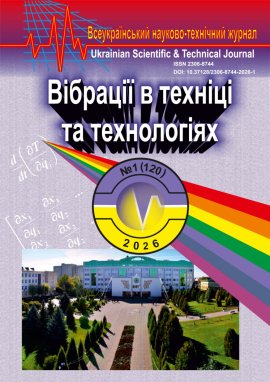
Issue №: 1(120)
The journal deals with the problems of vibration technologies and machines, mathematical methods of vibration process studies, information on design and technological development, presents teaching and methodological aspects of teaching in the Higher School of Applied Sciences, where vibration machines and technologies are studied.
DESCRIPTOR-BASED APPROACH TO THE DESCRIPTION OF FEED MATERIAL MIXING PROCESSES
Kupchuk Ihor – Candidate of Technical Sciences, Associate professor, Associate Professor of the Department of Engineering Mechanics and Technological Processes in the Agricultural Industry, Faculty of Engineering and Technology, Vinnytsia National Agrarian University (3, Sonychna St., Vinnytsia, 21008, Ukraine, e-mail: kupchuk.igor@i.ua; http://orcid.org/0000-0002-2973-6914).
The article proposes a systemic descriptor-based approach to describing the mixing processes of multicomponent feed materials, within which the process is interpreted as the evolution of a state in a multidimensional space of physically interpretable coordinates. The relevance of the study is determined by the complex rheological nature of feed mixtures, which combine frictional, cohesive, fibrous, and viscoplastic components characterized by spatial and temporal heterogeneity of stress–strain states. The traditional mechanistic description through individual mixing mechanisms does not provide a coherent coordinate-based language for analyzing process regimes and transitions between them.
The aim of the research is to establish a generalized state space of the mixing process and to structure the interrelationships between descriptors as coordinates of this space. The methodological foundation of the research includes conceptual modeling, structural-logical analysis, and physical interpretation of constraints arising from the mechanics of granular and viscoplastic media. The process state is represented as a vector of descriptors D₁-D₉, grouped into four functional blocks: material–microstructural, deformation–energetic, flow–topological, and evolutionary–stabilization.
It is shown that mixing regimes should be interpreted as subregions of an admissible state space formed with consideration of physical, rheological, and structural–topological constraints. Three types of structural relationships between descriptors are identified: physical incompatibility, conditional dominance, and hierarchical subordination. The combined effect of these relationships shapes the internal geometry of the state space, determines the stratification of regime domains, and defines the admissibility of coordinate combinations. It is substantiated that the “narrowing” of the space of possible states is a consequence of the physical properties of the material medium rather than a formal modeling assumption.
The proposed approach enables a transition from an empirically oriented description of the mixing process to its systemic interpretation as a structured set of physically admissible states. This provides a methodological basis for further quantitative parameterization of process evolution, the development of regime stability criteria, and the optimization of operating modes of mixing apparatuses of various design types.
1. Paul, E. L., Atiemo-Obeng, V. A., & Kresta, S. M. (2004). Handbook of industrial mixing: Science and practice. John Wiley & Sons. https://doi.org/10.1002/0471451452
2. Ottino, J. M., & Khakhar, D. V. (2000). Mixing and segregation of granular materials. Annual Review of Fluid Mechanics, 32, 55–91. https://doi.org/10.1146/annurev.fluid.32.1.55
3. Khakhar, D. V., McCarthy, J. J., & Ottino, J. M. (1999). Mixing and segregation of granular materials in chute flows. Chaos, 9(3), 594–610. https://doi.org/10.1063/1.166433
4. Marigo, M., & Stitt, E. (2015). Discrete Element Method (DEM) for industrial applications. KONA Powder and Particle Journal, 32, 236–252. https://doi.org/10.14356/kona.2015016
5. Bonn, D., Denn, M. M., Berthier, L., Divoux, T., & Manneville, S. (2017). Yield stress materials in soft condensed matter. Reviews of Modern Physics, 89(3), 035005. https://doi.org/10.1103/RevModPhys.89.035005
6. Kupchuk, I. (2025). Physical principles and classification of feed material mixing processes. Техніка, енергетика, транспорт АПК, (4(131)), 55–68. https://doi.org/10.37128/2520-6168-2025-4-6
7. Ottino, J. M. (1989). The kinematics of mixing: Stretching, chaos, and transport. Cambridge University Press.
8. Haken, H. (2004). Synergetics: Introduction and advanced topics. Springer. https://doi.org/10.1007/978-3-662-10184-1
9. Bertalanffy, L. (1973). General system theory: Foundations, development, applications. George Braziller.
10. Jaeger, H. M., Nagel, S. R., & Behringer, R. P. (1996). Granular solids, liquids, and gases. Reviews of Modern Physics, 68, 1259–1273. https://doi.org/10.1103/RevModPhys.68.1259
11. Forterre, Y., & Pouliquen, O. (2008). Flows of dense granular media. Annual Review of Fluid Mechanics, 40, 1–24. https://doi.org/10.1146/annurev.fluid.40.111406.102142
12. Schulze, D. (2021). Powders and bulk solids: Behavior, characterization, storage and flow. Springer. https://doi.org/10.1007/978-3-030-76720-4
13. Divoux, T., Fardin, M. A., Manneville, S., & Lerouge, S. (2016). Shear banding in complex fluids. Annual Review of Fluid Mechanics, 48, 81–103. https://doi.org/10.1146/annurev-fluid-122414-034416
14. Gray, J. M. N. T., & Thornton, A. R. (2005). A theory for particle size segregation in shallow granular free-surface flows. Proceedings of the Royal Society A: Mathematical, Physical and Engineering Sciences, 461, 1447–1473. https://doi.org/10.1098/rspa.2004.1420
15. Chhabra, R. P., & Richardson, J. F. (2008). Non-Newtonian flow and applied rheology (2nd ed.). Butterworth-Heinemann. https://doi.org/10.1016/B978-0-7506-8532-0.X0001-7
16. Polievoda, Yu. A., Volynets, Ye. O., & Bystrytskyi, O. P. (2022). Matematychna model rukhu chastynok v tsylindrychnomu konteineri vibrozmishuvacha [Mathematical model of particle motion in a cylindrical container of a vibratory mixer]. Vibrations in Engineering and Technology, (4(107)), 20–25. https://doi.org/10.37128/2306-8744-2022-4-3
17. Stadnik, M., Solona, O., & Burlaka, S. (2025). Doslidzhennia vplyvu heometrii robochykh orhaniv zmishuvacha na kinetiku zmishuvannia sypkykh seredovyshch [Investigation of the influence of working body geometry on the mixing kinetics of granular media]. Herald of Khmelnytskyi National University. Technical Sciences, (2(349)), 23–27. https://doi.org/10.31891/2307-5732-2025-349-2
18. Stadnik, M., Babyn, I., Luts, P., & Ripa, S. (2024). Analiz teoretychnykh doslidzhen prystroiv dozuvannia ta zmishuvannia zhyvylnykh rozchyniv [Analysis of theoretical studies of dosing and mixing devices for nutrient solutions]. Vibrations in Engineering and Technology, (3(114)), 90–96. https://doi.org/10.37128/2306-8744-2024-3-11
About the journal
The journal "Vibrations in Engineering and Technologies" is included in the list of technical scientific publications of Ukraine
(Category "B", Order of the Ministry of Education and Science of Ukraine dated July 2, 2020 No. 886)
Old version of the site: http://vibrojournal.vsau.edu.ua/
The journal "Vibrations in Engineering and Technology" is indexed by the following databases and catalogs:





The certificateof massmedia State registration:kv no 16643-5115 from 30.04.2010 .
Founder of the journal: Vinnytsia National Agrarian University
The journal is devoted to highlighting current issues in engineering, mechanical engineering, and technological processes, including the study of dynamic and oscillatory phenomena in technical systems, the application of mathematical methods for process modeling and analysis, as well as the presentation of results of design-engineering and technological developments. Particular attention is given to the study of vibration processes and their application in modern technologies.
The purpose of the scientific journal “Vibrations in Engineering and Technologies” is to disseminate the results of fundamental and applied research in the field of engineering sciences aimed at developing theoretical foundations and practical approaches to the design, analysis, and improvement of machines, materials, and technological processes, including the use of vibration and oscillatory effects in various sectors of production.
The publication is focused on the formation of a modern scientific and informational environment for the effective exchange of research results, support of innovative development, and implementation of advanced technical solutions in industry, agro-industrial production, and related fields.
The journal promotes the development of interdisciplinary research, the integration of modern engineering approaches, and the enhancement of the efficiency of technological processes and technical systems, including through the rational use of vibration phenomena.
Objectives of the Scientific Journal
To achieve its stated purpose, the journal addresses the following key objectives:
dissemination of results of fundamental and applied scientific research in the fields of mechanics, mechanical engineering, technological processes, machine dynamics, and equipment, as well as in areas related to the application of vibration phenomena in engineering and technologies;
promotion of research aimed at the creation and improvement of machines, mechanisms, and technological equipment based on oscillatory and vibration processes;
support for the implementation of modern technological solutions focused on improving productivity, energy efficiency, and reliability of technical systems;
обеспечение scientific exchange of research results among research institutions, higher education establishments, and industrial enterprises;
development of interdisciplinary cooperation among researchers in the fields of mechanics, materials science, material processing technologies, and automation of technological processes;
dissemination of modern scientific achievements and advanced technologies related to the application of vibration processes in production and technical systems.
Publisher Vinnytsia National Agrarian University
In June 1994 the 2nd International Scientific and Technical Conference "Application of vibrations for technological purposes" was organized on the basis of Vinnytsia State Agricultural Institute. Leading experts in this field, noting the significant contribution to the school of Vibration Engineering under the leadership of P. S. Bernyk, proposed to create a professional all-Ukrainian scientific and technical journal "Vibration in engineering and technology..The journal was foundedat Vinnytsia State Agricultural Institute and P.S. Bernyk was elected to be the chief editor .
For all these years (since 1994) theJournal "vibration in engineering and technology" published 119 issues wherestudy of vibration effects, the creation of progressive energy saving technologies and equipment for their implementation were highlighted.
Currently Ihor Kupchuk, Candidate of Technical Sciences, Associate professor, Associate Professor of the Department of Engineering Mechanics and Technological Processes in the Agricultural Industry Faculty of Engineering and Technology Vinnytsia National Agrarian University is the chief editor of the "Vibrations in engineering and Technology"
The journal "Vibration in Engineering and technology", which has no analogues on the territory of Ukraine, is well known abroad.
