

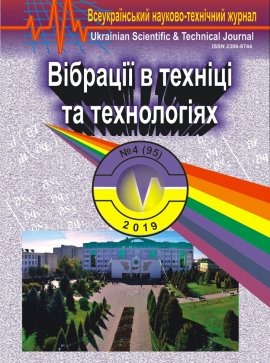
Issue №: 4(95)
The journal deals with the problems of vibration technologies and machines, mathematical methods of vibration process studies, information on design and technological development, presents teaching and methodological aspects of teaching in the Higher School of Applied Sciences, where vibration machines and technologies are studied.
PULSE BENDED BEAM WITH BINARY BOUNDARY CONDITIONS
Olshanskiy Vasyl Pavlovych – Doctor of Physical and Mathematical Sciences, Professor of the Department of Physics and Theoretical Mechanics, Petro Vasilenko Kharkiv National Technical University of Agriculture (44, Alchevskyi str., Kharkiv, Ukraine, 61002, e mail: OlshanskiyVP@gmail.com).
Burlaka Volodymyr Vasilovych – Candidate of Technical Sciences (Ph. D.), Associate Professor of the Department of Physics and Theoretical Mechanics, Petro Vasilenko Kharkiv National Technical University of Agriculture (44, Alchevskyi str., Kharkiv, Ukraine, 61002, e mail: Burlaka2V@ukr.net).
Slipchenko Maksym Volodymyrovych Candidate of Technical Sciences (Ph. D.), Associate Professor of the Department of Physics and Theoretical Mechanics, Petro Vasilenko Kharkiv National Technical University of Agriculture (44, Alchevskyi str., Kharkiv, Ukraine, 61002, e mail: Slipchenko_M@ukr.net).
A theoretical study of the movement of a beam with binary boundary conditions at a short-term pulsed load is carried out in the article. The non-stationary oscillations of the beam, caused by short-term force loading, are evenly distributed along its length. Beam movement is considered in two stages. It is assumed that the conditions for fixing the ends of the beam are associated with the direction (sign) of their rotation when the beam is bending. It is assumed that under the action of the load, the edges of the beam are rigidly clamped, that is, the angles of their rotation are equal to zero, and after unloading and changing the sign of the curvature of the beam they become pivotally supported in cylindrical hinges. According to the second boundary conditions, the free oscillation of the beam passes. Due to the use of the method of compensating loads, the analytical part of the isolation is expressed in rows of sines. Since the system has an asymmetric elastic characteristic with respect to the position of static equilibrium, the method of adding solutions is used to achieve this goal. As a result, the calculation is reduced to the numerical solution of the Volterra type integral equation on a computer. In addition, an approximation is proposed, which gives simpler calculation formulas than a piecewise linear approximation. The proposed approximation allows us to calculate the value of the boundary moments and obtain the formula for the beam deflections. Numerical analysis showed that for certain durations of force loading, the beam deflection amplitude with pinched edges in the direction of the external impulse is less than the deflection amplitude in the opposite direction during the movement of the unloaded beam with hinged edges. This dynamic effect is characteristic of systems with an asymmetric characteristic of elasticity, which occurs when a binary fixing of the edges of the beam or when it is supported by unilateral elastic supports. Formulas are derived by which it is possible to calculate the time when the effect of asymmetry will be most clearly expressed, and also in which case it will be absent. Numerical results confirming the adequacy of the proposed dependencies are presented.
1. Filippov, A. P., Kohmanyuk, S. S. & Yanyutin, E. G. (1978). Deformirovanie elementov konstruktsiy pod deystviem udarnyih i impulsnyih nagruzok. Naukova dumka..
2. Kohmanyuk S. S., et al. (1989). Dinamika konstruktsiy pri vozdeystvii kratkovremennyih nagruzok. Naukova dumka.
3. Starovoytov, E. I., Yarovaya, A. V. & Leonenko D. V. (2003). Lokalnyie i impulsnyie nagruzheniya trehsloynyih elementov konstruktsiy. Bel.GUT.
4. Olshanskyi, V. P. & Olshanskyi, S. V. (2018) Kolyvannia balky z binarnym zakriplenniam kraiv pry impulsnomu navantazhenni. Visnyk NTU «KhPI». Seriia: Matematychne modeliuvannia v tekhnitsi ta tekhnolohiiakh, No 27 (1303), 68ؘ-73.
5. Yanyutin, E. G., et al. (2004). Zadachi impulsnogo deformirovaniya elementov konstruktsiy. HNADU.
6. Smetankina, N. V. (2011) Nestatsionarnye deformirovanie, termouprugost i optimizatsiya mnogosloynyih plastin i tsilindricheskih obolochek. Miskdruk.
7. Olshanskiy, V. P., Tischenko, L. N. & Olshanskyi, S. V. (2012). Kolebaniya sterzhney i plastin pri mehanicheskom udare. Miskdruk.
8. Olshanskiy, V. P., & Olshanskyi, S. V. (2018) Deformuvannia impulsom balky, odnobichno pidkriplenoi pruzhnoju oporoju. Mekhanika ta mashynobuduvannia, No 1, 37-46.
About the journal
The journal "Vibrations in Engineering and Technologies" is included in the list of technical scientific publications of Ukraine
(Category "B", Order of the Ministry of Education and Science of Ukraine dated July 2, 2020 No. 886)
Old version of the site: http://vibrojournal.vsau.edu.ua/
The journal "Vibrations in Engineering and Technology" is indexed by the following databases and catalogs:





The certificateof massmedia State registration:kv no 16643-5115 from 30.04.2010 .
Founder of the journal: Vinnytsia National Agrarian University
The journal is devoted to highlighting current issues in engineering, mechanical engineering, and technological processes, including the study of dynamic and oscillatory phenomena in technical systems, the application of mathematical methods for process modeling and analysis, as well as the presentation of results of design-engineering and technological developments. Particular attention is given to the study of vibration processes and their application in modern technologies.
The purpose of the scientific journal “Vibrations in Engineering and Technologies” is to disseminate the results of fundamental and applied research in the field of engineering sciences aimed at developing theoretical foundations and practical approaches to the design, analysis, and improvement of machines, materials, and technological processes, including the use of vibration and oscillatory effects in various sectors of production.
The publication is focused on the formation of a modern scientific and informational environment for the effective exchange of research results, support of innovative development, and implementation of advanced technical solutions in industry, agro-industrial production, and related fields.
The journal promotes the development of interdisciplinary research, the integration of modern engineering approaches, and the enhancement of the efficiency of technological processes and technical systems, including through the rational use of vibration phenomena.
Objectives of the Scientific Journal
To achieve its stated purpose, the journal addresses the following key objectives:
dissemination of results of fundamental and applied scientific research in the fields of mechanics, mechanical engineering, technological processes, machine dynamics, and equipment, as well as in areas related to the application of vibration phenomena in engineering and technologies;
promotion of research aimed at the creation and improvement of machines, mechanisms, and technological equipment based on oscillatory and vibration processes;
support for the implementation of modern technological solutions focused on improving productivity, energy efficiency, and reliability of technical systems;
обеспечение scientific exchange of research results among research institutions, higher education establishments, and industrial enterprises;
development of interdisciplinary cooperation among researchers in the fields of mechanics, materials science, material processing technologies, and automation of technological processes;
dissemination of modern scientific achievements and advanced technologies related to the application of vibration processes in production and technical systems.
Publisher Vinnytsia National Agrarian University
In June 1994 the 2nd International Scientific and Technical Conference "Application of vibrations for technological purposes" was organized on the basis of Vinnytsia State Agricultural Institute. Leading experts in this field, noting the significant contribution to the school of Vibration Engineering under the leadership of P. S. Bernyk, proposed to create a professional all-Ukrainian scientific and technical journal "Vibration in engineering and technology..The journal was foundedat Vinnytsia State Agricultural Institute and P.S. Bernyk was elected to be the chief editor .
For all these years (since 1994) theJournal "vibration in engineering and technology" published 119 issues wherestudy of vibration effects, the creation of progressive energy saving technologies and equipment for their implementation were highlighted.
Currently Ihor Kupchuk, Candidate of Technical Sciences, Associate professor, Associate Professor of the Department of Engineering Mechanics and Technological Processes in the Agricultural Industry Faculty of Engineering and Technology Vinnytsia National Agrarian University is the chief editor of the "Vibrations in engineering and Technology"
The journal "Vibration in Engineering and technology", which has no analogues on the territory of Ukraine, is well known abroad.
