

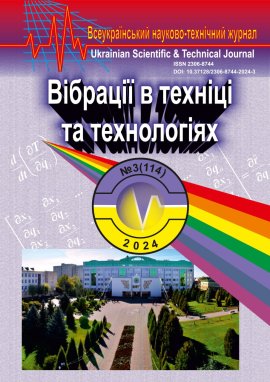
Issue №: 3(114)
The journal deals with the problems of vibration technologies and machines, mathematical methods of vibration process studies, information on design and technological development, presents teaching and methodological aspects of teaching in the Higher School of Applied Sciences, where vibration machines and technologies are studied.
MATHEMATICAL MODEL OF THE MOVEMENT OF TABLE BEET ROOT CROP ALONG THE SPIRALS OF A VIBRATING CLEANER
Holovach Ivan – Corresponding Member of the National Academy of Sciences of Ukraine, Doctor of Technical Sciences, Professor, Professor of the Department of Mechanics of the National University of Bioresources and Nature Management of Ukraine (15 Heroiv Oborony St., Kyiv, Ukraine, 03041; e-mail: holovach.iv@ gmail.com).
Solona Olena – Ph.D., Associate Professor, Dean of the Faculty of Production Technology, Processing and Robotics in Livestock Breeding of the Vinnytsia National Agrarian University (3, Sonyachna St., Vinnytsia, Ukraine, 21008, e-mail: solona_o_v@ukr.net).
Martynyuk Volodymyr – PhD student of the National University of Bioresources and Nature Management of Ukraine (15, Heroiv Oborony St., Kyiv, Ukraine, 03041).
A pressing issue in the technological process of table beet production is the cleaning of root crops from adhered soil, loose impurities, and plant residues after harvesting. The efficiency of this process significantly determines the quality of the final product, its suitability for long-term storage, and subsequent processing. Modern root crop cleaning technologies widely use mechanical methods, among which vibrational and spiral cleaning systems hold a special place. However, many existing designs have several shortcomings, such as insufficient impurity removal efficiency or an increased risk of root crop damage.
This study presents a new design of a vibrational spiral cleaner developed to enhance the efficiency of table beet root cleaning. A mathematical model of the root crop's movement along the working channel of the cleaner was constructed to analyze and optimize the operation of this design. It is during this movement that adhered soil, loose impurities, and plant residues are removed.
Based on the developed equivalent scheme, a system of differential equations describing the dynamics of the root crop's movement along the surface of the working channel was formulated. Numerical solutions of this system on a personal computer made it possible to study the influence of structural parameters (spiral geometry, pitch, and material) and kinematic parameters (vibration frequency and amplitude) on the speed of root crop movement and the cleaning quality. The analysis of the obtained results showed that optimizing the cleaner's parameters ensures uniform cleaning, reduces the likelihood of root crop damage, and increases the overall process efficiency.
The results of this research have practical significance for the further improvement of cleaner designs and their implementation in industrial technologies. The application of the proposed technical solutions will contribute to improving the cleaning quality of table beet root crops, enhancing production efficiency, and reducing equipment maintenance costs.
1. Misener, G.C. & McLeod, C.D. (1989). Resource efficient approach to potato-stone-clod separation. AMA, Agricultural Mechanization in Asia, Africa and Latin America. 20(2), 33–36. [in English]
2. Peters, R. (1997). Damage of potato tubers: A Review. Potato Research. 39(Spec. Issue), 479–484. [in English]
3. Veerman, A. & Wustman, R. (2005). Present state and future prospects of potato storage technology. Potato in Progress: Science Meets Practice, Book Chapter, 179–189. [in English]
4. Bishop, C., Rees, D., Cheema, M.U.A., Harper, G. & Stroud, G. (2012). Potatoes. Crop PostHarvest: Science and Technology: Perishables. Book Chapter, 179–189. [in English]
5. Ichiki, H., Nguyen Van, N. & Yoshinaga, K. (2013). Stone-clod separation and its application to potato in Hokkaido. Engineering in AgricultureEnvironment and Food. 6(2), 77–85. [in English]
6. Guo, W. & Campanella, O.H. (2017). A relaxation model based on the application of fractional calculus for describing the viscoelastic behavior of potato tubers. Transactions of the ASABE. 60(1), 259–264. [in English]
7. Bulgakov, V., Nikolaenko, S., Adamchuk, V., Ruzhуlo, Z. & Olt, J. (2018). Theory of retaining potato bodies during operation of spiral separator. Agronomy Research. 16(1), 41–51. doi: 10.15159/AR.18.036 [in English]
8. Bulgakov, V., Nikolaenko, S., Adamchuk, V., Ruzhуlo, Z. & Olt, J. (2018). Theory of impact interaction between potato bodies and rebounding conveyor. Agronomy Research. 16(1), 52–64. doi: 10.15159/AR.18.037. [in English]
9. Feller, R., Margolin, E., Hetzroni, A. & Galili, N. (1987). Impingement angle and product interference effects on clod separation. Transactions of the American Society of Agricultural Engineers. 30(2), 357–360. [in English]
10. Bulgakov, V., Ivanovs, S., Adamchuk, V. & Ihnatiev, Y. (2017). Investigation of the parameters of the experimental spiral potato heap separator on the quality of work. Agronomy Research. 15(1), 44–54. [in English]
11. Bulgakov, V., Nikolaenko, S., Adamchuk, V., Ruzhуlo, Z. & Olt, J. (2018). Mathematical model of cleaning potatoes on surface of spiral separator. Agronomy Research. 16(4), 1590–1606. doi: 10.15159/AR.18.173. [in English]
12. Vasilenko, P.M. (1996). Introduction to agricultural mechanics. Kiev, Agricultural Education, 252 pp. [in Ukrainian]
13. Bulgakov V. M., Smolinsky S. V. (2017). Synthesis of spiral separators of potato harvesting machines. Kyiv: CPU "COMPRINT". 223p. [in Ukrainian]
About the journal
The journal "Vibrations in Engineering and Technologies" is included in the list of technical scientific publications of Ukraine
(Category "B", Order of the Ministry of Education and Science of Ukraine dated July 2, 2020 No. 886)
Old version of the site: http://vibrojournal.vsau.edu.ua/
The journal "Vibrations in Engineering and Technology" is indexed by the following databases and catalogs:





The certificateof massmedia State registration:kv no 16643-5115 from 30.04.2010 .
Founder of the journal: Vinnytsia National Agrarian University
The journal is devoted to highlighting current issues in engineering, mechanical engineering, and technological processes, including the study of dynamic and oscillatory phenomena in technical systems, the application of mathematical methods for process modeling and analysis, as well as the presentation of results of design-engineering and technological developments. Particular attention is given to the study of vibration processes and their application in modern technologies.
The purpose of the scientific journal “Vibrations in Engineering and Technologies” is to disseminate the results of fundamental and applied research in the field of engineering sciences aimed at developing theoretical foundations and practical approaches to the design, analysis, and improvement of machines, materials, and technological processes, including the use of vibration and oscillatory effects in various sectors of production.
The publication is focused on the formation of a modern scientific and informational environment for the effective exchange of research results, support of innovative development, and implementation of advanced technical solutions in industry, agro-industrial production, and related fields.
The journal promotes the development of interdisciplinary research, the integration of modern engineering approaches, and the enhancement of the efficiency of technological processes and technical systems, including through the rational use of vibration phenomena.
Objectives of the Scientific Journal
To achieve its stated purpose, the journal addresses the following key objectives:
dissemination of results of fundamental and applied scientific research in the fields of mechanics, mechanical engineering, technological processes, machine dynamics, and equipment, as well as in areas related to the application of vibration phenomena in engineering and technologies;
promotion of research aimed at the creation and improvement of machines, mechanisms, and technological equipment based on oscillatory and vibration processes;
support for the implementation of modern technological solutions focused on improving productivity, energy efficiency, and reliability of technical systems;
обеспечение scientific exchange of research results among research institutions, higher education establishments, and industrial enterprises;
development of interdisciplinary cooperation among researchers in the fields of mechanics, materials science, material processing technologies, and automation of technological processes;
dissemination of modern scientific achievements and advanced technologies related to the application of vibration processes in production and technical systems.
Publisher Vinnytsia National Agrarian University
In June 1994 the 2nd International Scientific and Technical Conference "Application of vibrations for technological purposes" was organized on the basis of Vinnytsia State Agricultural Institute. Leading experts in this field, noting the significant contribution to the school of Vibration Engineering under the leadership of P. S. Bernyk, proposed to create a professional all-Ukrainian scientific and technical journal "Vibration in engineering and technology..The journal was foundedat Vinnytsia State Agricultural Institute and P.S. Bernyk was elected to be the chief editor .
For all these years (since 1994) theJournal "vibration in engineering and technology" published 119 issues wherestudy of vibration effects, the creation of progressive energy saving technologies and equipment for their implementation were highlighted.
Currently Ihor Kupchuk, Candidate of Technical Sciences, Associate professor, Associate Professor of the Department of Engineering Mechanics and Technological Processes in the Agricultural Industry Faculty of Engineering and Technology Vinnytsia National Agrarian University is the chief editor of the "Vibrations in engineering and Technology"
The journal "Vibration in Engineering and technology", which has no analogues on the territory of Ukraine, is well known abroad.
