

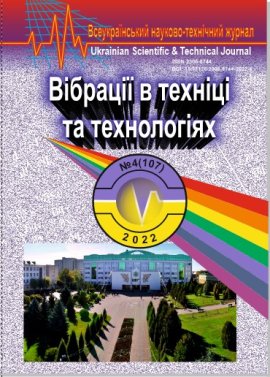
Issue №: 4 (107)
The journal deals with the problems of vibration technologies and machines, mathematical methods of vibration process studies, information on design and technological development, presents teaching and methodological aspects of teaching in the Higher School of Applied Sciences, where vibration machines and technologies are studied.
MATHEMATICAL MODEL OF THE MOVEMENT OF PARTICLES IN A CYLINDRICAL VIBRATING MIXER CONTAINERS
Polievoda Yurii – PhD, Associate Professor of the Department of technological processes and equipment for processing and food production, Vinnytsia National Agrarian University (Sonyachna st., 3, Vinnytsia, 21008, Ukraine, e-mail: vinyura36@gmail.com).
Volynets Yevhenii – postgraduate student of the Department Technological processes and the possession of food processing and food production of the Vinnytsia National Agrarian University (Sonyachna st., 3, Vinnytsia, 21008, Ukraine, e-mail: evgen110596@gmail.com).
Bystrytskiy Oleksandr engineer of farming «Letagor»
Mixing is the process of bringing different masses of products into close interaction by increasing the contact area in order to obtain the product of the required consistency, to maintain the latter or to evenly distribute impurities in the main volume of products.
The process of mixing components with different physical and mechanical properties is realized mainly by creating shear deformations in the entire mass of the product with the help of blades, rotating screws, or other working bodies. At the same time, in order to ensure a uniform distribution of the components, it is necessary to give the particles of the dispersed mass such trajectories that would ensure the greatest probability of their crossing. But the movement of these particles in the volume of the mixture is opposed by the forces of inertia and the forces of dry internal friction (friction of particles against each other) and forces of dry external friction (friction of material particles against the container, blades or other working organs of the mixer), which, as a rule, are on the order of lower than the forces of dry internal friction. In addition, when mixing, it is necessary to overcome the forces of gravity, which try to lower the particles of the material to the bottom, which leads to their delamination.
Numerical modeling has been increasingly used in the description of mixing processes of loose materials in recent decades. Numerical modeling is especially convenient when describing the processes of gravity-overflow mixing, when it occurs most actively in a thin layer of material, in which there is a random transition of component particles to the adjacent layer.
The article examines the modeling of the movement of particles during the rotating movement of the cylindrical mixer chamber without the use of blade intensifiers and the effect of vibration on the product.
1. Polievoda, Yu. A., & Volynets, Ye. O. (2021). Analiz rozvytku tekhnolohichnoho obladnannya dlya vyrobnytstva kharchovykh sumishey. [Analysis of the development of technological equipment for the production of food mixtures]. Tekhnika, enerhetyka, transport APK – Engineering, energy, transport AIC. 4 (111), 72–79. [in Ukrainian].
2. Tsurkan, O. V., & Polievoda, Yu. A., & Volynets, Ye. O., & Pokhodai M. V. (2016). Osoblyvosti konstruktsiyi kombinovanoho zmishuvacha dlya pererobnykh i kharchovykh vyrobnytstv [Design features of the combined mixer for processing and food industries]. Vibratsiyi v tekhnitsi ta tekhnolohiyakh – Vibrations in engineering and technologies. 1, 149–154. [in Ukrainian].
3. Polievoda, Yu. A., & Volynets, Ye. O. (2021). Doslidzhennia vibroreolohichnykh modelei sharu sypkoho seredovyshcha [Investigation of vibroreological models of the bulk layer]. Tekhnika, enerhetyka, transport APK - Engineering, energy, transport AIC. 1 (112), 53–60. [in Ukrainian].
4. Stotsko, Z. A., Topilnytskyi, V. H., Kusyi, Ya. M. (2011). Rozroblennia neliniinoi modeli p’iatykonteinernoi obrobliuvalnoi vibratsiinoi systemy. [Development of a non-linear model of a five-container processing vibration system]. Visnyk Nats. un-tu Lvivska politekhnika Optymizatsiia vyrobnychykh protsesiv i tekhnichnyi kontrol u mashynobuduvanni y pryladobuduvanni. 702. 32–39. [in Ukrainian].
5. Polievoda, Yu. A. (2015). Perspektyvy zastosuvannya vibratsiynykh efektiv v ridkykh tekhnolohichnykh systemakh kharchovykh i pererobnykh vyrobnytstv. [Prospects for the application of vibration effects in liquid technological systems of food and processing industries]. Zbirnyk naukovykh pratsʹ Vinnytsʹkoho natsionalʹnoho ahrarnoho universytetu – Collection of scientific works of the Vinnytsia National Agrarian University. 1, 124–130. [in Ukrainian].
6. Palamarchuk, I. P., Polievoda, Yu. A., Yanovych, V. P. (2009). Analiz matematychnoyi modeli vibrovidtsentrovoyi mashyny dlya ochyshchennya ridkoyi syrovyny. [Analysis of the mathematical model of the vibro-centrifugal machine for cleaning liquid raw materials]. Vibratsiyi v tekhnitsi ta tekhnolohiyakh – Vibrations in engineering and technologies. 4, 129–136. [in Ukrainian].
7. Yanovych, V., Tsurkan, O., Polyevoda, Y. (2019). Development of the vibrocentric machine for the production of a basic mixture of homeopathic preparations. University Politehnica of Bucharest. Scientific bulletin, Series D: Mechanical Engineering. 81, 2, 13–26. [in English].
8. Yanovych, V., Polievoda, Y., Duda, D. (2019). Development of a vibrocentric machine for raw glycerin purification. University Politehnica of Bucharest. Scientific bulletin, Series D: Mechanical Engineering. 81, 4, 17–28. [in English].
9. Yanovych, V., Žitek, P., Hashemi-Dezaki, H., Polievoda, Y. Effect of vibration on the rheological properties of glycerin during its purification. Journal of Vibroengineering. 23, 5, 1095–1108. [in English].
10. Palamarchuk, I. P., Yanovych, V. P., Polievoda, Yu. A., Brianskyi, V. V. (2010). Analiz matematychnoi modeli vibrovidtsentrovoho zmishuvacha dlia vyhotovlennia sukhykh molochnykh sumishei. [Analysis of the mathematical model of the vibro-centrifugal mixer for the production of dry milk mixtures] Zbirnyk naukovykh prats vinnytskoho derzhavnoho ahrarnoho universytetu, seriia tekhnichni nauky. 4, 5–12. [in Ukrainian].
11. Bernyk M. P. (2002). Doslidzhennya dynamiky rukhu vibratsiynoho zmishuvacha z debalansnym vibrozbudzhuvachem ta mayatnykovym pryvodom lopatevoho valu [Study of the dynamics of the movement of a vibrating mixer with an unbalanced vibrator and a pendulum drive of a blade shaft]. Visnyk Kharkivsʹkoho derzhavnoho tekhnichnoho universytetu silʹsʹkoho hospodarstva. 9, 338–345 [in Ukrainian].
About the journal
The journal "Vibrations in Engineering and Technologies" is included in the list of technical scientific publications of Ukraine
(Category "B", Order of the Ministry of Education and Science of Ukraine dated July 2, 2020 No. 886)
Old version of the site: http://vibrojournal.vsau.edu.ua/
The journal "Vibrations in Engineering and Technology" is indexed by the following databases and catalogs:





The certificateof massmedia State registration:kv no 16643-5115 from 30.04.2010 .
Founder of the journal: Vinnytsia National Agrarian University
The journal is devoted to highlighting current issues in engineering, mechanical engineering, and technological processes, including the study of dynamic and oscillatory phenomena in technical systems, the application of mathematical methods for process modeling and analysis, as well as the presentation of results of design-engineering and technological developments. Particular attention is given to the study of vibration processes and their application in modern technologies.
The purpose of the scientific journal “Vibrations in Engineering and Technologies” is to disseminate the results of fundamental and applied research in the field of engineering sciences aimed at developing theoretical foundations and practical approaches to the design, analysis, and improvement of machines, materials, and technological processes, including the use of vibration and oscillatory effects in various sectors of production.
The publication is focused on the formation of a modern scientific and informational environment for the effective exchange of research results, support of innovative development, and implementation of advanced technical solutions in industry, agro-industrial production, and related fields.
The journal promotes the development of interdisciplinary research, the integration of modern engineering approaches, and the enhancement of the efficiency of technological processes and technical systems, including through the rational use of vibration phenomena.
Objectives of the Scientific Journal
To achieve its stated purpose, the journal addresses the following key objectives:
dissemination of results of fundamental and applied scientific research in the fields of mechanics, mechanical engineering, technological processes, machine dynamics, and equipment, as well as in areas related to the application of vibration phenomena in engineering and technologies;
promotion of research aimed at the creation and improvement of machines, mechanisms, and technological equipment based on oscillatory and vibration processes;
support for the implementation of modern technological solutions focused on improving productivity, energy efficiency, and reliability of technical systems;
обеспечение scientific exchange of research results among research institutions, higher education establishments, and industrial enterprises;
development of interdisciplinary cooperation among researchers in the fields of mechanics, materials science, material processing technologies, and automation of technological processes;
dissemination of modern scientific achievements and advanced technologies related to the application of vibration processes in production and technical systems.
Publisher Vinnytsia National Agrarian University
In June 1994 the 2nd International Scientific and Technical Conference "Application of vibrations for technological purposes" was organized on the basis of Vinnytsia State Agricultural Institute. Leading experts in this field, noting the significant contribution to the school of Vibration Engineering under the leadership of P. S. Bernyk, proposed to create a professional all-Ukrainian scientific and technical journal "Vibration in engineering and technology..The journal was foundedat Vinnytsia State Agricultural Institute and P.S. Bernyk was elected to be the chief editor .
For all these years (since 1994) theJournal "vibration in engineering and technology" published 119 issues wherestudy of vibration effects, the creation of progressive energy saving technologies and equipment for their implementation were highlighted.
Currently Ihor Kupchuk, Candidate of Technical Sciences, Associate professor, Associate Professor of the Department of Engineering Mechanics and Technological Processes in the Agricultural Industry Faculty of Engineering and Technology Vinnytsia National Agrarian University is the chief editor of the "Vibrations in engineering and Technology"
The journal "Vibration in Engineering and technology", which has no analogues on the territory of Ukraine, is well known abroad.
