

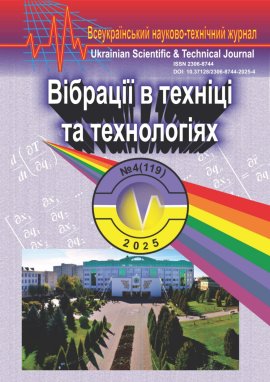
Issue №: 4(119)
The journal deals with the problems of vibration technologies and machines, mathematical methods of vibration process studies, information on design and technological development, presents teaching and methodological aspects of teaching in the Higher School of Applied Sciences, where vibration machines and technologies are studied.
EXPERIMENTAL STUDY OF THE HOMOGENEITY OF MIXING BULK MATERIALS IN A CENTRIFUGAL DOSING MIXER
Dmytriv Ihor - Candidate of Technical Sciences, Associate Professor, Associate Professor of the Department of Automotive Transport, Lviv Polytechnic National University, 79013, 12 Stepan Bandera Str., Lviv, Ukraine, е-mail: Ihor.V.Dmytriv@lpnu.ua, http://orcid.org/0000-0002-5107-7273
Sahan Oleh - recipient of the PhD degree of Department of Desing Machine and Automotive Engineering, Lviv Polytechnic National University, 79013, 12 Stepan Bandera Str., Lviv, Ukraine, е-mail: Oleh.Y.Sahan@lpnu.ua, https://orcid.org/0009-0004-5116-8679
The paper presents the results of an experimental study of multicomponent bulk-material mixing in a continuous centrifugal dispenser–mixer. The objective was to quantitatively evaluate mixture homogeneity and to determine how key design and operating parameters affect mixing quality by combining classical statistical indicators with digital image analysis. To test the hypothesis that the mixer can ensure a high level of homogeneity, a planned three-factor experiment was carried out by varying the dosing disk rotational speed, the disk generatrix angle, and the excess pressure in the working zone.
The assessment procedure relied on introducing color markers for each mixture component, taking control samples after mixing, and photographing them under fixed lighting conditions and a fixed camera geometry. Image processing included correction of the captured frames, color-based segmentation, estimation of component fractions within the image, and statistical aggregation across measurement series. Based on the resulting dataset, integral homogeneity indicators were calculated and compared for different combinations of factors, which made it possible to identify characteristic trends in mixing quality depending on the operating mode.
The experimental results demonstrate a consistently high level of mixing across a wide range of operating conditions, while the influence of the investigated parameters follows a regular pattern, providing a basis for further optimization of the design and settings. The proposed approach not only confirms the efficiency of the centrifugal dispenser–mixer but also establishes a reproducible method for quantitative mixing-quality evaluation based on digital images. The findings can be applied in the food, pharmaceutical, chemical, and construction industries, as well as for laboratory quality control and process analytical technology tasks.
1. Danckwerts P.V. (1952). Determination and measurement of certain characteristics of mixtures. Applied Scientific Research. 3. 279–296. https://doi.org/10.1007/BF03184936
2. Lacey P.M.C. (1954). Development of the theory of particle mixing. Journal of Applied Chemistry. 4(5). 257–268. https://doi.org/10.1002/jctb.5010040505
12. Rielly C.D., Cullen P.J., Romañach R.J., Abatzoglou N. (2015). Mixing Theory. In Pharmaceutical Blending and Mixing. P. 1–24. https://doi.org/10.1002/0471451452.mix001
4. Asachi M., Hassanpour A., Ghadiri M., Bayly A.E. (2018). Review of current methods for evaluating powder mixing. Advanced Powder Technologies. 29(7). 1525–1549. https://doi.org/10.1016/j.apt.2018.03.025
5. Giraud M., Lemieux M., Chaouki J. (2022). Multiscale methodology for quantitative assessment of the homogeneity of co-ground powders. Chemical Engineering Science. 249. 117–146. https://doi.org/10.1016/j.ces.2022.117146.
6. Berthiaux H., Mosorov V., Tomczak L., Gatumel C., Demeyre J.-F. (2006). Principal component analysis for characterising the homogeneity of powder mixtures using image processing techniques // Chemical Engineering and Processing: Process Intensification.– 45(5). 397–403. https://doi.org/10.1016/j.cep.2005.11.002
7. Koç A.B., Dereli H., Yildirim O. (2007). Monitoring dry powder mixing with real-time image processing. Journal of Applied Sciences. 7(8). 1218–1223. https://doi.org/10.3923/jas.2007.1218.1223
8. Jin X., Gao Y., Zhou Y., Wang S., Li J. (2022). DEM modelling of mixing efficiency in a ribbon mixer using the Leahy mixing index. Powder Technology. 403. Article 117384. https://doi.org/10.1016/j.powtec.2022.117384.
9. Matos J., Quintanilla M.A.S., Ponce F. (2018). Lagrangian analysis of mixing granular materials in a rotating drum using a segregation scale. Powder Technology. 332. 109–120. https://doi.org/10.1016/j.powtec.2018.03.026
10. Fan Y., Chen X.D., Chen Y. (2014). Quantitative assessment of the mixing quality of particle systems using Dankerts segregation intensity. Powder Technology. 264. 582–590. https://doi.org/10.1016/j.powtec.2014.05.037
11. Dmitriv V.T., Dmitriv I.V., Yatsunsky P.P. (2019). Investigation of a pneumatic electromagnetic pulse collector for a milking machine using the planned experiment method. Scientific journal ‘Engineering of Environmental Management’. Kharkiv: Petro Vasylenko Kharkiv National Technical University of Agriculture, 2(12). 66-720. [in Ukrainian]
About the journal
The journal "Vibrations in Engineering and Technologies" is included in the list of technical scientific publications of Ukraine
(Category "B", Order of the Ministry of Education and Science of Ukraine dated July 2, 2020 No. 886)
Old version of the site: http://vibrojournal.vsau.edu.ua/
The journal "Vibrations in Engineering and Technology" is indexed by the following databases and catalogs:





The certificateof massmedia State registration:kv no 16643-5115 from 30.04.2010 .
Founder of the journal: Vinnytsia National Agrarian University
The journal is devoted to highlighting current issues in engineering, mechanical engineering, and technological processes, including the study of dynamic and oscillatory phenomena in technical systems, the application of mathematical methods for process modeling and analysis, as well as the presentation of results of design-engineering and technological developments. Particular attention is given to the study of vibration processes and their application in modern technologies.
The purpose of the scientific journal “Vibrations in Engineering and Technologies” is to disseminate the results of fundamental and applied research in the field of engineering sciences aimed at developing theoretical foundations and practical approaches to the design, analysis, and improvement of machines, materials, and technological processes, including the use of vibration and oscillatory effects in various sectors of production.
The publication is focused on the formation of a modern scientific and informational environment for the effective exchange of research results, support of innovative development, and implementation of advanced technical solutions in industry, agro-industrial production, and related fields.
The journal promotes the development of interdisciplinary research, the integration of modern engineering approaches, and the enhancement of the efficiency of technological processes and technical systems, including through the rational use of vibration phenomena.
Objectives of the Scientific Journal
To achieve its stated purpose, the journal addresses the following key objectives:
dissemination of results of fundamental and applied scientific research in the fields of mechanics, mechanical engineering, technological processes, machine dynamics, and equipment, as well as in areas related to the application of vibration phenomena in engineering and technologies;
promotion of research aimed at the creation and improvement of machines, mechanisms, and technological equipment based on oscillatory and vibration processes;
support for the implementation of modern technological solutions focused on improving productivity, energy efficiency, and reliability of technical systems;
обеспечение scientific exchange of research results among research institutions, higher education establishments, and industrial enterprises;
development of interdisciplinary cooperation among researchers in the fields of mechanics, materials science, material processing technologies, and automation of technological processes;
dissemination of modern scientific achievements and advanced technologies related to the application of vibration processes in production and technical systems.
Publisher Vinnytsia National Agrarian University
In June 1994 the 2nd International Scientific and Technical Conference "Application of vibrations for technological purposes" was organized on the basis of Vinnytsia State Agricultural Institute. Leading experts in this field, noting the significant contribution to the school of Vibration Engineering under the leadership of P. S. Bernyk, proposed to create a professional all-Ukrainian scientific and technical journal "Vibration in engineering and technology..The journal was foundedat Vinnytsia State Agricultural Institute and P.S. Bernyk was elected to be the chief editor .
For all these years (since 1994) theJournal "vibration in engineering and technology" published 119 issues wherestudy of vibration effects, the creation of progressive energy saving technologies and equipment for their implementation were highlighted.
Currently Ihor Kupchuk, Candidate of Technical Sciences, Associate professor, Associate Professor of the Department of Engineering Mechanics and Technological Processes in the Agricultural Industry Faculty of Engineering and Technology Vinnytsia National Agrarian University is the chief editor of the "Vibrations in engineering and Technology"
The journal "Vibration in Engineering and technology", which has no analogues on the territory of Ukraine, is well known abroad.
