

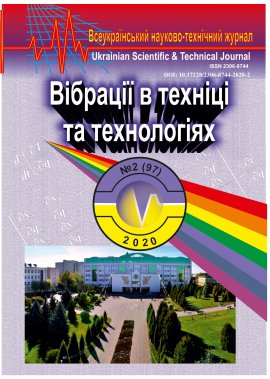
Issue №: 2(97)
The journal deals with the problems of vibration technologies and machines, mathematical methods of vibration process studies, information on design and technological development, presents teaching and methodological aspects of teaching in the Higher School of Applied Sciences, where vibration machines and technologies are studied.
Application of the method of current functions in stationary plastic deformation processes
Rekechynsky Volodymyr Ivanovych - Postgraduate Student of Vinnytsia National Agrarian University (3, Solnyshchaya St., Vinnytsia, Ukraine, 21008, e-mail: volodimir_rekecinskiy@ukr.net).
A method of determining the components of the strain rate tensor based on the method of current functions is developed. It is assumed that, with an axisymmetric plastic deformation of the metal in a channel with curvilinear borders, the kinematics of the process are similar to a flat flow. Using the incompressibility equation and the differential equation of the current lines, it is established that the current function maintains a constant value along the current lines. Two infinitely close current lines are considered in the flow plane to explain the kinematic content of the current function. The expression for flow through the finite transverse-sized tube was obtained. In the absence of radial velocity components at the boundaries, we obtain the restrictions imposed on derivatives of the current functions at these boundaries. The method of calculation of kinematic deformation characteristics for established axisymmetric processes will allow to simplify the mathematical processing of the obtained results.
Real processes of metal processing are always accompanied by uneven plastic molding, which affects the power and kinematic parameters, the quality of finished products. The main technological factors affecting the appearance of the inhomogeneity and the nature of its distribution are the form factor (geometric parameters of the original workpiece) and the coefficient of contact friction. The study of technological parameters affecting the distribution of non-uniformity of plastic molding will allow to create practical recommendations for reducing the influence of the above mentioned parameters to ensure more uniform plastic deformation.
Due to elastic-plastic deformation and local heating, which occur during surface-plastic deformation processing, the stress-strain and physical state of the surface layer is formed. This changes the microgeometry of the surface, the physical and mechanical properties of the surface layer of the workpiece. The surface treated by methods of surface-plastic deformation, has high hardness, residual compression stresses in the surface layer, smoothed out the micro-roughness. Accordingly, increases wear resistance, fatigue strength, resistance to corrosion and more.
1. Ogorodnikov V. А. Resurs plastichnosti metallov pri holodnom obemnom formoizmenenii: monografia / V. А. Ogorodnikov, I. А. Derevenko, L. I. Alieva // Vinnitsa: VNTU, 2016. - 176 s.
2. Dmitriev А. М. Uchet neodnorodnosti mehanicheskih svoistv i skorosti deformatsii v raschetah protsesov vydavlivania / А. М. Dmitriev, А. L. Vorontsov // Kuznechno-shtampovochnoe proizvodstvo, 2004, № 8. s. 3–10.
3. Kotsiubivska К. І. Resurs plastichnosti metaliv pri poperechnomu vidavliuvanni z protitiskom: monografia / К. І. Kotsiubivska, Iu. А. Burenikov, І. О. Sivak. – Vinnitsia : VNTU, 2011. – 156 s.
4. Kolmogorov V. L. Mehanika obrabotki metallov davleniem / V. L. Kolmogorov. – Ekaterinburg: UPI, 2001. – 836 s.
5. Basin М. Е. Otsenka primenimosti teorii uprugo-plasticheskogo techenia pri modelirovanii protsesa volochenia metalla / М. Е. Basin, М. G. Boiarshinov, G. L. Kolmogorov // Vycheslitelnaia mehanika. — 2005. — № 3. — s. 70-75.
6. Aljushin Ju.A. Svjaz' linij toka i skorosti deformacii v processah razvitogo plasticheskogo formoizmenenija. Izv. vuzov. Chernaja metallurgija. 1970. №8. S.71-74.
7. Kucherjaev B.V. K opredeleniju dejstvitel'nyh funkcij toka i funkcij naprjazhenij pri reshenii zadach teorii vjazkoplasticheskih techenij. Plasticheskaja deformacija legkih i special'nyh splavov. M.: Metallurgija, 1982. Vyp 2. S.27-37.
8. Kuzmenko V.Y., Balakyn V.F. Reshenie na JeVM zadach plasticheskogo deformirovanija. Kiev : Tehnika, 1990. 136 s.
9. Shebeik A. Reshenie na CVM metodom vizioplastichnosti zadachi osesimmetrichnogo pressovanija cherez matricu s krivolinejnoj obrazujushhej. Trudy amerikanskogo obshhestva inzhinerov - mehanikov. Konstruirovanie i tehnologija mashinostroenija, 1972. №2. S. 273-279.
10. Loitsianskyi L.H. Mehanika zhidkosti i gaza. M.: Nauka, 1987. 840s.
11. Ogorodnikov V. А. On the Influence of Curvature of the Trajectories of Deformation of a Volume of the Material by Pressing on Its Plasticity Under the Conditions of Complex Loading. Materials Science.Vol. 54, 2018. P. 326-332.
12. Maslov A. The determination of the parameters of a vibration machinef the internal compaction of concrete mixtures. International Journal of Engineering & Technology. Vol. 7, 2018. Р. 12-19.
13. Puzyr R. Experimental Study of the Process of Radial Rotation Profiling of Wheel Rims Resulting in Formation and Technological Flattening of the Corrugations. Manufacturing Technology, 2018. Vol. 18 (1), Р. 106-111.
About the journal
The journal "Vibrations in Engineering and Technologies" is included in the list of technical scientific publications of Ukraine
(Category "B", Order of the Ministry of Education and Science of Ukraine dated July 2, 2020 No. 886)
Old version of the site: http://vibrojournal.vsau.edu.ua/
The journal "Vibrations in Engineering and Technology" is indexed by the following databases and catalogs:





The certificateof massmedia State registration:kv no 16643-5115 from 30.04.2010 .
Founder of the journal: Vinnytsia National Agrarian University
The journal is devoted to highlighting current issues in engineering, mechanical engineering, and technological processes, including the study of dynamic and oscillatory phenomena in technical systems, the application of mathematical methods for process modeling and analysis, as well as the presentation of results of design-engineering and technological developments. Particular attention is given to the study of vibration processes and their application in modern technologies.
The purpose of the scientific journal “Vibrations in Engineering and Technologies” is to disseminate the results of fundamental and applied research in the field of engineering sciences aimed at developing theoretical foundations and practical approaches to the design, analysis, and improvement of machines, materials, and technological processes, including the use of vibration and oscillatory effects in various sectors of production.
The publication is focused on the formation of a modern scientific and informational environment for the effective exchange of research results, support of innovative development, and implementation of advanced technical solutions in industry, agro-industrial production, and related fields.
The journal promotes the development of interdisciplinary research, the integration of modern engineering approaches, and the enhancement of the efficiency of technological processes and technical systems, including through the rational use of vibration phenomena.
Objectives of the Scientific Journal
To achieve its stated purpose, the journal addresses the following key objectives:
dissemination of results of fundamental and applied scientific research in the fields of mechanics, mechanical engineering, technological processes, machine dynamics, and equipment, as well as in areas related to the application of vibration phenomena in engineering and technologies;
promotion of research aimed at the creation and improvement of machines, mechanisms, and technological equipment based on oscillatory and vibration processes;
support for the implementation of modern technological solutions focused on improving productivity, energy efficiency, and reliability of technical systems;
обеспечение scientific exchange of research results among research institutions, higher education establishments, and industrial enterprises;
development of interdisciplinary cooperation among researchers in the fields of mechanics, materials science, material processing technologies, and automation of technological processes;
dissemination of modern scientific achievements and advanced technologies related to the application of vibration processes in production and technical systems.
Publisher Vinnytsia National Agrarian University
In June 1994 the 2nd International Scientific and Technical Conference "Application of vibrations for technological purposes" was organized on the basis of Vinnytsia State Agricultural Institute. Leading experts in this field, noting the significant contribution to the school of Vibration Engineering under the leadership of P. S. Bernyk, proposed to create a professional all-Ukrainian scientific and technical journal "Vibration in engineering and technology..The journal was foundedat Vinnytsia State Agricultural Institute and P.S. Bernyk was elected to be the chief editor .
For all these years (since 1994) theJournal "vibration in engineering and technology" published 119 issues wherestudy of vibration effects, the creation of progressive energy saving technologies and equipment for their implementation were highlighted.
Currently Ihor Kupchuk, Candidate of Technical Sciences, Associate professor, Associate Professor of the Department of Engineering Mechanics and Technological Processes in the Agricultural Industry Faculty of Engineering and Technology Vinnytsia National Agrarian University is the chief editor of the "Vibrations in engineering and Technology"
The journal "Vibration in Engineering and technology", which has no analogues on the territory of Ukraine, is well known abroad.
