

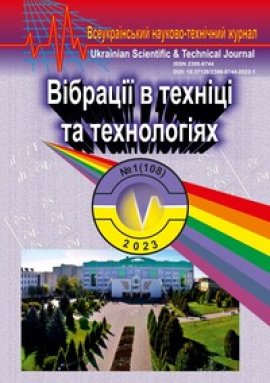
Issue №: 1 (108)
The journal deals with the problems of vibration technologies and machines, mathematical methods of vibration process studies, information on design and technological development, presents teaching and methodological aspects of teaching in the Higher School of Applied Sciences, where vibration machines and technologies are studied.
USE OF THE METHOD OF DISCRETE ELEMENTS IN SIMULATION OF THE MOVEMENT AND LAYING OF SEEDS OF SMALL-SEED CULTURES
Yaropud Vitaliy - Candidate of Technical Sciences, Associate Professor of the Department of machinery and equipment for agricultural production of Vinnytsia National Agrarian University
(St. Soniachna, 3, Vinnytsia, Ukraine, 21008, e-mail: yaropud77@gmail.com).
Tesliuk Gennadii - Candidate of Technical Sciences, Associate Professor, Head of the Department of Tractors and Agricultural Machinery of the Dnipro State Agrarian and Economic University (25 Serhiy Yefremova St., Dnipro, Ukraine, 49600).
Datsiuk Dmytro - postgraduate student of the Department "Machinery and Equipment of Agricultural Production" of Vinnytsia National Agrarian University (3 Sonyachna Street, Vinnytsia, 21008).
Modern theoretical studies of mechanical-technological processes of the process of moving seeds under the action of working bodies of technical means are reduced to analytical methods, which leads to the compilation of complex systems of differential equations with boundary and initial conditions. Among the modern methods of computer modeling of mechanical-technological processes of moving a loose medium (seed mixture), methods based on the concept of discrete representation of matter - the method of particle dynamics and the method of discrete elements - are of particular interest. The Discrete Element Method (DEM) is an engineering numerical method for modeling the motion of many interacting discrete objects, which are usually solid particles. The purpose of the research is to simulate the movement and packing of seeds of small-seeded crops using the method of discrete elements in the Simcenter STAR-CCM+ CAE system software package. The physical models for simulation in the Simcenter STAR-CCM+ software package are: three-dimensional model, non-stationary implicit model, one-component gas (air) mathematical model, ideal gas (air) model, turbulent air flow model, k-ε air turbulence model, isothermal energy equation fluids, Reynolds-averaged Navier-Stokes equation, separated flow, gradient and boundary methods, Lagrangian model of multiphase environment, multiphase interaction model, discrete element model (DEM), gravity field/ As a result of research, a mathematical model of random packing of small-seeded seeds crops in the container, which allowed to determine the regression equation of its density from the effective diameter of the seeds and the coefficient of variation of this diameter. It was found that with a decrease in the effective seed diameter Dμ and an increase in the coefficient of variation δ, an increase in the random packing density φ of small-seeded crops of spherical shape in the container is observed. This is explained by the fact that the seeds of a smaller diameter fill the voids between the seeds of a larger diameter.
1. Yaropud V.M., Aliyev E.B., Datsyuk D.A. Methods of numerical modeling of the sowing apparatus of the breeding seeder of small-seed crops. Machinery & Energetics. Journal of Rural Production Research. 2021. 12 (3), 121 127. http://dx.doi.org/10.31548/machenergy2021.02
2. Yaropud V.M., Datsyuk D.A. Ways to improve the sowing apparatus of the breeding seeder of small-seed crops. Vibrations in engineering and technology. 2021. 1 (100), 156 166. DOI : 10.37128/2306-8744-2021-1-15
3. Datsyuk D.A., Yaropud V.M., Aliyev E.B. Appareil de semis pour l’ensemencement de cultures à petites céréales. pat. n° 149682 Ua, IPC A01S 7/04, A01V 49/06. 2021. Boul. 48. 4 s.
4. Aliev E. B., Bandura V. M., Pryshliak V. M., Yaropud V. M., Trukhanska O. O. Modeling of mechanical and technological processes of the agricultural industry. INMATEH – Agricultural Engineering. № 54 (1). 2018. Р. 95−104. http://aliev.in.ua/doc/stat/2018/stat_2.pdf. [5]
5. Aliiev E., Gavrilchenko A., Tesliuk H., Tolstenko A., Koshul’ko V. 2019. Improvement of the sunflower seed separation process efficiency on the vibrating surface. Acta Periodica Technologica. APTEFF. № 50. 2019. Р. 12–22. DOI: 10.2298/APT1950012A
6. Aliyev E.B. Modèles physiques et mathématiques des processus de séparation de précision des graines de tournesol : monographie. Zaporozhye : Statut. 2019. 196 p. ISBN 978-617-7759-32-3.
7. Vasilenko O.V. 2020. Computer simulation : tutorial. Zaporozhye : NU "Zaporizhzhya Polytechnic." 2020. 175 cf. ISBN 978-617-529-293-8.
8. Andrunik V.A., Vysotskaya V.A., Pasechnik V.V., Chirun L.B., Chirun L.V. Méthodes numériques en sciences informatiques : manuel. Maison d’édition "New World-2000." 2017. 470 cf. ISBN 978-617-7519-06-4.
9. Aliev E.B., Mikolenko S.Yu., Sova N.A. et autres. Appui technique et technologique à la transformation sans déchets de matières premières céréalières en produits alimentaires et en aliments pour animaux : monographie collective/par total. édité par E. B. Aliyev. LIRA. 2022. 192 s. ISBN 978-966-981-687-0.
10. Shevchenko I., Aliiev E. Improving theefficiency ofthe process ofcontinuous flowmixing of bulkcomponents. Eastern-European Journal of Enterprise Technologies. № 6/1 (108). 2020. P. 6–13. DOI: 10.15587/1729-4061.2020.216409
11. Yaropud V., Honcharuk I., Datsiuk D., Aliiev E. The model for random packaging of small-seeded crops’ seeds in the reservoir of selection seeders sowing unit. Agraarteadus, Vol. 33 (1). 2020. Р. 199–208. https://dx.doi.org/10.15159/jas.22.08
12. Shevchenko I., Aliiev E. Study of the process of calibration of confectionery sunflower seeds. Food Science and Technology. Volume 12, Issue 4. 2018. P. 135–142.
13. Yaropud V., Honcharuk I., Datsiuk D., Aliiev E. The model for random packaging of small-seeded crops’ seeds in the reservoir of selection seeders sowing unit. Agraarteadus, Vol. 33 (1). 2020. Р. 199–208. https://dx.doi.org/10.15159/jas.22.08
14. Dinesh J. Modelling and Simulation of a Single Particle in Laminar Flow Regime of a Newtonian Liquid. Excerpt from the Proceedings of the COMSOL Conference. Bangalore. 2009. P. 1–9 https://www.comsol.com/paper/download/46302/Jamnani.pdf
15. Di Renzo Alberto, Di Maio Francesco Paolo. Comparison of contact-force models for the simulation of collisions in DEM-based granular flow codes. Chemical Engineering Science. № 59 (1). 2004. Р. 525–541. DOI: 10.1016/j.ces.2003.09.037
16. Komiwes V., Mege P., Meimon Y., Herrmann H. Simulation of granular flow in a fluid applied to sedimentation. – Granular Matter, 8 (1). 2006. Р. 41–54. DOI: 10.1007/s10035-005-0220-3
17. Kubicki D., Lo S. Slurry transport in a pipeline – Comparison of CFD and DEM models. – Ninth International Conference on CFD in the Minerals and Process Industries. CSIRO, Melbourne, Australia, 10-12 December 2012. Р. 1-6.
18. Sang Won Han, Won Joo Lee, Sang Jun Lee. Study on the Particle Removal Efficiency of Multi Inner Stage Cyclone by CFD Simulation. World Academy of Science, Engineering and Technology. № 6. 2012. Р. 411–415. DOI: 10.5281/zenodo.1330605
19. Satish G., Ashok Kumar K., Vara Prasad V., Pasha Sk. M. Comparison of flow analysis of a sudden and gradual changeof pipe diameter using fluent software. IJRET: International Journal of Research in Engineering and Technology, № 2 (12). 2013. Р. 41–45. https://citeseerx.ist.psu.edu/viewdoc/download?doi= 10.1.1.686.4460&rep=rep1&type=pdf
20. Iguchi Manabu, Ilegbusi Olusegun J. Basic Transport Phenomena in Materials Engineering. Springer. 2014. 260 p. DOI: 10.1007/978-4-431-54020-5
About the journal
The journal "Vibrations in Engineering and Technologies" is included in the list of technical scientific publications of Ukraine
(Category "B", Order of the Ministry of Education and Science of Ukraine dated July 2, 2020 No. 886)
Old version of the site: http://vibrojournal.vsau.edu.ua/
The journal "Vibrations in Engineering and Technology" is indexed by the following databases and catalogs:





The certificateof massmedia State registration:kv no 16643-5115 from 30.04.2010 .
Founder of the journal: Vinnytsia National Agrarian University
The journal is devoted to highlighting current issues in engineering, mechanical engineering, and technological processes, including the study of dynamic and oscillatory phenomena in technical systems, the application of mathematical methods for process modeling and analysis, as well as the presentation of results of design-engineering and technological developments. Particular attention is given to the study of vibration processes and their application in modern technologies.
The purpose of the scientific journal “Vibrations in Engineering and Technologies” is to disseminate the results of fundamental and applied research in the field of engineering sciences aimed at developing theoretical foundations and practical approaches to the design, analysis, and improvement of machines, materials, and technological processes, including the use of vibration and oscillatory effects in various sectors of production.
The publication is focused on the formation of a modern scientific and informational environment for the effective exchange of research results, support of innovative development, and implementation of advanced technical solutions in industry, agro-industrial production, and related fields.
The journal promotes the development of interdisciplinary research, the integration of modern engineering approaches, and the enhancement of the efficiency of technological processes and technical systems, including through the rational use of vibration phenomena.
Objectives of the Scientific Journal
To achieve its stated purpose, the journal addresses the following key objectives:
dissemination of results of fundamental and applied scientific research in the fields of mechanics, mechanical engineering, technological processes, machine dynamics, and equipment, as well as in areas related to the application of vibration phenomena in engineering and technologies;
promotion of research aimed at the creation and improvement of machines, mechanisms, and technological equipment based on oscillatory and vibration processes;
support for the implementation of modern technological solutions focused on improving productivity, energy efficiency, and reliability of technical systems;
обеспечение scientific exchange of research results among research institutions, higher education establishments, and industrial enterprises;
development of interdisciplinary cooperation among researchers in the fields of mechanics, materials science, material processing technologies, and automation of technological processes;
dissemination of modern scientific achievements and advanced technologies related to the application of vibration processes in production and technical systems.
Publisher Vinnytsia National Agrarian University
In June 1994 the 2nd International Scientific and Technical Conference "Application of vibrations for technological purposes" was organized on the basis of Vinnytsia State Agricultural Institute. Leading experts in this field, noting the significant contribution to the school of Vibration Engineering under the leadership of P. S. Bernyk, proposed to create a professional all-Ukrainian scientific and technical journal "Vibration in engineering and technology..The journal was foundedat Vinnytsia State Agricultural Institute and P.S. Bernyk was elected to be the chief editor .
For all these years (since 1994) theJournal "vibration in engineering and technology" published 119 issues wherestudy of vibration effects, the creation of progressive energy saving technologies and equipment for their implementation were highlighted.
Currently Ihor Kupchuk, Candidate of Technical Sciences, Associate professor, Associate Professor of the Department of Engineering Mechanics and Technological Processes in the Agricultural Industry Faculty of Engineering and Technology Vinnytsia National Agrarian University is the chief editor of the "Vibrations in engineering and Technology"
The journal "Vibration in Engineering and technology", which has no analogues on the territory of Ukraine, is well known abroad.
