

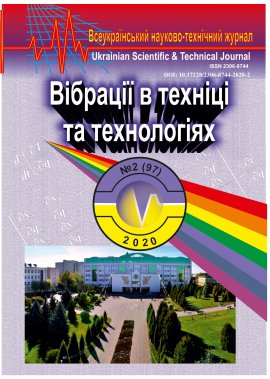
Issue №: 2(97)
The journal deals with the problems of vibration technologies and machines, mathematical methods of vibration process studies, information on design and technological development, presents teaching and methodological aspects of teaching in the Higher School of Applied Sciences, where vibration machines and technologies are studied.
STRUCTURAL DEVELOPMENT AND RESEARCH OF TECHNOLOGICAL PARAMETERS OF MACHINES FOR CENTRIFUGAL -PLANETARY VIBRATION TREATMENT
Yaroshenko Leonid Victorovich candidate of technical sciences, associate professor of the department of electric power engineering, electrical engineering and electromechanics of Vinnitsa national agrarian university, Service address: Vinnitsa, st. Sonyachna 3, VNAU 21008, e-mail: volvinlv@gmail.com.
Kupchuk Igor – candidate of technical sciences (Ph.D of Engeneering), Senior Lecturer of the Department of General Technical Disciplines and Labor Protection, Vinnitsa National Agrarian University (3, Sonyachna St., Vinnitsa, Ukraine, 21008, e-mail: kupchuk.igor@i.ua).
Zamrii Mykhailo – 4th year student of specialty 208 of Agroengineering, Faculty of Engineering and Technology of Vinnytsia National Agrarian University (str. Sonyachna, 3, Vinnytsia, 21008, Ukraine, e-mail: zamrij99@gmail.com).
The paper analyzes current state and prospects of further development of technology and equipment for mechanization and automation of finishing and cleaning of details. It is stated that the most effective for this purpose are the methods of abrasive machining, which include bulk galvanizing, vibration, centrifugal-rotary and centrifugal-planetary processing. These methods reduce the complexity and cost of processing, which in some cases reaches 20% of the total cost of manufacturing parts. Each of these methods has a different level of efficiency, certain advantages and disadvantages, the level of versatility and scope of effective application.
The processes of vibration processing are quite deeply studied, for its industrial mass-produced technological equipment, but they have certain shortcomings that limit their use for further widespread implementation. Centrifugal-rotary processing is a more productive process of three-dimensional finishing and cleaning treatment, but its scope is limited by the possibility of processing parts that are not complex, usually flat. The most productive methods of finishing and cleaning of details include centrifugal-planetary volume processing which high efficiency is caused by repeated loading of particles of working load by inertial forces that creates preconditions for the solutions of a wide range of technological problems, for example, processing of details of difficult form, small weight and the sizes from materials of high hardness or viscosity that represents a serious problem for other methods of volume processing.
The constructive scheme is offered in the work and the influence of the composition of the abrasive free-granular working environment on the productivity of the machine for centrifugal-planetary processing of details is investigated. The kinetics of metal removal from the surface of machined parts using different types of abrasive working environment is analyzed. The results of comparative machining of parts in a torus vibrating machine and a machine for centrifugal-planetary machining are given. It is shown that the simultaneous use of centrifugal-planetary and vibration processing methods allows to increase the intensity of the process while ensuring high quality machining of parts of relatively complex shape. The constructive scheme of the machine which allows to implement the specified combined method of processing is offered and described.
1. Babichev, A.P. & Babichev, I.A. (1999). Osnovy vibratsyonnoy tehnologii [Vibration technology fundamentals]. Rostov-nа-Donu: Izd. Tsentr DGTU, 624 [In Russian].
2. Babichev, A.P. & Motrenko, P.D. (2003). Otdelochno-uprochnyayutshaya obrabotka detaley mnogokratnym vibroudarnym instrymentom [Finishing and hardening processing of parts with multiple vibration-impact tools]. Rostov-nа-Donu: Izd. Tsentr DGTU, 192 [In Russian].
3. Kartashov, I.N. (1975). Obrabotka detaley svobodnymy аbrazivami v vibriruyutshyh rezervuarah [Free abrasive machining of parts in vibrating tanks]. К.: Vytsha shkola, 188 [In Russian].
4. Zverovtshykov, A. E (2013). Mnogofunktsionalnaya tsentrobejno-planetarnaya obrabotka. Monografiya [Multifunctional centrifugal planetary machining. Monograph]. М.: Infra-M, 176. ISBN 978-5-16-009253-9 [In Russian].
5. Bukatov, А.S. (1990). Perspektivy razvitiya tsentrobejno-planetarnoy obrabotki [Prospects for the development of centrifugal-planetary machining]. Mehanizatsiya i avtomatizatsiya proizvodstva – Mechanization and automation of production, 5, 17-18 [In Russian].
6. Yaroshenko, L.V. (2019). Eksperymentalni doslidgennya rozpodilu dynamichnogo naporu tsyrkulyatsiynogo ruhu robochogo seregovytcha v toroyidalnyh konteynerah vibratsiynyh mashyn [Experimental advancement of the dynamic pressure of the circulating chamber of the working center in the toroidal containers of the vibrating machines]. Vibratsiyi v tehnitsi ta tehnologiyah – Vibrations in engineering and technology,3 (94), 33 - 44. DOI: 10.37128/2306-8744-2019-3-5 [In Ukrainian].
7. Bernyk, P.S. & Yaroshenko, L.V. (1998). Vibratsionnyye tehnologicheskiye mashyny s prostranstvyennymi kolebaniyamy rabochyh organov [Vibrating technological machines with spatial vibrations of working tools]. Vinnytsya.: VNAU, 116 [In Russian].
8. Chubyk, R.V. & Yaroshenko, L.V. (2011). Kerovani vibratsiyni tekhnolohichni mashyny [Controlled vibrating technological machines]. Vinnytsya.: VNAU, 355 [In Ukrainian].
About the journal
The journal "Vibrations in Engineering and Technologies" is included in the list of technical scientific publications of Ukraine
(Category "B", Order of the Ministry of Education and Science of Ukraine dated July 2, 2020 No. 886)
Old version of the site: http://vibrojournal.vsau.edu.ua/
The journal "Vibrations in Engineering and Technology" is indexed by the following databases and catalogs:





The certificateof massmedia State registration:kv no 16643-5115 from 30.04.2010 .
Founder of the journal: Vinnytsia National Agrarian University
The journal is devoted to highlighting current issues in engineering, mechanical engineering, and technological processes, including the study of dynamic and oscillatory phenomena in technical systems, the application of mathematical methods for process modeling and analysis, as well as the presentation of results of design-engineering and technological developments. Particular attention is given to the study of vibration processes and their application in modern technologies.
The purpose of the scientific journal “Vibrations in Engineering and Technologies” is to disseminate the results of fundamental and applied research in the field of engineering sciences aimed at developing theoretical foundations and practical approaches to the design, analysis, and improvement of machines, materials, and technological processes, including the use of vibration and oscillatory effects in various sectors of production.
The publication is focused on the formation of a modern scientific and informational environment for the effective exchange of research results, support of innovative development, and implementation of advanced technical solutions in industry, agro-industrial production, and related fields.
The journal promotes the development of interdisciplinary research, the integration of modern engineering approaches, and the enhancement of the efficiency of technological processes and technical systems, including through the rational use of vibration phenomena.
Objectives of the Scientific Journal
To achieve its stated purpose, the journal addresses the following key objectives:
dissemination of results of fundamental and applied scientific research in the fields of mechanics, mechanical engineering, technological processes, machine dynamics, and equipment, as well as in areas related to the application of vibration phenomena in engineering and technologies;
promotion of research aimed at the creation and improvement of machines, mechanisms, and technological equipment based on oscillatory and vibration processes;
support for the implementation of modern technological solutions focused on improving productivity, energy efficiency, and reliability of technical systems;
обеспечение scientific exchange of research results among research institutions, higher education establishments, and industrial enterprises;
development of interdisciplinary cooperation among researchers in the fields of mechanics, materials science, material processing technologies, and automation of technological processes;
dissemination of modern scientific achievements and advanced technologies related to the application of vibration processes in production and technical systems.
Publisher Vinnytsia National Agrarian University
In June 1994 the 2nd International Scientific and Technical Conference "Application of vibrations for technological purposes" was organized on the basis of Vinnytsia State Agricultural Institute. Leading experts in this field, noting the significant contribution to the school of Vibration Engineering under the leadership of P. S. Bernyk, proposed to create a professional all-Ukrainian scientific and technical journal "Vibration in engineering and technology..The journal was foundedat Vinnytsia State Agricultural Institute and P.S. Bernyk was elected to be the chief editor .
For all these years (since 1994) theJournal "vibration in engineering and technology" published 119 issues wherestudy of vibration effects, the creation of progressive energy saving technologies and equipment for their implementation were highlighted.
Currently Ihor Kupchuk, Candidate of Technical Sciences, Associate professor, Associate Professor of the Department of Engineering Mechanics and Technological Processes in the Agricultural Industry Faculty of Engineering and Technology Vinnytsia National Agrarian University is the chief editor of the "Vibrations in engineering and Technology"
The journal "Vibration in Engineering and technology", which has no analogues on the territory of Ukraine, is well known abroad.
