

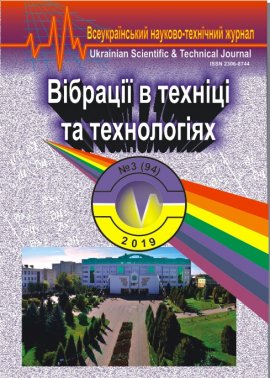
Issue №: 3 (94)
The journal deals with the problems of vibration technologies and machines, mathematical methods of vibration process studies, information on design and technological development, presents teaching and methodological aspects of teaching in the Higher School of Applied Sciences, where vibration machines and technologies are studied.
RESEARCH OF THE STRESS-STRAIN STATE OF THE MAIN CYLINDER OF THE HYDRAULIC PRESS
Nemchynov Serhii – Candidate of Technical Sciences, Associate Professor of the Department of Material Sciences, SHEI Ukrainian State University of Chemical Technology (8, Gagarin avenue, Dnipro, Ukraine, 49005, e-mail: sinonis@ukr.net).
Nachovnyy Illya – Candidate of Technical Sciences, Associate Professor of the Department of Mechanical Engineering and Engineering Mechanics, SHEI Ukrainian State University of Chemical Technology (8, Gagarin avenue, Dnipro, Ukraine, 49005, e-mail: decan_meh@ukr.net).
Khristenko Alexander – engineer of the Department of Chemical Production Equipment, SHEI Ukrainian State University of Chemical Technology (8, Gagarin avenue, Dnipro, Ukraine, 49005, e-mail: khristenko_av@ukr.net).
Babenko Vasyl – art. Lecturer of the Department of Applied Mechanics, SHEI Ukrainian State University of Chemical Technology (8, Gagarin avenue, Dnipro, Ukraine, 49005, e-mail: decan_meh@ukr.net).
In the article the stress-strain state of the main cylinder of the hydraulic press for the manufacturing of large-sized plastic products has been investigated using software of finite-element analysis. It is established that the stress-strain state is characterized by a general and local uneven distribution of stresses and displacements. The nature of the distribution of stresses, deformations, displacements, safety factors along the length of the cylinder allowed conditionally divide the cylinder into three characteristic zones: flange zone, Lame zone, bottom zone. In each of the zones we found the areas in which the maximum stresses and strains are observed. It was found that the maximum equivalent stresses calculated according to the Huber-Mises energy theory of strength are observed on the inner surface of the cylinder, and in their fillets in the zones of the bottom and flange. A comparative analysis of the stresses and displacements determined by the Lame formulas and the finite element method showed that in the Lame zone their values do not change significantly. Studies on the influence of the radius, which varied over a wide range, and the fillet angle, made it possible to establish the region of maximum principal and equivalent stresses and reduce their magnitude. The calculations revealed the fillet region in which the axial tensile stresses act and determine the fillet angle at which the axial stresses are equal in magnitude and sign The study allowed to change the geometry of the cylinder, reduce the stress in the cylinder fillet and its weight. The results of the study can be applied to improve the existing and design of new hydraulic presses of the chemical industry, as well as the basis for further research.
1. Surkov, I. A., Moiseyev, A. P., Kulagin, D. A., Korolev, S. A. (2005). Ustanovleniye i ustraneniye prichiny razrusheniya donnoy chasti glavnykh tsilindrov moshchnykh gidravlicheskikh pressov. Kuznechno-shtampovochnoye proizvodstvo. Obrabotka metallov davleniyem. (12),
36–38. [in Russian].
2. Kalinichenko, P. M., Lymarenko, O. M., Zyablov, Yu. V. (2006). Napruzhenyy stan tovstostinnoho tsylindra z kontsentratoramy. Trudy Odesskoho polytekhnycheskoho unyversyteta.
(2(26)), 1–4. [in Ukrainian].
3. Antsifirov, A. A., Krivoshein, V. A., Zimov, D. V. (2017). Sposob modelirovaniya glavnogo tsilindra gidravlicheskogo pressa. Inzhenernyy zhurnal: nauka i innovatsii. (3), 1-10. http://dx.doi/org/10.18698/2308-6033-2017-3-1595. [in Russian].
4. Laptev, A. M., Tkachenko, Ya. Yu., Didenko, A. A. (2012). Optimizatsiya rabochego tsilindra gidravlicheskogo pressa usiliyem 50 MN Obrabotka materialov davleniyem. (3 (32)), 204–207. [in Russian].
5. Surkov, I. A., Moiseyev, A. P. (2004). Ustraneniye prichin i preduprezhdeniye razrusheniy tsilindrov moshchnykh gidravlicheskikh pressov. Kuznechno-shtampovochnoye proizvodstvo. (5), 42–43. [in Russian].
6. Pat. 2358873 RF, MPK V30V 15/04. Korpus rabochego tsilindra moshchnogo gidravlicheskogo pressa / Bespalov V. V., Blik F. S., Korolev S. A. i dr.; zayavitel' i patentoobladatel' OOO «Nadezhnost' plyus». – № 20017128882; zayavl. 27.07.2007; opubl. 20.06.2009, Byul. № 16. – 7 s.
7. Phalguna, B. N. Stress and failure analysis of thick walled cylinder with oblique Hole International Journal of Engineering Research & Technology. 2017. Vol. 6. Issue 08. P. 36–45.
8. Mihai Ţalu D. L., Stefan Ţalu D. L., A finite element analysis of hydraulic cylinder of linear hydraulic motor from horizontal Hydraulic Press – 2 MN. Journal of Engineering Studies and Research. 2010. Vol. 16. No. 4. P. 59–62.
About the journal
The journal "Vibrations in Engineering and Technologies" is included in the list of technical scientific publications of Ukraine
(Category "B", Order of the Ministry of Education and Science of Ukraine dated July 2, 2020 No. 886)
Old version of the site: http://vibrojournal.vsau.edu.ua/
The journal "Vibrations in Engineering and Technology" is indexed by the following databases and catalogs:





The certificateof massmedia State registration:kv no 16643-5115 from 30.04.2010 .
Founder of the journal: Vinnytsia National Agrarian University
The journal is devoted to highlighting current issues in engineering, mechanical engineering, and technological processes, including the study of dynamic and oscillatory phenomena in technical systems, the application of mathematical methods for process modeling and analysis, as well as the presentation of results of design-engineering and technological developments. Particular attention is given to the study of vibration processes and their application in modern technologies.
The purpose of the scientific journal “Vibrations in Engineering and Technologies” is to disseminate the results of fundamental and applied research in the field of engineering sciences aimed at developing theoretical foundations and practical approaches to the design, analysis, and improvement of machines, materials, and technological processes, including the use of vibration and oscillatory effects in various sectors of production.
The publication is focused on the formation of a modern scientific and informational environment for the effective exchange of research results, support of innovative development, and implementation of advanced technical solutions in industry, agro-industrial production, and related fields.
The journal promotes the development of interdisciplinary research, the integration of modern engineering approaches, and the enhancement of the efficiency of technological processes and technical systems, including through the rational use of vibration phenomena.
Objectives of the Scientific Journal
To achieve its stated purpose, the journal addresses the following key objectives:
dissemination of results of fundamental and applied scientific research in the fields of mechanics, mechanical engineering, technological processes, machine dynamics, and equipment, as well as in areas related to the application of vibration phenomena in engineering and technologies;
promotion of research aimed at the creation and improvement of machines, mechanisms, and technological equipment based on oscillatory and vibration processes;
support for the implementation of modern technological solutions focused on improving productivity, energy efficiency, and reliability of technical systems;
обеспечение scientific exchange of research results among research institutions, higher education establishments, and industrial enterprises;
development of interdisciplinary cooperation among researchers in the fields of mechanics, materials science, material processing technologies, and automation of technological processes;
dissemination of modern scientific achievements and advanced technologies related to the application of vibration processes in production and technical systems.
Publisher Vinnytsia National Agrarian University
In June 1994 the 2nd International Scientific and Technical Conference "Application of vibrations for technological purposes" was organized on the basis of Vinnytsia State Agricultural Institute. Leading experts in this field, noting the significant contribution to the school of Vibration Engineering under the leadership of P. S. Bernyk, proposed to create a professional all-Ukrainian scientific and technical journal "Vibration in engineering and technology..The journal was foundedat Vinnytsia State Agricultural Institute and P.S. Bernyk was elected to be the chief editor .
For all these years (since 1994) theJournal "vibration in engineering and technology" published 119 issues wherestudy of vibration effects, the creation of progressive energy saving technologies and equipment for their implementation were highlighted.
Currently Ihor Kupchuk, Candidate of Technical Sciences, Associate professor, Associate Professor of the Department of Engineering Mechanics and Technological Processes in the Agricultural Industry Faculty of Engineering and Technology Vinnytsia National Agrarian University is the chief editor of the "Vibrations in engineering and Technology"
The journal "Vibration in Engineering and technology", which has no analogues on the territory of Ukraine, is well known abroad.
