

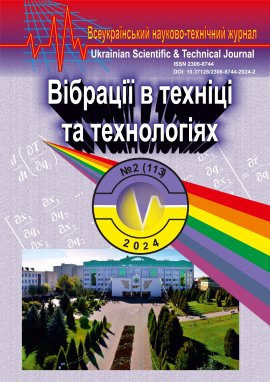
Issue №: 2(113)
The journal deals with the problems of vibration technologies and machines, mathematical methods of vibration process studies, information on design and technological development, presents teaching and methodological aspects of teaching in the Higher School of Applied Sciences, where vibration machines and technologies are studied.
PROCESSING OF MEAT PRODUCTION WASTE INTO ANIMAL FEED
Huts Viktor – Doctor of Technical Sciences, Professor of the Department of Bioengineering, Bio- and Food Technologies, Faculty of Production, Processing and Robotics in Animal Husbandry, Vinnytsia National Agrarian University (8 Yunosti Avenue, Vinnytsia, 21008, Ukraine, 21021, e-mail: Goots@ukr.net, orcid: http://orcid.org/0000-0003-3874-5609).
Volynets Yevhenii – assistant of the Department of Bioengineering, Bio- and Food Technologies, Faculty of Production, Processing and Robotics in Animal Husbandry, Vinnytsia National Agrarian University (8 Yunosti Avenue, Vinnytsia, 21008, Ukraine, 21021, e-mail: evgen110596@gmail.com, orcid: https://orcid.org/0000-0002-3298-6316).
During the slaughter and primary processing of animals, production of sausages, canned food, medicines and other products, meat processing plants, meat processing shops, slaughterhouses and other enterprises working with meat raw materials receive a significant amount of raw materials that are considered production waste - non-food raw materials. According to sanitary requirements, it cannot be used for food purposes. It is processed into animal feed or utilized. The amount of non-food meat raw materials ranges from 12...30% of the live weight of animals in meat and fat production during primary processing of livestock and 2...10% in the production of semi-finished products and sausages. It quickly deteriorates, becomes biohazardous, and loses quality. Therefore, if accumulation is necessary, non-food meat raw materials should be stored separately, not in contact with the environment, polluting it and negatively affecting workers. Processed non-food meat products such as industrial fat and dry animal feed also require special storage conditions.
Depending on the capacity of the enterprise, the amount of meat raw materials unsuitable for food purposes, the technical equipment of the production, and the economic feasibility of its processing, different technologies and, accordingly, different processing equipment are used. It should ensure high-quality processing of a wide range of different types of meat, and be maximally adapted to the formation of technological lines with closed transport devices.
Processing must be carried out in compliance with veterinary and sanitary rules and legal requirements. It is only possible to design modern technological lines for processing meat production waste into animal feed in accordance with the existing environmental safety requirements based on the results of new scientific research and the introduction of innovative engineering developments.
1. Koval, O.A., Tkachenko, K.D. (2002). Intensyfikatsiia vyrobnytstva tvarynnykh kormiv z miasnoi syrovyny [Intensification of animal feed production from meat raw materials]. Naukovi pratsi NUKhT – Scientific works of NUFT, 11. P. 82-83 [in Ukrainian].
2. Huts, V.S., Hlon, O.A., Reznikov, S.I. (1997). Teoretychni doslidzhennia kinematychnykh elementiv rukhu osadu pry rozvantazhenni tsentryfuh [Theoretical studies of kinematic elements of sediment movement during centrifuge unloading]. Naukovi pratsi UDUKhT – Scientific works of UDUHT, 3. P. 36-40 [in Ukrainian].
3. Palamarchuk, I.P., Bernyk, P.S., Stetsko, Z.A., Yaskov, V.V., Zozuliak, I.A. (2004). Mekhanichni protsesy ta obladnannia pererobnoho ta kharchovoho vyrobnytstva: navch. posib. Tom 1 [Mechanical processes and equipment of processing and food production: textbook. Volume 1], Vydavnytstvo NU «Lvivska politekhnika» 336 p [in Ukrainian].
4. Palamarchuk, I.P., Bernyk, P.S., Stetsko, Z.A., Yaskov, V.V., Zozuliak, I.A. (2006). Teplomasoobminni protsesy ta obladnannia pererobnoho ta kharchovoho vyrobnytstva: navch.posib. Tom 2 [Heat and mass transfer processes and equipment of processing and food production: a textbook. Volume 2], Lviv: Vydavnytstvo «Beskyd Bit». 368 p [in Ukrainian].
5. Sevostianov, I.V., Zozuliak, I.A. (2020). Tekhnolohichne obladnannia tsekhiv pererobky produktsii tvarynnytstva: navch. posib [Technological equipment of livestock products processing shops: a textbook], Vinnytsia: VNAU. 127 p [in Ukrainian].
6. Huts, V.S., Prypik, O.S., Koval, O.A. (2001). Kompiuterni prohramy analitychnykh rozrakhunkiv protsesiv kharchovykh vyrobnytstv [Computer programs for analytical calculations of food production processes]. Naukovi pratsi UDUKhT – Scientific works of UDUHT, 10 (2). P. 135 [in Ukrainian].
7. Huts, V.S. (1998). Osadove tsentryfuhuvannia nekontsentrovanykh kharchovykh suspenzii [Sediment centrifugation of nonconcentrated food suspensions]. Naukovi pratsi UDUKhT – Scientific works of UDUHT, 4. P. 63-65 [in Ukrainian].
8. Koval, O.A. (2000). Reolohichni modeli kharchovykh produktiv [Rheological models of food products]. Kharchova promyslovist – Food industry, 45. P. 218-222 [in Ukrainian].
9. Honcharov, H.I. (2003). Tekhnolohiia pervynnoi pererobky khudoby i produktiv zaboiu: navch. posib [Technology of primary processing of livestock and slaughter products: a textbook], NUKHT. 160 p [in Ukrainian].
10. Klymenko, M.M., Vinnikova, L.H., Bereza, I.H. (2006). Tekhnolohiia miasa ta miasnykh produktiv [Technology of meat and meat products]. Kyiv: Higher Education. 640 p [in Ukrainian].
11. Boiko, I., Hridasov, V., Dziuba, A. (2004). Praktykum po mashynakh ta obladnanniu [Workshop on machines and equipment]. Kharkiv : KHSTUA. 272 p [in Ukrainian].
12. Myronchuk, V.H. et al. (2004). Rozrakhunky obladnannia pererobnoi i kharchovoi promyslovosti. Navchalnyi posibnyk [Calculations of equipment for processing and food industry. Study guide]. Vinnytsia : New book. 288 p [in Ukrainian].
13. Polievoda, Yu.A., Volynets, Ye.O. (2020). Analiz rozvytku tekhnolohichnoho obladnannia dlia vyrobnytstva kharchovykh sumishei [Analysis of the development of technological equipment for the production of food mixtures]. Vibratsii v tekhnitsi ta tekhnolohiiakh – Vibrations in engineering and technology, 4 (111). P. 72-79 [in Ukrainian].
About the journal
The journal "Vibrations in Engineering and Technologies" is included in the list of technical scientific publications of Ukraine
(Category "B", Order of the Ministry of Education and Science of Ukraine dated July 2, 2020 No. 886)
Old version of the site: http://vibrojournal.vsau.edu.ua/
The journal "Vibrations in Engineering and Technology" is indexed by the following databases and catalogs:





The certificateof massmedia State registration:kv no 16643-5115 from 30.04.2010 .
Founder of the journal: Vinnytsia National Agrarian University
The journal is devoted to highlighting current issues in engineering, mechanical engineering, and technological processes, including the study of dynamic and oscillatory phenomena in technical systems, the application of mathematical methods for process modeling and analysis, as well as the presentation of results of design-engineering and technological developments. Particular attention is given to the study of vibration processes and their application in modern technologies.
The purpose of the scientific journal “Vibrations in Engineering and Technologies” is to disseminate the results of fundamental and applied research in the field of engineering sciences aimed at developing theoretical foundations and practical approaches to the design, analysis, and improvement of machines, materials, and technological processes, including the use of vibration and oscillatory effects in various sectors of production.
The publication is focused on the formation of a modern scientific and informational environment for the effective exchange of research results, support of innovative development, and implementation of advanced technical solutions in industry, agro-industrial production, and related fields.
The journal promotes the development of interdisciplinary research, the integration of modern engineering approaches, and the enhancement of the efficiency of technological processes and technical systems, including through the rational use of vibration phenomena.
Objectives of the Scientific Journal
To achieve its stated purpose, the journal addresses the following key objectives:
dissemination of results of fundamental and applied scientific research in the fields of mechanics, mechanical engineering, technological processes, machine dynamics, and equipment, as well as in areas related to the application of vibration phenomena in engineering and technologies;
promotion of research aimed at the creation and improvement of machines, mechanisms, and technological equipment based on oscillatory and vibration processes;
support for the implementation of modern technological solutions focused on improving productivity, energy efficiency, and reliability of technical systems;
обеспечение scientific exchange of research results among research institutions, higher education establishments, and industrial enterprises;
development of interdisciplinary cooperation among researchers in the fields of mechanics, materials science, material processing technologies, and automation of technological processes;
dissemination of modern scientific achievements and advanced technologies related to the application of vibration processes in production and technical systems.
Publisher Vinnytsia National Agrarian University
In June 1994 the 2nd International Scientific and Technical Conference "Application of vibrations for technological purposes" was organized on the basis of Vinnytsia State Agricultural Institute. Leading experts in this field, noting the significant contribution to the school of Vibration Engineering under the leadership of P. S. Bernyk, proposed to create a professional all-Ukrainian scientific and technical journal "Vibration in engineering and technology..The journal was foundedat Vinnytsia State Agricultural Institute and P.S. Bernyk was elected to be the chief editor .
For all these years (since 1994) theJournal "vibration in engineering and technology" published 119 issues wherestudy of vibration effects, the creation of progressive energy saving technologies and equipment for their implementation were highlighted.
Currently Ihor Kupchuk, Candidate of Technical Sciences, Associate professor, Associate Professor of the Department of Engineering Mechanics and Technological Processes in the Agricultural Industry Faculty of Engineering and Technology Vinnytsia National Agrarian University is the chief editor of the "Vibrations in engineering and Technology"
The journal "Vibration in Engineering and technology", which has no analogues on the territory of Ukraine, is well known abroad.
