

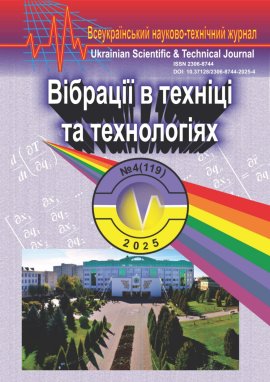
Issue №: 4(119)
The journal deals with the problems of vibration technologies and machines, mathematical methods of vibration process studies, information on design and technological development, presents teaching and methodological aspects of teaching in the Higher School of Applied Sciences, where vibration machines and technologies are studied.
INVESTIGATION OF SPREADING IN AK6 ALUMINUM ALLOY DURING HOT ROLLING
Chmykh Kateryna – Recipient of the Third Educational and Scientific Level of the Vinnytsia National Agrarian University (Sunny str., 3, Vinnytsia, Ukraine, 21008, e-mail: catherina099@gmail.com, https://orcid.org/0000-0001-8873-4436).
This article presents a comprehensive study of the transverse spreading (Δb) of the AK6 aluminum alloy during hot rolling, taking into account the influence of key technological parameters, structural transformations, and contact conditions between the metal and the rolls. The aim of the study is to determine the regularities of lateral metal flow, evaluate the roles of temperature, reduction degree, billet diameter, and roll diameter in forming the magnitude of Δb, as well as to assess the accuracy of analytical models used for predicting spreading under hot deformation conditions.
Experimental tests were conducted on billets of various diameters and at different reduction levels, enabling an analysis of the effects of geometric and kinematic factors on metal flow within the deformation zone. It is shown that hot rolling results in reduced transverse spreading compared to cold deformation due to lower flow stress, activation of dynamic recovery and recrystallization, and increased plasticity of the AK6 alloy within the temperature range of 420–480 °С. It was established that the reduction degree is a decisive factor governing the nonlinear growth of Δb, whereas an increase in the initial billet diameter leads to a decrease in lateral flow due to stronger transverse frictional forces and changes in the deformation zone geometry.
It is demonstrated that the roll diameter significantly affects spreading intensity: a larger roll diameter (D) increases the deformation zone length, intensifies tangential friction forces, and contributes to partial redistribution of metal flow in the transverse direction. Special attention is given to comparing analytical models by Passini, Skriabin, and temperature-corrected formulations, all of which showed satisfactory agreement with experimental findings. This confirms their suitability for engineering calculations and practical prediction of spreading under varying technological conditions.
The obtained results have important practical implications for optimizing hot rolling processes of aluminum alloys. They make it possible to reduce errors in roll pass design, improve the dimensional accuracy of rolled products, minimize the risk of edge defects (waviness, “earing”, microcracks), and ensure stable performance characteristics of AK6 alloy products.
1. Shvets, L. (2020). The essence and possibility of the method of isothermal deformation. Slovak International Scientific Journal, 1(42), 16–24. [English]
2. Skriabin, S. O. (2018). Doslidzhennia poperechnoho rozshyrennia pry prokatuvanni zahotovok zminnoho diametra [Study of transverse spreading during rolling of billets of variable diameter]. Metaloobrobka ta obrobka tyskom. [Ukrainian]
3. Passini, D. (2005). Rolling Theory and Metal Flow in Deformation Processes. Springer. [English]
4. Polukhin, P. (2014). Plasticity and Hot Deformation of Aluminum Alloys. Elsevier. [English]
5. Kolosov, M. A. (2012). Teoriia ta modeliuvannia protsesiv ploskoho prokatuvannia [Theory and modelling of flat rolling processes]. NTUU “KPI”. [Ukrainian]
6. Avakovich, V. (2010). Stress-state analysis in rod rolling. Journal of Materials Processing Technology. [English]
7. Shvets, L., & Trukhanska, O. (2021). Deformation of aluminum alloys in isothermal conditions. Tekhnika, Enerhetyka, Transport APK, 3(114), 68–74. https://doi.org/10.37128/2520-6168-2021-3-8 [English]
8. Shvets, L. (2022). Expansion during rolling of preparations in different calibers. Slovak International Scientific Journal, 62, 17–30. [English]
9. Puzyr, R., & Shvets, L. (2022). Development of methods of experimental and analytical research of metal flow in the center of deformation of aluminum alloys during combine parts rolling. Norwegian Journal of Development of the International Science, 83, 63–74. [English]
10. Shvets, L. (2020). Extension value with hot-rolled aluminum alloy specimens of round section in smooth rollers. In Scientific Foundations of Modern Engineering (pp. 234–240). Boston. [English]
About the journal
The journal "Vibrations in Engineering and Technologies" is included in the list of technical scientific publications of Ukraine
(Category "B", Order of the Ministry of Education and Science of Ukraine dated July 2, 2020 No. 886)
Old version of the site: http://vibrojournal.vsau.edu.ua/
The journal "Vibrations in Engineering and Technology" is indexed by the following databases and catalogs:





The certificateof massmedia State registration:kv no 16643-5115 from 30.04.2010 .
Founder of the journal: Vinnytsia National Agrarian University
The journal is devoted to highlighting current issues in engineering, mechanical engineering, and technological processes, including the study of dynamic and oscillatory phenomena in technical systems, the application of mathematical methods for process modeling and analysis, as well as the presentation of results of design-engineering and technological developments. Particular attention is given to the study of vibration processes and their application in modern technologies.
The purpose of the scientific journal “Vibrations in Engineering and Technologies” is to disseminate the results of fundamental and applied research in the field of engineering sciences aimed at developing theoretical foundations and practical approaches to the design, analysis, and improvement of machines, materials, and technological processes, including the use of vibration and oscillatory effects in various sectors of production.
The publication is focused on the formation of a modern scientific and informational environment for the effective exchange of research results, support of innovative development, and implementation of advanced technical solutions in industry, agro-industrial production, and related fields.
The journal promotes the development of interdisciplinary research, the integration of modern engineering approaches, and the enhancement of the efficiency of technological processes and technical systems, including through the rational use of vibration phenomena.
Objectives of the Scientific Journal
To achieve its stated purpose, the journal addresses the following key objectives:
dissemination of results of fundamental and applied scientific research in the fields of mechanics, mechanical engineering, technological processes, machine dynamics, and equipment, as well as in areas related to the application of vibration phenomena in engineering and technologies;
promotion of research aimed at the creation and improvement of machines, mechanisms, and technological equipment based on oscillatory and vibration processes;
support for the implementation of modern technological solutions focused on improving productivity, energy efficiency, and reliability of technical systems;
обеспечение scientific exchange of research results among research institutions, higher education establishments, and industrial enterprises;
development of interdisciplinary cooperation among researchers in the fields of mechanics, materials science, material processing technologies, and automation of technological processes;
dissemination of modern scientific achievements and advanced technologies related to the application of vibration processes in production and technical systems.
Publisher Vinnytsia National Agrarian University
In June 1994 the 2nd International Scientific and Technical Conference "Application of vibrations for technological purposes" was organized on the basis of Vinnytsia State Agricultural Institute. Leading experts in this field, noting the significant contribution to the school of Vibration Engineering under the leadership of P. S. Bernyk, proposed to create a professional all-Ukrainian scientific and technical journal "Vibration in engineering and technology..The journal was foundedat Vinnytsia State Agricultural Institute and P.S. Bernyk was elected to be the chief editor .
For all these years (since 1994) theJournal "vibration in engineering and technology" published 119 issues wherestudy of vibration effects, the creation of progressive energy saving technologies and equipment for their implementation were highlighted.
Currently Ihor Kupchuk, Candidate of Technical Sciences, Associate professor, Associate Professor of the Department of Engineering Mechanics and Technological Processes in the Agricultural Industry Faculty of Engineering and Technology Vinnytsia National Agrarian University is the chief editor of the "Vibrations in engineering and Technology"
The journal "Vibration in Engineering and technology", which has no analogues on the territory of Ukraine, is well known abroad.
