

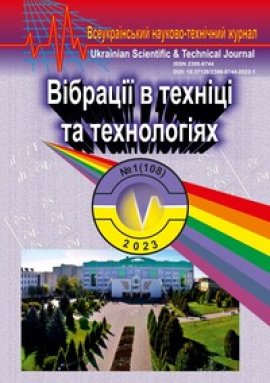
Issue №: 1 (108)
The journal deals with the problems of vibration technologies and machines, mathematical methods of vibration process studies, information on design and technological development, presents teaching and methodological aspects of teaching in the Higher School of Applied Sciences, where vibration machines and technologies are studied.
FEATURES OF THE GRAIN MICRONIZATION PROCESS
Yurii Polievoda – PhD, Associate Professor of the Department of technological processes and equipment for processing and food production, Vinnytsia National Agrarian University (Sonyachna st., 3, Vinnytsia, 21008, Ukraine, e-mail: vinyura36@gmail.com).
Viktor Revva – postgraduate student of the Department Technological processes and the possession of food processing and food production of the Vinnytsia National Agrarian University (Sonyachna st., 3, Vinnytsia, 21008, Ukraine, e-mail: Viktorreva1@gmail.com).
Ihor Tverdokhlib – PhD of Engeneering Science, Associate Professor at the Department of General Technical Disciplines and Labor Protection of Vinnytsia National Agrarian University (3, Sonychna St., Vinnytsia, 21008, Ukraine, e-mail: igor_tverdokhlib@yahoo.com).
Effective means of reducing the loss of grain products are its processing and bringing it to the condition humidity by means of heat treatment. One of these methods - micronization of grain allows to reduce non-productive energy consumption, improve the quality of the finished product, it can be considered the most promising for thermal processing of grain in the food industry. The purpose of this study is to increase the energy and quality efficiency of the grain micronization process by studying the features of its flow in various technological conditions. The analysis of sources devoted to the issue of grain micronization shows that the main direction of research is the substantiation of process parameters and the development of new technological methods. To successfully conduct research in this direction, it is necessary to understand all the features of the elements of this system (installation and grain) that arise during the implementation of the micronization process. The nature of the interaction between the material and IR radiation largely depends on the optical characteristics of the grain. Optical properties of materials are usually characterized by their transmission, absorption and reflection capacity. The optical characteristics of materials depend on a number of factors, such as structure, humidity, process temperature, etc. The properties of vitreous and floury grains are particularly different. The effect of grain structure especially affects the reflection coefficients of radiant energy. So, for the same wavelength of 0,9-1,3 μm and moisture content of 5-30%, for floury wheat grains it is equal to 0.68-0,73, while for vitreous grains it has a value of 0,48-0,54. There cannot be a universal approach to determine the rational parameters of the grain micronization process. In each case, there must be specific approaches to determine the rational parameters of the process. This will significantly increase the energy and quality efficiency of the grain processing process.
1. Podpriatov, H. I., Rozhko, V. I., Skaletska, L. F. (2014). Tekhnolohiia zberihannia ta pererobky produktsii roslynnytstva. [Technology of storage and processing of crop products]. Pidruchnyk. Ahrarna osvita. P. 393. [in Ukrainian].
2. Polievoda, Y.A., Revva, V.Y., Popov, I.I. (2022). Metody termichnoyi obrobky zerna. [Methods of heat treatment of grain]. Vibratsiyi v tekhnitsi ta tekhnolohiyakh. Vol. № 2 (105). P.122-129. [in Ukrainian].
3. Kotov, B.I., Kalinichenko, R.A., Stepanenko, S.P., Shvydya, V.O., Lisetsʹkyy, V.O. (2017). Modelyuvannya tekhnolohichnykh protsesiv v typovykh obʺyektakh pislyazbyralʹnoyi obrobky i zberihannya zerna (separatsiya, sushinnya, aktyvne ventylyuvannya, okholodzhennya). [Modeling of technological processes in typical facilities of post-harvest processing and grain storage (separation, drying, active ventilation, cooling). Monohrafiya. P. 552 [in Ukrainian].
4. Kalinichenko, R.A., Solona, O.V., Tverdokhlib, I.V. (2017). Doslidzhennya radiatsiyno-konvektyvnoyi termoobrobky zerna u vibrokyplyachomu shari. [Study of radiative-convective heat treatment of grain in a vibrating fluidized bed] Vibratsiyi v tekhnitsi ta tekhnolohiyakh. Vol. № 2 (58). P. 95-98. [in Ukrainian].
5. Solona, V.O., Kotov, B.I., Spirin, A.V., Kalinichenko, R.A. (2016). Obgruntuvannya parametriv poyednanykh protsesiv mikronizatsiyi i podribnennya iz zastosuvannyam vibratsiynykh tekhnolohiy pry pererobtsi zerna na korm. [Justification of the parameters of the combined processes of micronization and grinding with the use of vibration technologies in the processing of grain into fodder]. Vibratsiyi v tekhnitsi ta tekhnolohiyakh. Vol. № 3 (83). P. 213-218. [in Ukrainian]
6. Palamarchuk, I. P., Tsurkan, O. V., Prysyazhnyuk, D. V., Polievoda, Y.A. (2016). Obhruntuvannya skhemy vibroozonuyuchoyi susharky dlya pislyazbyralʹnoyi obrobky zerna. [Rationale for the vibro-ozonation dryer scheme for post-harvest grain processing]. Naukovi pratsi Natsionalʹnoho universytetu kharchovykh tekhnolohiy. № 6. T. 22. P. 151–156. [in Ukrainian].
7. Yemchyk, V. V., Polievoda, Y.A., Revva, V. Y. (2022). Obhruntuvannya konstruktyvnoyi skhemy ustanovky dlya obrobky zernystoho materialu infrachervonym vyprominyuvannyam. [Rationale of the structural scheme of the installation for processing granular material with infrared radiation]. Tekhnika, enerhetyka, transport APK. № 3 (118). P. 43–52. [in Ukrainian].
8. Polievoda, Y. A. (2019). Patent na korysnu modelʹ. Infrachervona vibrosusharka. [Infrared vibrating dryer]. № 136236. Publikatsiya vidomostey 12.08. Byul. № 15. [in Ukrainian].
9. Bandura, V., Kalinichenko, R., Kotov, B., Spirin, A. (2018). Theoretical rationale and identification of heat and mass transfer processes in vibration dryers with IR-energy supply. Eastern-European Journal of Enterprise Technologies. Vol. 4, № 8 (94). P. 50-58. [in English].
10. Kotov, B., Spirin, A., Kalinichenko, R., Bandura, V., Polievoda, Y., Tverdokhlib, I. (2019). Determination the parameters and modes of new heliocollectors constructions work for drying grain and vegetable raw material by active ventilation. Research in Agricultural Engineering. Vol. 65. № 1. P. 20-24. [in English].
11. Kotov, B., Spirin, A., Tverdokhlib, I., Polievoda, Y. (2018). Theoretical researches on cooling process regularity of the grain material in the layer. INMATEH – Agricultural Engineering. Vol. 54. № 1. P. 87-94. [in English].
12. Paziuk, V., Petrova, Z., Tokarchuk, O., Polievoda, Y. (2021). Special aspects of soybean drying with high seedling vigor. Scientific bulletin, Series D: Mechanical Engineering. Vol. 83. Iss. 2. P. 327–336. [in English].
13. Hanieh Sajjadi, Seyed Hadi Ebrahimi, Seyed Alireza Vakili, Abbas Rohani, Mahmood Reza Golzarian,Vahideh Heidarian Miri. (2022). Operational conditions and potential benefits of grains micronization for ruminant: A review. Animal Feed Science and Technology. Vol. 287. 115285. [in English].
14. Sitong Lai., Zhenjia Chen., Yanqing Zhang., Guang Li., Yuanmeng Wang., Qingliang Cui. (2023). Micronization Effects on Structural, Functional, and Antioxidant Properties of Wheat Bran. MDPI. Foods. Vol.12. Issue 1. [in English].
About the journal
The journal "Vibrations in Engineering and Technologies" is included in the list of technical scientific publications of Ukraine
(Category "B", Order of the Ministry of Education and Science of Ukraine dated July 2, 2020 No. 886)
Old version of the site: http://vibrojournal.vsau.edu.ua/
The journal "Vibrations in Engineering and Technology" is indexed by the following databases and catalogs:





The certificateof massmedia State registration:kv no 16643-5115 from 30.04.2010 .
Founder of the journal: Vinnytsia National Agrarian University
The journal is devoted to highlighting current issues in engineering, mechanical engineering, and technological processes, including the study of dynamic and oscillatory phenomena in technical systems, the application of mathematical methods for process modeling and analysis, as well as the presentation of results of design-engineering and technological developments. Particular attention is given to the study of vibration processes and their application in modern technologies.
The purpose of the scientific journal “Vibrations in Engineering and Technologies” is to disseminate the results of fundamental and applied research in the field of engineering sciences aimed at developing theoretical foundations and practical approaches to the design, analysis, and improvement of machines, materials, and technological processes, including the use of vibration and oscillatory effects in various sectors of production.
The publication is focused on the formation of a modern scientific and informational environment for the effective exchange of research results, support of innovative development, and implementation of advanced technical solutions in industry, agro-industrial production, and related fields.
The journal promotes the development of interdisciplinary research, the integration of modern engineering approaches, and the enhancement of the efficiency of technological processes and technical systems, including through the rational use of vibration phenomena.
Objectives of the Scientific Journal
To achieve its stated purpose, the journal addresses the following key objectives:
dissemination of results of fundamental and applied scientific research in the fields of mechanics, mechanical engineering, technological processes, machine dynamics, and equipment, as well as in areas related to the application of vibration phenomena in engineering and technologies;
promotion of research aimed at the creation and improvement of machines, mechanisms, and technological equipment based on oscillatory and vibration processes;
support for the implementation of modern technological solutions focused on improving productivity, energy efficiency, and reliability of technical systems;
обеспечение scientific exchange of research results among research institutions, higher education establishments, and industrial enterprises;
development of interdisciplinary cooperation among researchers in the fields of mechanics, materials science, material processing technologies, and automation of technological processes;
dissemination of modern scientific achievements and advanced technologies related to the application of vibration processes in production and technical systems.
Publisher Vinnytsia National Agrarian University
In June 1994 the 2nd International Scientific and Technical Conference "Application of vibrations for technological purposes" was organized on the basis of Vinnytsia State Agricultural Institute. Leading experts in this field, noting the significant contribution to the school of Vibration Engineering under the leadership of P. S. Bernyk, proposed to create a professional all-Ukrainian scientific and technical journal "Vibration in engineering and technology..The journal was foundedat Vinnytsia State Agricultural Institute and P.S. Bernyk was elected to be the chief editor .
For all these years (since 1994) theJournal "vibration in engineering and technology" published 119 issues wherestudy of vibration effects, the creation of progressive energy saving technologies and equipment for their implementation were highlighted.
Currently Ihor Kupchuk, Candidate of Technical Sciences, Associate professor, Associate Professor of the Department of Engineering Mechanics and Technological Processes in the Agricultural Industry Faculty of Engineering and Technology Vinnytsia National Agrarian University is the chief editor of the "Vibrations in engineering and Technology"
The journal "Vibration in Engineering and technology", which has no analogues on the territory of Ukraine, is well known abroad.
