

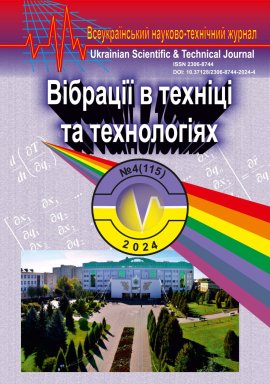
Issue №: 4(115)
The journal deals with the problems of vibration technologies and machines, mathematical methods of vibration process studies, information on design and technological development, presents teaching and methodological aspects of teaching in the Higher School of Applied Sciences, where vibration machines and technologies are studied.
EXPERIMENTAL STUDY OF WATER AND NUTRIENT BALANCE INTERACTIONS IN CLOSED HYDROPONIC SYSTEMS
Stadnik Mykola – Doctor of Technical Sciences, Professor of the Department of Electrical Power Engineering, Electrical Engineering and Electromechanics of Vinnytsia National Agrarian University (3 Sonyachna St., Vinnytsia, 21008, Ukraine.
Burlaka Serhiy – Doctor of Philosophy in Industrial Mechanical Engineering, Senior Lecturer of the Department of Engineering Mechanics and Technological Processes in the Agricultural Industry of Vinnytsia National Agrarian University (3 Sonyachna St., Vinnytsia, 21008, Ukraine, e-mail: ipserhiy@gmail.com, https://orcid.org/0000-0002-4079-4867)
Luts Pavlo – Candidate of Technical Sciences, Senior Lecturer of the Department of Machinery and Equipment for Agricultural Production of Vinnytsia National Agrarian University (3 Sonyachna St., Vinnytsia, 21008, Ukraine, e-mail: serhiydron@gmail.com)
This article presents a study aimed at modeling the interactions of water and nutrient balances in hydroponic systems, which are increasingly recognized as an environmentally sustainable and highly efficient method for growing plants without soil. Hydroponic systems provide optimal nutrient delivery to plants through a water solution maintained in a closed cycle, reducing water and fertilizer usage compared to traditional agriculture. However, the effectiveness of such systems largely depends on precise regulation of water and nutrient balances to ensure proper plant growth and optimize resource use.
The purpose of this study is to develop a comprehensive model that considers the dynamics of water and nutrient environments within the hydroponic system and predicts plants' requirements for essential nutrients. The article examines key parameters that influence nutrient balance in hydroponics, including pH level, concentrations of essential micro- and macronutrients, nutrient uptake rates by plants, evaporation, transpiration, temperature variations, and the nutrient ratio in the solution. Achieving stable water and nutrient balance requires accounting for all these factors and adjusting system parameters according to external conditions and the plants' growth stage.
The study’s methodology is based on a combination of mathematical modeling and experimental data, enabling the creation of an adaptive model for the hydroponic system. The article details the model structure, including input variables (temperature, humidity, nutrient concentration), exchange processes (uptake and transpiration), and output variables (optimal nutrient element concentrations). The modeling results facilitate the control and adjustment of the nutrient solution, minimizing water and fertilizer usage while ensuring maximum plant yield.
The practical significance of the developed model lies in its applicability for managing hydroponic farms of various scales, from home setups to industrial agricultural enterprises.
1. Gil L.S., Pashkovskyi A.I., Sulima L.T. (2008) Modern technologies of vegetable growing in closed and open soil. Education manual. Vinnytsia: Nova Kniga, 368 p. [in Ukrainian].
2. Pastushenko V.Y., Stetsenko A.M. (2009) Automated system for managing the moisture supply of agricultural crops during drip irrigation. Automated control systems and automation devices. Kharkiv: National University of Radio Electronics. № 147. P.46–52. [in Ukrainian].
3. Sevostyanov I.V., Melnyk O.S. (2021) Improving the operation of hydroponic installations. Technology, energy, transport of agricultural industry. № 4(115). P.119–127. [in Ukrainian].
4. Sevostianov I., Melnyk O. (2022) Elaboration and researches of apparatus of control for hydroponic installations. Vibrations in engineering and technology. № 1(104). P.57–62. in English
5. Kovalev M.M., Vasylkovska K.V. (2020) The influence of the salt composition of the nutrient solution on the cultivation of different varieties of romaine lettuce in hydroponic columns. Current state of science in agriculture and nature management: theory and practice. Kropyvnytskyi. National Technical University, November 20, 2020. P.83–86. [in Ukrainian].
6. Minenko S.V., Savchenko V.M., Krot V.V. (2016) Analysis of the dependence of the intensity of productive photosynthesis on microclimate regimes in industrial greenhouses. Bulletin of Zhytomyr NAEU. № 1 (53). T.1. P.270–275. [in Ukrainian].
7. Savchenko V.M., Minenko S.V., Makhov O.A. (2013) Formal models for microclimate regulation in greenhouses. Materials of international Scientific and practical Internet conferences, March 16, 2013. Ternopil: Krok,. P.87-89. [in Ukrainian].
8. Savchenko V.M., Minenko S.V., Makhov O.A. (2013) Strategies for controlling microclimate processes in industrial greenhouses. Increasing the reliability of machines and equipment: a collection of theses of reports of the 7th All-Ukrainian scientific and practical conference of students and postgraduates. Kirovohrad: KNTU, P.48-50. [in Ukrainian].
9. Kovalev M.M., Zvezdun O.M. (2021) Cultivation of the most common varieties of romaine lettuce on different types of substrates in NTF systems. Aquatic bioresources and aquaculture. Issue 1. P.27–36. [in Ukrainian].
About the journal
The journal "Vibrations in Engineering and Technologies" is included in the list of technical scientific publications of Ukraine
(Category "B", Order of the Ministry of Education and Science of Ukraine dated July 2, 2020 No. 886)
Old version of the site: http://vibrojournal.vsau.edu.ua/
The journal "Vibrations in Engineering and Technology" is indexed by the following databases and catalogs:





The certificateof massmedia State registration:kv no 16643-5115 from 30.04.2010 .
Founder of the journal: Vinnytsia National Agrarian University
The journal is devoted to highlighting current issues in engineering, mechanical engineering, and technological processes, including the study of dynamic and oscillatory phenomena in technical systems, the application of mathematical methods for process modeling and analysis, as well as the presentation of results of design-engineering and technological developments. Particular attention is given to the study of vibration processes and their application in modern technologies.
The purpose of the scientific journal “Vibrations in Engineering and Technologies” is to disseminate the results of fundamental and applied research in the field of engineering sciences aimed at developing theoretical foundations and practical approaches to the design, analysis, and improvement of machines, materials, and technological processes, including the use of vibration and oscillatory effects in various sectors of production.
The publication is focused on the formation of a modern scientific and informational environment for the effective exchange of research results, support of innovative development, and implementation of advanced technical solutions in industry, agro-industrial production, and related fields.
The journal promotes the development of interdisciplinary research, the integration of modern engineering approaches, and the enhancement of the efficiency of technological processes and technical systems, including through the rational use of vibration phenomena.
Objectives of the Scientific Journal
To achieve its stated purpose, the journal addresses the following key objectives:
dissemination of results of fundamental and applied scientific research in the fields of mechanics, mechanical engineering, technological processes, machine dynamics, and equipment, as well as in areas related to the application of vibration phenomena in engineering and technologies;
promotion of research aimed at the creation and improvement of machines, mechanisms, and technological equipment based on oscillatory and vibration processes;
support for the implementation of modern technological solutions focused on improving productivity, energy efficiency, and reliability of technical systems;
обеспечение scientific exchange of research results among research institutions, higher education establishments, and industrial enterprises;
development of interdisciplinary cooperation among researchers in the fields of mechanics, materials science, material processing technologies, and automation of technological processes;
dissemination of modern scientific achievements and advanced technologies related to the application of vibration processes in production and technical systems.
Publisher Vinnytsia National Agrarian University
In June 1994 the 2nd International Scientific and Technical Conference "Application of vibrations for technological purposes" was organized on the basis of Vinnytsia State Agricultural Institute. Leading experts in this field, noting the significant contribution to the school of Vibration Engineering under the leadership of P. S. Bernyk, proposed to create a professional all-Ukrainian scientific and technical journal "Vibration in engineering and technology..The journal was foundedat Vinnytsia State Agricultural Institute and P.S. Bernyk was elected to be the chief editor .
For all these years (since 1994) theJournal "vibration in engineering and technology" published 119 issues wherestudy of vibration effects, the creation of progressive energy saving technologies and equipment for their implementation were highlighted.
Currently Ihor Kupchuk, Candidate of Technical Sciences, Associate professor, Associate Professor of the Department of Engineering Mechanics and Technological Processes in the Agricultural Industry Faculty of Engineering and Technology Vinnytsia National Agrarian University is the chief editor of the "Vibrations in engineering and Technology"
The journal "Vibration in Engineering and technology", which has no analogues on the territory of Ukraine, is well known abroad.
