

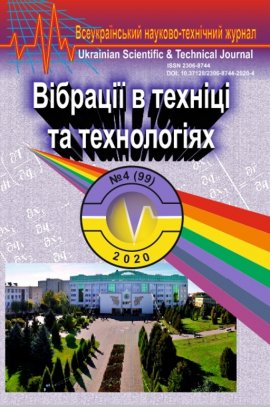
Issue №: 4(99)
The journal deals with the problems of vibration technologies and machines, mathematical methods of vibration process studies, information on design and technological development, presents teaching and methodological aspects of teaching in the Higher School of Applied Sciences, where vibration machines and technologies are studied.
EVALUATION OF THE INFLUENCE OF VELOCITY ROTOR REGIMES ON ELECTRICITY CONSUMPTION DRIVED BY A VIBRATION DISC CRUSHER
Solona Olena – Candidate of Technical Sciences (Ph. D in Engeneering), Associate Professor of the Department of General Technical Disciplines and Labor Protection, Vinnytsia National Agrarian University (3, Solnyschaya St., Vinnytsia, Ukraine,21008, e-mail: solona_o_v@ukr.net).
Kupchuk Ihor – Candidate of Technical Sciences (Ph. D in Engeneering), Associate Professor of the Department of General Technical Disciplines and Labor Protection, Vinnitsa National Agrarian University (3, Sonyachna St., Vinnitsa, Ukraine, 21008, e-mail: kupchuk.igor@i.ua).
Hontar Volodymyr – postgraduate in specialty 133 «Sectoral Mechanical Engineering» of Vinnytsia National Agrarian University (3, Sonychna St., Vinnytsia, 21008, Ukraine, +380683260329, bulbashka31@gmail.com).
Didyk Andrii – Master's student majoring in 208 “Agroengineering” of Vinnytsia National Agrarian University (3, Sonychna St., Vinnytsia, 21008, Ukraine, +380972830537, anddidyk99@gmail.com).
Among a number of methods for intensifying the process of grinding grain material in the technology of compound feed preparation, one of the most promising can be considered the use of a vibration field, which contributes to the formation of optimal conditions for the timely withdrawal of the finished product from the grinding zone and ensures self-cleaning of the separation surfaces from the remnants of the crushed product (especially when using non-food classes grain), thereby ensuring the maximum throughput of the machine.
Given that for grinding in feed production mainly use impact machines, which are adapted to the destruction of solid and at the same time fragile objects, as well as the economic feasibility of processing substandard feed grain, which has completely opposite physical and mechanical characteristics. scheme of vibrating-rotary disk crusher. The essence of the development is to provide a combined force on the material, namely, due to the rotational and vibratory motion of the impact elements of the crusher, a combination of impact destruction and cutting material, which will process both hard and wet material without significantly reducing equipment throughput. In addition, the oscillating mode of the working chamber and, as a consequence, the separation surface will facilitate the timely removal of the finished product from the grinding zone.
The next stage of creating a vibrating-rotary crusher, which precedes the design and constructive implementation is to perform theoretical calculations of its parameters, including using the methods of mathematical modeling.
Thus, in order to achieve high efficiency of the process of grinding feed by the designed machine, theoretical studies of the relationship between the values of kinematic parameters of the executive bodies and electricity consumption to drive them, the main results of which are presented in the article.
1. Kaletnik, H. M., Kulyk, M. F. & Hlushko, Ya. T. (2006). Enerhooshchadni tekhnolohii kormiv – osnova konkurentozdatnosti tvarynnytstva [Energy-saving feed technologies - the basis of animal competitiveness]. Vinnytsia : Teza. 340 p. [In Ukrainian].
2. Kupchuk, I. M. (2019). Eksperymentalni doslidzhennia protsesu podribnennia furazhnoho zerna vibratsiinoiu dyskovoiu drobarkoiu [Experimental studies of the process of grinding fodder grain with a vibrating disk crusher]. Vibratsii v tekhnitsi ta tekhnolohiiakh – Vibrations in engineering and technology, 3 (94), 68-75 [In Ukrainian].
3. Nanka, O.V & Boiko, I.H. (2012). Shliakhy znyzhennia enerhoiemnosti podribnennia zernovykh kormiv ta pidvyshchennia yakosti podribnennia [Ways to reduce the energy consumption of grinding grain feed and improve the quality of grinding]. Tekhnolohiia vyrobnytstva i pererobky produktsii tvarynnytstva. Zbirnyk naukovykh prats BNAU – Technology of production and processing of livestock products. Collection of scientific works of BNAU, 7, 55-58 [In Ukrainian].
4. Toneva, P., Epple, P. & Breuer, M. (2011). Grinding in an air classifier mill – Part I : Characterisation of the one-phase flow. Powder Technology, 211, 19-27 [In English].
5. Kupchuk, I.M., Solona, O.V., Derevenko, I.A. & Tverdokhlib, I.V. (2018). Verification of the mathematical model of the energy consumption drive for vibrating disc crusher. Inmateh – Agricultural Engineering, 55, 111-118 [In English].
6. Hvozdiev, O.V., Shpyhanovych, T.O. & Yalpachyk, O.V. (2011). Vdoskonalennia protsesu podribnennia zerna [Improving the process of grinding grain]. Zbirnyk naukovykh prats Vinnytskoho natsionalnoho ahrarnoho universytetu. Seriia: Tekhnichni nauky – Collection of scientific works of Vinnytsia National Agrarian University. Series: Technical Sciences, 11, 143-150 [In Ukrainian].
7. Islam, M. N. & Matzen, R. (1988). Size distribution analysis of ground wheat by hammer mill. Powder Technology, 54, 235–241 [In English].
8. Kosse, V. & Mathew, J. (2017). Design of hammer mills for optimum performance. Proceeding of the Institution of Mechanical Engineers, 215, 87-94 [In English].
9. Bulgakov, V., Pascuzzi, S., Ivanovs, S., Kaletnik, G. & Yanovich, V. (2018). Angular oscillation model to predict the performance of a vibratory ball mill for the fine grinding of grain. Biosystems Engineering, 171, 155-164 [In English].
10. Goncharevich, I. F. & Frolov, K. V. (1981). Teoriya vibratsionnoy tehniki i tehnologii [Theory of vibration technology and technology]. Moskva : Nauka. 320 p [In Russian].
11. Palamarchuk, I.P., Yanovych, V.P. & Kupchuk, I.M. (2013). Vibrorotorna drobarka [Grinder rotor vibration]. Patent, 85270, UA [in Ukrainian].
12. Bulhakov, V.M., Adamchuk, V.V., Kaletnik, H.M. & Chernysh, O.M. (2016). Teoretychne doslidzhennia zburenykh harmoniinykh kolyvan u vibratsiinykh pryvodakh mashyn [Theoretical study of perturbed harmonic oscillations in vibrating drives of machines]. Vibratsii v tekhnitsi ta tekhnolohiiakh – Vibrations in engineering and technology. 2 (82), 5-9 [in Ukrainian].
13. Ianovych, V. P. & Kaletnik, H. M. (2017). Obgruntuvannia rezhymnykh ta konstruktyvnykh parametriv hiratsiinoho mlyna dlia vyrobnytstva vysokoaktyvnykh premiksiv [Substantiation of regime and design parameters of gyration mill for production of highly active premixes]. Vibratsii v tekhnitsi ta tekhnolohiiakh – Vibrations in engineering and technology, 1 (84), 15-21 [in Ukrainian].
14. Yanovych, V. P. & Kupchuk, I. M. (2017). Determination of rational operating parameters for a vibrating disk-type grinder used in ethanol industry. Inmateh – Agricultural Engineering, 52, 143-148 [In English].
15. Palamarchuk, I. P., Yanovich, V. P. & Kupchuk, I. N. (2015). Analiz matematicheskoy modeli vibrorotornoy drobilki [Analysis of the mathematical model of a vibro-rotor crusher.]. MOTROL. Commission of Motorization and Energetics in Agriculture, 17, 4, 139-144 [In Russian].
About the journal
The journal "Vibrations in Engineering and Technologies" is included in the list of technical scientific publications of Ukraine
(Category "B", Order of the Ministry of Education and Science of Ukraine dated July 2, 2020 No. 886)
Old version of the site: http://vibrojournal.vsau.edu.ua/
The journal "Vibrations in Engineering and Technology" is indexed by the following databases and catalogs:





The certificateof massmedia State registration:kv no 16643-5115 from 30.04.2010 .
Founder of the journal: Vinnytsia National Agrarian University
The journal is devoted to highlighting current issues in engineering, mechanical engineering, and technological processes, including the study of dynamic and oscillatory phenomena in technical systems, the application of mathematical methods for process modeling and analysis, as well as the presentation of results of design-engineering and technological developments. Particular attention is given to the study of vibration processes and their application in modern technologies.
The purpose of the scientific journal “Vibrations in Engineering and Technologies” is to disseminate the results of fundamental and applied research in the field of engineering sciences aimed at developing theoretical foundations and practical approaches to the design, analysis, and improvement of machines, materials, and technological processes, including the use of vibration and oscillatory effects in various sectors of production.
The publication is focused on the formation of a modern scientific and informational environment for the effective exchange of research results, support of innovative development, and implementation of advanced technical solutions in industry, agro-industrial production, and related fields.
The journal promotes the development of interdisciplinary research, the integration of modern engineering approaches, and the enhancement of the efficiency of technological processes and technical systems, including through the rational use of vibration phenomena.
Objectives of the Scientific Journal
To achieve its stated purpose, the journal addresses the following key objectives:
dissemination of results of fundamental and applied scientific research in the fields of mechanics, mechanical engineering, technological processes, machine dynamics, and equipment, as well as in areas related to the application of vibration phenomena in engineering and technologies;
promotion of research aimed at the creation and improvement of machines, mechanisms, and technological equipment based on oscillatory and vibration processes;
support for the implementation of modern technological solutions focused on improving productivity, energy efficiency, and reliability of technical systems;
обеспечение scientific exchange of research results among research institutions, higher education establishments, and industrial enterprises;
development of interdisciplinary cooperation among researchers in the fields of mechanics, materials science, material processing technologies, and automation of technological processes;
dissemination of modern scientific achievements and advanced technologies related to the application of vibration processes in production and technical systems.
Publisher Vinnytsia National Agrarian University
In June 1994 the 2nd International Scientific and Technical Conference "Application of vibrations for technological purposes" was organized on the basis of Vinnytsia State Agricultural Institute. Leading experts in this field, noting the significant contribution to the school of Vibration Engineering under the leadership of P. S. Bernyk, proposed to create a professional all-Ukrainian scientific and technical journal "Vibration in engineering and technology..The journal was foundedat Vinnytsia State Agricultural Institute and P.S. Bernyk was elected to be the chief editor .
For all these years (since 1994) theJournal "vibration in engineering and technology" published 119 issues wherestudy of vibration effects, the creation of progressive energy saving technologies and equipment for their implementation were highlighted.
Currently Ihor Kupchuk, Candidate of Technical Sciences, Associate professor, Associate Professor of the Department of Engineering Mechanics and Technological Processes in the Agricultural Industry Faculty of Engineering and Technology Vinnytsia National Agrarian University is the chief editor of the "Vibrations in engineering and Technology"
The journal "Vibration in Engineering and technology", which has no analogues on the territory of Ukraine, is well known abroad.
