

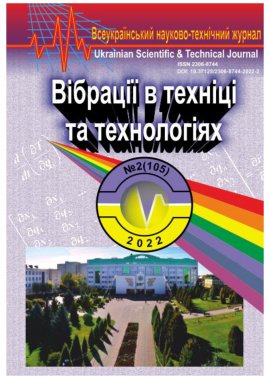
Issue №: 2(105)
The journal deals with the problems of vibration technologies and machines, mathematical methods of vibration process studies, information on design and technological development, presents teaching and methodological aspects of teaching in the Higher School of Applied Sciences, where vibration machines and technologies are studied.
CONSTRUCTION OF CURVED LIMIT DEFORMATIONS OF MATERIALS
Matviychuk Viktor – Doctor of Technical Sciences, Full Professor, Head of the Department of Electric Power Engineering, Electrical Engineering and Electromechanics, Vinnitsa National Agrarian University (3 Solnechna St., Vinnitsa, 21008, Ukraine, email: vamatv50@gmail.com)
Kolisnyk Mykola – Assistant Professor, Department of Electric Power Engineering, Electrical Engineering and Electromechanics, Vinnitsa National Agrarian University (3, Solnechna str., Vinnitsa, 21008, Ukraine, email: kolisnik30@gmail.com).
Andrii Shtuts – Assistant Professor, Department of Electric Power Engineering, Electrical Engineering and Electromechanics, Vinnitsa National Agrarian University (3, Solnechna str., Vinnitsa, 21008, Ukraine, email: shtuts1989@gmail.com).
The analysis of construction of curves of limiting deformations of metals is carried out in the work. It is established that traditional test methods, such as deposition and stretching of cylindrical specimens, do not ensure the constancy of the stress state, and therefore contribute to the history of deformation in the construction of curves. During deposition, there is an increase in the stress state due to the curvature of the lateral surface of the sample (barrel formation), which is caused by friction at the ends. And when stretched, the stress index also increases, as a result of the formation of the neck due to the loss of resistance to deformation. Therefore, measures were considered to ensure reliable results in the construction of curves of boundary deformations, excluding the influence of the history of deformation. When settling, such measures include the use of plastic, softer than the sample material, foil at the ends of the samples and the gradual removal of the edges of the hole at their ends by grinding or deposition without foil. In addition, the experimental-calculation method was considered, which involves the construction of ways of deformation and correction of the limit deformation using the criterion of deformability. When stretching, in the case of neck formation, the increase in deformation linearly depends on the ratio of the radius of curvature of the neck to its diameter. The equation by which the experimental-calculation method can take into account the influence of the neck on the increase of ultimate deformations is given. To experimentally determine the ultimate tensile deformation, a method of rolling cylindrical specimens on a wedge with rolls whose radii increase during rolling is proposed, which eliminates the appearance of the neck. Boundary strain curves can be constructed with sufficient accuracy for torsion and deposition test specimens, and tensile strain values are obtained using approximated dependences tested for different metals.
1. Ogorodnikov V.A. (1983). Estimation of deformability of metals during pressure treatment. Kyiv: Higher school. C. 175. [in Ukranian].
2. Mikhalevich V.M. (1998). Tensor models of damage accumulation. Vinnytsia: "UNIVERSUM - Vinnytsia". S. 195. [in Ukranian].
3. V.A. Matviychuk., I.S. Aliev. (2009). "Improvement of processes of local rotational processing by pressure on the basis of the analysis of deformability of metals". Kramatorsk: DGMA. Monograph. [in Ukranian].
4. Matviychuk V.A. (2007). On increasing the plasticity of metals in cases of neck tension. Forging and stamping production. Metal forming. № 9. S. 18-22. [in Ukranian].
5. V.M. Mikhalevich., Yu. V. Dobranyuk. (2015). Analytical representation of the maximum radius of cylindrical workpieces during axisymmetric deposition with barrel formation. Bulletin of Mechanical Engineering and Transport. № 1. Pp. 59-66. [in Ukranian].
6. V.A. Matviychuk., V.M. Mikhalevich., Yu. V. Dobranyuk., I.A. Bubnovskaya., "Method for determining the plasticity of metals by rolling cylindrical specimens on a wedge", IPC G01N 3/08 (2006/01) . № 109984, September 26, 2016. [in Ukranian].
7. Smirnov-Alyaev G.A. (1968). Mechanical foundations of plastic processing. Mechanical engineering. C. 272. [in Ukranian].
8. A. Shtuts, M. Kolisnyk, V. Yavdyk. (2018). Improvement of processes of rolling stamping on the basis of investigation of technological parameters on the mechanics of workpieces formation. MOTROL. Commission of Motorization and Energetics in Agriculture. Р. 19-25. Lublin [in Poland].
9. Kraievskyi V. O., Matviychuk, V. A., Mykhalevych, V. M. (2003). Vplyv tekhnolohichnykh parametriv na kinematyku kholodnoho tortsevoho rozkochuvannia. Udoskonalennia protsesiv ta obladnannia obrobky tyskom v mashynobuduvanni i metalurhii. Kramatorsk - Sloviansk. 286-291. [in Ukranian].
10. Matviychuk V.A., Kolisnyk M.A., Shtuts A.A. (2018). Investigation of the stress-strain state of the workpiece material during direct extrusion by rolling stamping. Engineering, energy, transport of agro-industrial complex. № 3 (102). 77-84. [in Ukrainian].
11. Shtuts A., Kolisnyk M., Vydmysh A., Voznyak O., Baraban S., Kulakov P. (2020). Improvement of Stamping by Rolling Processes of Pipe and Cylindrical Blades on Experimental Research. Actual Challenges in Energy & Mining.
Vol. 844. P.168-181. (Scopus SNIP: 0.29). [in Switzerland].
12. Karnaukh S. G., Markov O. E., Aliieva L. I., Kukhar V. V. (2020). Designing and researching of the equipment for cutting by breaking of rolled stock. The International Journal of Advanced Manufacturing Technology. № 109(9-12). pp. 2457–2464. DOI: 10.1007/s00170-020-05824-7. [in English]
About the journal
The journal "Vibrations in Engineering and Technologies" is included in the list of technical scientific publications of Ukraine
(Category "B", Order of the Ministry of Education and Science of Ukraine dated July 2, 2020 No. 886)
Old version of the site: http://vibrojournal.vsau.edu.ua/
The journal "Vibrations in Engineering and Technology" is indexed by the following databases and catalogs:





The certificateof massmedia State registration:kv no 16643-5115 from 30.04.2010 .
Founder of the journal: Vinnytsia National Agrarian University
The journal is devoted to highlighting current issues in engineering, mechanical engineering, and technological processes, including the study of dynamic and oscillatory phenomena in technical systems, the application of mathematical methods for process modeling and analysis, as well as the presentation of results of design-engineering and technological developments. Particular attention is given to the study of vibration processes and their application in modern technologies.
The purpose of the scientific journal “Vibrations in Engineering and Technologies” is to disseminate the results of fundamental and applied research in the field of engineering sciences aimed at developing theoretical foundations and practical approaches to the design, analysis, and improvement of machines, materials, and technological processes, including the use of vibration and oscillatory effects in various sectors of production.
The publication is focused on the formation of a modern scientific and informational environment for the effective exchange of research results, support of innovative development, and implementation of advanced technical solutions in industry, agro-industrial production, and related fields.
The journal promotes the development of interdisciplinary research, the integration of modern engineering approaches, and the enhancement of the efficiency of technological processes and technical systems, including through the rational use of vibration phenomena.
Objectives of the Scientific Journal
To achieve its stated purpose, the journal addresses the following key objectives:
dissemination of results of fundamental and applied scientific research in the fields of mechanics, mechanical engineering, technological processes, machine dynamics, and equipment, as well as in areas related to the application of vibration phenomena in engineering and technologies;
promotion of research aimed at the creation and improvement of machines, mechanisms, and technological equipment based on oscillatory and vibration processes;
support for the implementation of modern technological solutions focused on improving productivity, energy efficiency, and reliability of technical systems;
обеспечение scientific exchange of research results among research institutions, higher education establishments, and industrial enterprises;
development of interdisciplinary cooperation among researchers in the fields of mechanics, materials science, material processing technologies, and automation of technological processes;
dissemination of modern scientific achievements and advanced technologies related to the application of vibration processes in production and technical systems.
Publisher Vinnytsia National Agrarian University
In June 1994 the 2nd International Scientific and Technical Conference "Application of vibrations for technological purposes" was organized on the basis of Vinnytsia State Agricultural Institute. Leading experts in this field, noting the significant contribution to the school of Vibration Engineering under the leadership of P. S. Bernyk, proposed to create a professional all-Ukrainian scientific and technical journal "Vibration in engineering and technology..The journal was foundedat Vinnytsia State Agricultural Institute and P.S. Bernyk was elected to be the chief editor .
For all these years (since 1994) theJournal "vibration in engineering and technology" published 119 issues wherestudy of vibration effects, the creation of progressive energy saving technologies and equipment for their implementation were highlighted.
Currently Ihor Kupchuk, Candidate of Technical Sciences, Associate professor, Associate Professor of the Department of Engineering Mechanics and Technological Processes in the Agricultural Industry Faculty of Engineering and Technology Vinnytsia National Agrarian University is the chief editor of the "Vibrations in engineering and Technology"
The journal "Vibration in Engineering and technology", which has no analogues on the territory of Ukraine, is well known abroad.
