

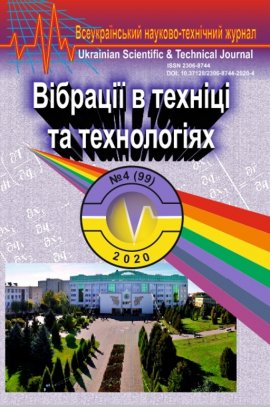
Issue №: 4(99)
The journal deals with the problems of vibration technologies and machines, mathematical methods of vibration process studies, information on design and technological development, presents teaching and methodological aspects of teaching in the Higher School of Applied Sciences, where vibration machines and technologies are studied.
COMPUTER SIMULATION OF THE PROCESS OF STAMPING BY ROLLING CYLINDRICAL AND PIPE PREPARATIONS USING THE DEFORM - 3D SOFTWARE COMPLEX
Andrii Shtuts - Assistant Professor, Department of Electric Power Engineering, Electrical Engineering and Electromechanics, Vinnitsa National Agrarian University (3, Solnechna str., Vinnitsa, 21008, Ukraine, email: shtuts1989@gmail.com).
The purpose of modeling is the analysis of the stress-strain (VAT) [7,14] condition and deformation of tubular, cylindrical workpieces in the deformation process, determining the energy parameters of the process, as well as the geometry of the deforming tool. transverse and longitudinal directions, as well as the cleanliness of the surface of the profiled cavity.
This article analyzes the features of local deformation, which define stamping by rolling as an independent type of metal pressure treatment in the metalworking industry. This problem is most effectively solved by using cold plastic deformation processes, which allow to bring the shape of the workpiece as close as possible to the shape of the finished product, and in some cases eliminate the need for further processing. Using the method of cold deformation instead of cutting, you can increase 2… 3 times the utilization of the metal. This ensures high quality of the workpiece surface, improves the physical and mechanical characteristics of the material, increases productivity and creates conditions for full automation of production. Examples of the most complete realization of advantages of stamping by rolling that provides efficiency of industrial use are resulted. In the priority areas of science and technology, a special role is given to energy and resource conservation.
In [3] the simulation results for rolling stamping without restriction with one-sided and two-sided restriction of metal flow along the length of lead blanks are presented.
Analysis of the experimental study showed that the process of stamping rolling (SHO) workpieces with conical and cylindrical rolls, allows you to control the flow of workpiece material by changing the size and direction of the axes of the workpiece roll, relative to the direction of rotation of the workpiece. The conducted modeling of SHO processes showed that the stress-strain state, deformation and deformability of the workpiece material also significantly depend on these parameters.
The technological capabilities of the SHO are limited mainly by the loss of stability and destruction of the workpieces, which, in turn, significantly depends on the direction of flow of metal at the contact of the roll with the workpiece.
Thus, the ability to control the direction of flow of the metal largely determines the ability to manufacture workpieces of the desired shape and size without destruction and loss of stability [2].
1. Matviichuk V. A., Aliiev I. S. (2009). Sovershenstvovanye protsessov lokalnoi rotatsyonnoi obrabotky davlenym na osnove analyza deformyruemosty metallov. Kramatorsk. [in Ukrainian].
2. Shtuts A., Kolisnyk M., Vydmysh A., et al. (2020). Improvement of Stamping by Rolling Processes of Pipe and Cylindrical Blades on Experimental Research . Actual Challenges in Energy & Mining. Vol. 844, 168–181. [in Switzerland].
3. Shtuts A., Kolisnyk M., Yavdyk V. (2018) Іmprovement of processes of rolling stamping on the basis of investigation of technological parameters on the mechanics of workpieces’ formation. MOTROL Commission of Motorization and Energetics in Agriculture. 1(20), 19 – 25. Lublin [in Poland].
4. Matviychuk V. A., Stuts A. A. (2016). Computational modeling of the process of stamping of rolled pipe blanks. All-Ukrainian scientific and technical journal "Technics, energy, transport of the agro-industrial complex." 171-178. [in Ukrainian].
5. Dobranyuk Yu. V., Alinva L. І., Mikhalevich V.M. (2010). Modeling behind the help of the DEFORM 3D software package of a stressed-deformed mill on the base surface of a cylindrical shape for an hour of butt clamping. Processing of metals by pressure: collection of scientific papers. - Kramatorsk: No. 4 (25). P. 3-10. [in Ukrainian].
6. Dobranyuk Yu. V., Mikhalevich V. M., Mikhalevich O. V., (2011). Rozrakhunok of the boundary mill to induce the curves of the boundary deformations of the biological surface of the cylindrical shape for the hour of the butt clamping. Testimonies about the revision of copyright on TV No. 38308. [in Ukrainian].
7. Mikhalevich V.M., Kraevsky V.A., Dobranyuk Yu.V. (2009). Modeling of ultimate deformations on a free surface during axisymmetric upsetting. Progressive methods and technological equipment of metal forming processes: mat. international scientific and technical conf. - Balt. state tech. un-t. 108-112. [in Russia].
8. Ogorodnikov V. A., Kiselev V. B.,. Sivak I. O. Energy. (2005). Deformations. Destruction Vinnytsia: UNIVERSUM. 204. [in Ukrainian].
9. Kolmogorov V. L. (1977). Plasticity and destruction . Metallurgy. 336. [in Ukrainian].
10. Matviychuk V. A., Shtuts, A. A., Yavdik V. V. (2015). Development of technological possibilities of stamping processes. Collection of Science Practitioners, Series: Technical Sciences. 27–33. [in Ukrainian].
11. Mikhalevich V.M., Dobranyuk Yu.V. (2013). Model of stress-deformed and boundary mills of the surface of cylindrical razors in case of end clamping: monograph . Vinnytsia: VNTU. 180. [in Ukrainian].
12. [Del G.D. (1971). Determination of stresses in the plastic area by the distribution of hardness. Mechanical Engineering. Moscow. 200. [in Russia].
13. Ogorodnikov V.A. (1989). Deformability and destruction of metals in plastic form change. Kiev. 150. [in Ukrainian].
14. [Surkov V. A., Galimov E. R. (2005). Development of the technology of stamping ring and flange blanks by rolling . Collection of materials of the XVII All-Russian scientific and technical conference KFMVAU. 134-135. [in Russia].
15. Ogorodnikov V. A., Arkhipova T. F. (2018). Theoretical and practical problems in the processing of materials in a vise and quality of faculty. Collection of materials of the IX International scientific and technical conference "Theoretical and practical problems in the processing of materials in a vise and quality of technical education"(dedicated to the 120th anniversary of the training of specialists in the processing of materials by pressure in KPI named after Igor Sikors). [in Ukrainian].
About the journal
The journal "Vibrations in Engineering and Technologies" is included in the list of technical scientific publications of Ukraine
(Category "B", Order of the Ministry of Education and Science of Ukraine dated July 2, 2020 No. 886)
Old version of the site: http://vibrojournal.vsau.edu.ua/
The journal "Vibrations in Engineering and Technology" is indexed by the following databases and catalogs:





The certificateof massmedia State registration:kv no 16643-5115 from 30.04.2010 .
Founder of the journal: Vinnytsia National Agrarian University
The journal is devoted to highlighting current issues in engineering, mechanical engineering, and technological processes, including the study of dynamic and oscillatory phenomena in technical systems, the application of mathematical methods for process modeling and analysis, as well as the presentation of results of design-engineering and technological developments. Particular attention is given to the study of vibration processes and their application in modern technologies.
The purpose of the scientific journal “Vibrations in Engineering and Technologies” is to disseminate the results of fundamental and applied research in the field of engineering sciences aimed at developing theoretical foundations and practical approaches to the design, analysis, and improvement of machines, materials, and technological processes, including the use of vibration and oscillatory effects in various sectors of production.
The publication is focused on the formation of a modern scientific and informational environment for the effective exchange of research results, support of innovative development, and implementation of advanced technical solutions in industry, agro-industrial production, and related fields.
The journal promotes the development of interdisciplinary research, the integration of modern engineering approaches, and the enhancement of the efficiency of technological processes and technical systems, including through the rational use of vibration phenomena.
Objectives of the Scientific Journal
To achieve its stated purpose, the journal addresses the following key objectives:
dissemination of results of fundamental and applied scientific research in the fields of mechanics, mechanical engineering, technological processes, machine dynamics, and equipment, as well as in areas related to the application of vibration phenomena in engineering and technologies;
promotion of research aimed at the creation and improvement of machines, mechanisms, and technological equipment based on oscillatory and vibration processes;
support for the implementation of modern technological solutions focused on improving productivity, energy efficiency, and reliability of technical systems;
обеспечение scientific exchange of research results among research institutions, higher education establishments, and industrial enterprises;
development of interdisciplinary cooperation among researchers in the fields of mechanics, materials science, material processing technologies, and automation of technological processes;
dissemination of modern scientific achievements and advanced technologies related to the application of vibration processes in production and technical systems.
Publisher Vinnytsia National Agrarian University
In June 1994 the 2nd International Scientific and Technical Conference "Application of vibrations for technological purposes" was organized on the basis of Vinnytsia State Agricultural Institute. Leading experts in this field, noting the significant contribution to the school of Vibration Engineering under the leadership of P. S. Bernyk, proposed to create a professional all-Ukrainian scientific and technical journal "Vibration in engineering and technology..The journal was foundedat Vinnytsia State Agricultural Institute and P.S. Bernyk was elected to be the chief editor .
For all these years (since 1994) theJournal "vibration in engineering and technology" published 119 issues wherestudy of vibration effects, the creation of progressive energy saving technologies and equipment for their implementation were highlighted.
Currently Ihor Kupchuk, Candidate of Technical Sciences, Associate professor, Associate Professor of the Department of Engineering Mechanics and Technological Processes in the Agricultural Industry Faculty of Engineering and Technology Vinnytsia National Agrarian University is the chief editor of the "Vibrations in engineering and Technology"
The journal "Vibration in Engineering and technology", which has no analogues on the territory of Ukraine, is well known abroad.
