

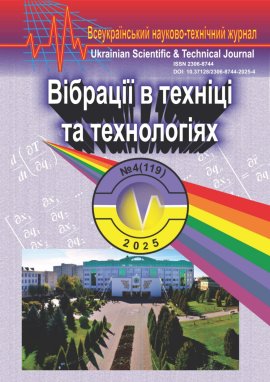
Issue №: 4(119)
The journal deals with the problems of vibration technologies and machines, mathematical methods of vibration process studies, information on design and technological development, presents teaching and methodological aspects of teaching in the Higher School of Applied Sciences, where vibration machines and technologies are studied.
ANALYTICAL STUDY OF THE INTERACTION OF THE ANGLE OF ELEVATION OF THE BOWL TRAY OF A SPIRAL VIBRATORY FEEDER FOR DOSING A SINGLE SUNFLOWER PRODUCT WITH ITS STRUCTURAL, TECHNOLOGICAL AND OPERATING PARAMETERS
Aliiev Elchyn – Doctor of Technical Sciences, Senior Researcher, Senior Lecturer Department of Engineering of Technical Systems of Dnipro State Agrarian and Economic University (St. S. Efremova, 25, Dnipro, Ukraine, 49000, e-mail: aliev@meta.ua, https://orcid.org/0000-0003- 4006-8803).
Chernii Olexandr – PhD student in 133 Industrial mechanical engineering, Senior Lecturer Department of Engineering of Technical Systems of Dnipro State Agrarian and Economic University (St. S. Efremova, 25, Dnipro, Ukraine, 49000, e-mail: sanek20.1984@gmail.com, https://orcid.org/0000-0003-0691-5829).
The article updates the research on optimizing the design and technological parameters of a spiral vibrating feeder for dosing sunflower seeds in automated phenotyping lines. A review of research on optimizing the value of the elevation angle of the vibrating feeder tray is presented. An analytical dependence for determining the limiting elevation angle of the vibrating feeder tray is obtained, which combines the established design and technological and operating parameters of the vibrating feeder: the coefficient of friction of the seeds f on the tray material, the angle of deviation of the inertia force β from the vertical, the amplitude of oscillations A of the bowl and its oscillation frequency ω. It was established that with an increase in the coefficient of friction of the seeds on the vibrating feeder tray, the limiting elevation angle of the tray also increases, and there is also an increase in the limiting angle with a decrease in the circular frequency of oscillations of the vibrating feeder bowl. The condition of self-braking of sunflower seeds on the spiral tray of the vibrating feeder in a stopped state was checked. In the Simcenter Star-CCM+ software package, a DEM model of sunflower seeds was created and numerical simulation of its movement along the vibrating tray was performed. By changing the values of the independent factors: α− the angle of elevation of the chute, ψ− the angle of throw and δ − the angle of inclination of the track axis to the horizontal, a factorial experiment was conducted according to plan 33. An analytical dependence of the change in the angle of elevation of the tray α depending on the values of the seed movement speed V, the throw angle ψ and the angle of inclination of the track axis to the horizontal δ was obtained. It was established that with the range of seed movement speeds along the spiral tray of the vibrating feeder V= 0.019÷0.028 m/s, the specified productivity of the vibrating feeder is ensured. The final value of the angle α was taken to be 2.4°. The calculated design parameters of the vibrating feeder will contribute to the movement of seeds in a continuous mode with an overload coefficient of about one, which will reduce the likelihood of injury to the seed material. The research steps in the plan for studying a spiral vibrating feeder for dosing sunflower seeds include the creation of an experimental sample of a vibrating feeder according to the adopted design and technological parameters and experimentally established actual indicators of the quality of its work using their comparison with theoretical ones, which is necessary to assess the overall accuracy of the study.
1. Kobets, A.S., Dyrda, V.I., Kozub, Yu.G. (2013), Pidyomno-transportni mashyny [Lifting and conveying machines], Lugansk, Ukraine. [in Ukrainian].
2. Aliiev, E. (2025). Analiz vibratsiynykh zhyvylʹnykiv dlya transportuvannya ta dozuvannya nasinnya v systemi yikh avtomatychnoho fenotypuvannya [Analysis of Vibrating Feeders for Transporting and Dosing Seeds in the System of Their Automatic Phenotyping]. Central Ukrainian Scientific Bulletin. Technical Sciences, 1(12(43)), 147–163. https://doi.org/10.32515/2664-262x.2025.12(43).1.147-163 [in Ukrainian].
3. Pieruschka, R., & Schurr U. (2019). Plant Phenotyping: Past, Present, and Future. Plant Phenomics, 2019, 1–6. doi: 10.34133/2019/7507131
4. Aliev, E. B. (2022). Avtomatychne fenotypuvannia nasinnievoho materialu soniashnyku: Monohrafiia. Kyiv: Ahrarna nauka. [in Ukrainian].
5. Aliev, E. B., & Vedmedieva, K. V. (2024). Kilʹkisne fenotypuvannia henotypiv soniashnyku: Monohrafiia. Dnipro: LIRA. [in Ukrainian].
6. Lanets, O. S. (2018). Osnovy rozrakhunku ta konstruivannia vibratsiinykh mashyn. Knyha 1. Teoriia ta praktyka stvorennia vibratsiinykh mashyn z harmoniinym rukhom robochoho orhana: Navchalʹnyi posibnyk. Lviv: Vydavnytstvo Lvivsʹkoi politekhniky. [in Ukrainian].
7. Iskovich-Lototsky, R. D. (2022). Obladnannya avtomatyzovanykh vyrobnytstv. Chastyna 2. Avtomatychni liniyi. Hnuchki vyrobnychi systemy. Transportno-zavantazhuvalʹni prystroyi : elektronnyy navchalʹnyy posibnyk kombinovanoho (lokalʹnoho ta merezhnoho) vykorystannya [Elektronnyy resurs]. Vinnytsia: VNTU. [in Ukrainian].
8. Vrublevskyi, І. (2020). Optimization of vibratory conveying upward by inclined track with polyharmonic normal vibrations. Ukrainian Journal of Mechanical Engineering and Materials Science, 6(2), 34–42. https://doi.org/10.23939/ujmems2020.02.034
9. Vrublevskyi, I. Y. (2020). Increasing of elevation angles in vibratory conveyor with electromagnetic drive. Military Technical Collection, 0(22), 48–52. https://doi.org/10.33577/2312-4458.22.2020.48-52
10. Nam, L. G., Mui, N. V., & Tu, D. A. (2019). A method to desing vibratory bowl feeder by using FEM modal analysis. Vietnam Journal of Science and Technology, 57(1), 102. https://doi.org/10.15625/2525-2518/57/1/12859
11. Zhu, X., Xu, Y., Han, C., Yang, B., Luo, Y., Qiu, S., Huang, X., & Mao, H. (2025). Parameter Calibration and Experimental Verification of the Discrete Element Model of the Edible Sunflower Seed. Agriculture, 15(3), 292. https://doi.org/10.3390/agriculture15030292
12. Arunyanart, P., & Sudsawat, S. (2023) DEM Simulation for the Predicted Model of Total Rice Seeds Mass in a Vibratory Conveyor. International Journal of Engineering and Technology, 15(4), 161–165. https://doi.org/10.7763/ijet.2023.v15.1240
13. Xing, J. & Xu, L. & Liu, X. & Chen, J. & Yuan, Q. & Wang, R. (2017) Simulation and test of corn seeds' dispersion and arraying transport in electromagnetic vibration hopper. Nongye Gongcheng Xuebao/Transactions of the Chinese Society of Agricultural Engineering. 33, 32-39. 10.11975/j.issn.1002-6819.2017.13.005
14. Schiller, S., Perchtold, D., & Steiner, W. (2023). Nonlinear and chaotic dynamics of a vibratory conveying system. Nonlinear Dynamics, 111(11), 9799–9814. https://doi.org/10.1007/s11071-023-08363-4
15. Schiller, S., Steiner, W., & Schagerl, M. (2023). Extension of the bouncing ball model to a vibratory conveying system. Nonlinear Dynamics, 111(21), 19685–19702. https://doi.org/10.1007/s11071-023-08911-y
16. Shevchenko, I., Aliiev, E., Viselga, G., & Kaminski, J. R. (2021). Modeling Separation Process for Sunflower Seed Mixture on Vibro-Pneumatic Separators. Mechanics, 27(4), 311–320. https://doi.org/10.5755/j02.mech.27647
17. Ihor, V. (2021). Vibratory Conveying by Harmonic Longitudinal and Polyharmonic Normal Vibrations of Inclined Conveying Track. Journal of Vibration and Acoustics, 144(1). https://doi.org/10.1115/1.4051228
18. Khodabakhshian, R., Emadi, B., Abbaspour Fard, M. H., & Saiedirad, M. H. (2011). Modeling the Fracture Resistance of Sunflower Seed and Its Kernel as a Function of Moisture Content, Variety, Size and Loading Orientation. International Journal of Food Engineering, 7(3). https://doi.org/10.2202/1556-3758.2118
19. Wang, S., Yu, Z., Zhang, W., Zhao, D., & Aorigele. (2022). Friction Coefficient Calibration of Sunflower Seeds for Discrete Element Modeling Simulation. Phyton, 91(11), 2559–2582. https://doi.org/10.32604/phyton.2022.021354
20. Aliiev E. B. (2024) Doslidzhennya fryktsiynykh vlastyvostey poverkhonʹ nasinnya sonyashnyku [Study of the frictional properties of sunflower seed surfaces]. Scientific and Technical Bulletin of the Institute of Oilseed Crops NAAS.. 37. 127–138. URL: https://doi.org/10.36710/ioc-2024-37-12 (date of application: 11.11.2025). [in Ukrainian].
21. Frascio, M., Avalle, M., & Monti, M. (2018). Fatigue strength of plastics components made in additive manufacturing: first experimental results. Procedia Structural Integrity, 12, 32–43. https://doi.org/10.1016/j.prostr.2018.11.109
22. Domingo-Espin, M., Travieso-Rodriguez, J. A., Jerez-Mesa, R., & Lluma-Fuentes, J. (2018). Fatigue Performance of ABS Specimens Obtained by Fused Filament Fabrication. Materials, 11(12), 2521. https://doi.org/10.3390/ma11122521
About the journal
The journal "Vibrations in Engineering and Technologies" is included in the list of technical scientific publications of Ukraine
(Category "B", Order of the Ministry of Education and Science of Ukraine dated July 2, 2020 No. 886)
Old version of the site: http://vibrojournal.vsau.edu.ua/
The journal "Vibrations in Engineering and Technology" is indexed by the following databases and catalogs:





The certificateof massmedia State registration:kv no 16643-5115 from 30.04.2010 .
Founder of the journal: Vinnytsia National Agrarian University
The journal is devoted to highlighting current issues in engineering, mechanical engineering, and technological processes, including the study of dynamic and oscillatory phenomena in technical systems, the application of mathematical methods for process modeling and analysis, as well as the presentation of results of design-engineering and technological developments. Particular attention is given to the study of vibration processes and their application in modern technologies.
The purpose of the scientific journal “Vibrations in Engineering and Technologies” is to disseminate the results of fundamental and applied research in the field of engineering sciences aimed at developing theoretical foundations and practical approaches to the design, analysis, and improvement of machines, materials, and technological processes, including the use of vibration and oscillatory effects in various sectors of production.
The publication is focused on the formation of a modern scientific and informational environment for the effective exchange of research results, support of innovative development, and implementation of advanced technical solutions in industry, agro-industrial production, and related fields.
The journal promotes the development of interdisciplinary research, the integration of modern engineering approaches, and the enhancement of the efficiency of technological processes and technical systems, including through the rational use of vibration phenomena.
Objectives of the Scientific Journal
To achieve its stated purpose, the journal addresses the following key objectives:
dissemination of results of fundamental and applied scientific research in the fields of mechanics, mechanical engineering, technological processes, machine dynamics, and equipment, as well as in areas related to the application of vibration phenomena in engineering and technologies;
promotion of research aimed at the creation and improvement of machines, mechanisms, and technological equipment based on oscillatory and vibration processes;
support for the implementation of modern technological solutions focused on improving productivity, energy efficiency, and reliability of technical systems;
обеспечение scientific exchange of research results among research institutions, higher education establishments, and industrial enterprises;
development of interdisciplinary cooperation among researchers in the fields of mechanics, materials science, material processing technologies, and automation of technological processes;
dissemination of modern scientific achievements and advanced technologies related to the application of vibration processes in production and technical systems.
Publisher Vinnytsia National Agrarian University
In June 1994 the 2nd International Scientific and Technical Conference "Application of vibrations for technological purposes" was organized on the basis of Vinnytsia State Agricultural Institute. Leading experts in this field, noting the significant contribution to the school of Vibration Engineering under the leadership of P. S. Bernyk, proposed to create a professional all-Ukrainian scientific and technical journal "Vibration in engineering and technology..The journal was foundedat Vinnytsia State Agricultural Institute and P.S. Bernyk was elected to be the chief editor .
For all these years (since 1994) theJournal "vibration in engineering and technology" published 119 issues wherestudy of vibration effects, the creation of progressive energy saving technologies and equipment for their implementation were highlighted.
Currently Ihor Kupchuk, Candidate of Technical Sciences, Associate professor, Associate Professor of the Department of Engineering Mechanics and Technological Processes in the Agricultural Industry Faculty of Engineering and Technology Vinnytsia National Agrarian University is the chief editor of the "Vibrations in engineering and Technology"
The journal "Vibration in Engineering and technology", which has no analogues on the territory of Ukraine, is well known abroad.
